

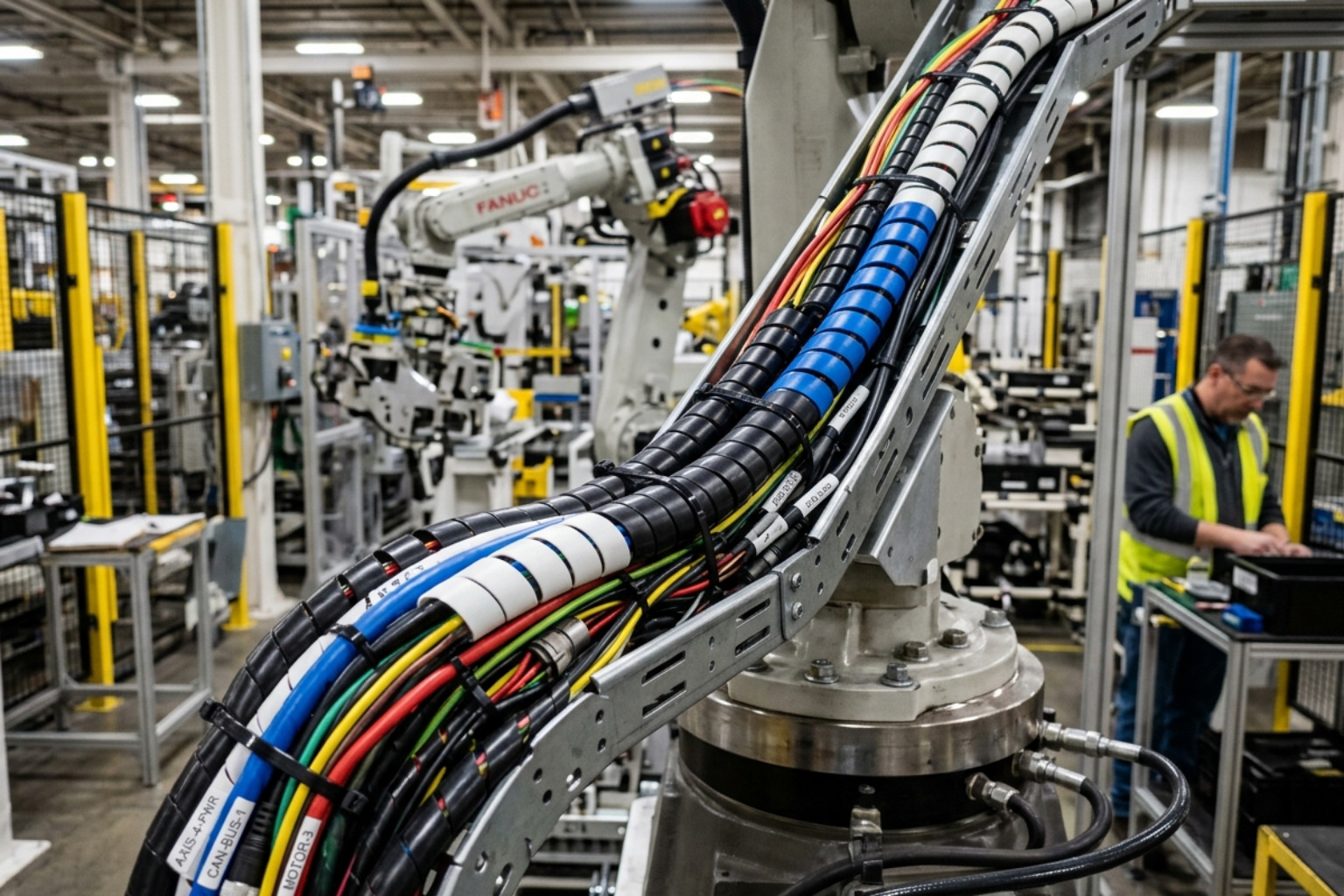
Why Cable Management for Robotics Directly Impacts Your Uptime
Cable management for robotics is the practice of organizing, routing, and protecting the power cables, communication lines, and pneumatic hoses that keep robotic systems running — and it’s one of the most overlooked factors in automation reliability.
Quick answer: Effective robotic cable management prevents the three most common failure modes — abrasion, kinking, and corkscrewing — by using protective wrap, proper routing, service loops, and strain relief. The goal is to let cables move with the robot without wearing out prematurely.
The core elements of a solid robotic cable management strategy:
- Protection — Shield cables from abrasion, heat, and mechanical stress
- Routing — Guide cables along paths that match the robot’s range of motion
- Strain relief — Prevent stress concentration at connection points and joints
- Labeling — Identify cables by function for faster troubleshooting
- Maintenance access — Allow inspection and replacement without major disassembly
Most automation engineers treat cable routing as an afterthought — something to sort out after the robot is already installed. That’s a costly mistake.
At a Robotic Industries Association (RIA) conference, leading system integrators named cable issues as the number one cause of downtime in robotics cells. Not mechanical wear. Not software. Cables.
And the problem isn’t always dramatic. It usually starts small — a cable that chafes against a robot arm over millions of cycles, or a bundle that gets twisted a few degrees too many on every rotation. Over time, those small stresses compound into broken conductors, failed sensors, and unplanned production stops.
The good news: most of these failures are entirely preventable with the right strategy.
Common Failure Modes in Automated Systems
In the high-speed world of 2026 automation, robots perform millions of repetitive cycles. Without a robust strategy for cable management for robotics, these movements eventually lead to mechanical fatigue. Understanding how cables fail is the first step toward preventing 4 Reasons to Organize and Manage Cables.
One of the most notorious failures is “corkscrewing.” This occurs when the internal copper strands and the outer jacket of a cable twist at different rates. The result is a cable that looks like a DNA helix, eventually leading to internal shorts. Similarly, jacket abrasion happens when cables rub against the robot’s chassis or other cables. Over time, the insulation wears thin, exposing live wires to the environment.
Kinking and conductor fatigue are equally dangerous. When a cable is bent beyond its specified radius, the copper strands inside begin to develop microscopic cracks. Eventually, these strands snap, leading to intermittent signals that are a nightmare to troubleshoot. You can Avoid Downtime with Spiral Cable Wrap by ensuring cables are bundled and protected, preventing them from catching on external hardware or snapping under tension. For a broader industry overview, the Association for Advancing Automation offers resources on robotics reliability and system design.
Identifying Mechanical Stress in Robotics
Robotic arms don’t just move back and forth; they rotate, pivot, and extend. Each axis presents a unique stress profile. For instance, the wrist of a 6-axis robot experiences high torsion, while the base axes deal more with linear movement and bending.
To Reduce Equipment Downtime with Spiral Cable Wrap, engineers must account for the torsion resistance of every line. If a cable isn’t designed to twist, it shouldn’t be placed in a high-rotation area. Scientific research indicates that the physics of failure in robotics is often concentrated at “constraint points” – the places where a cable is clamped or tied down. If these points are too tight, they become the epicenter for conductor fatigue.
Best Practices for Effective Cable Management for Robotics
The golden rule for modern robotics is “less is more.” In the past, technicians would use excessive amounts of tape or heavy-duty ties to secure cables to the robot arm. We now know this is counterproductive. Over-binding restricts natural movement and concentrates stress.
Effective cable management for robotics relies on axis synchronization and a segmented approach. By breaking the cable run into smaller sections, you can manage the specific stresses of each joint individually. This also makes it much easier to learn How to Cable Management for complex systems.
Key elements of a successful setup include:
- Service Loops: Providing 1-2 feet of extra cable (slack) at moving joints to prevent tension.
- Strain Relief: Using specialized clamps or spiral wrap to ensure the weight of the cable bundle isn’t pulling on the connectors.
- Segmented Dress Packs: Dividing the robot into logical zones to isolate movement.
For a more in-depth look, refer to this Detailed Guide to Industrial Cable Protection.
Implementing the Segmented Approach
Think of a 6-axis robot as three separate entities:
- Axis 6 to 3: The “wrist” area where cables experience the most complex 3D rotation.
- Axis 3 to 2: The “elbow” area where bending is the primary concern.
- Axis 2 to 1: The “base” where cables transition from the moving arm to the stationary floor.
By using junction boxes at the transitions (such as at Axis 3), you can replace a worn segment of the cable without having to re-pull the entire line from the controller to the end-effector. This modularity is essential for high-uptime environments. Knowing How to Organize Cables and Wires in these segments ensures that power lines don’t interfere with sensitive communication signals.
Selecting the Right Cable Management for Robotics Solutions
Choosing the right material is just as important as the routing itself. M.M. Newman Corporation’s Heli-Tube® spiral cable wrap is a premier choice for robotics because it bundles wires and hoses firmly while allowing for individual wire breakouts at any point. This is critical when sensors or valves need to “exit” the main bundle to reach specific parts of the robot arm.
| Material | Temp Range (F) | Key Benefits |
|---|---|---|
| PTFE | -320°F to 500°F | Chemically inert, widest temp range, non-flammable. |
| Nylon | -40°F to 250°F | Self-extinguishing, highly abrasion resistant, lightweight. |
| Polyethylene | -76°F to 190°F | Versatile, cost-effective, available in UV-resistant black. |
When browsing the Heli-Tube® Spiral Wrap Product Category, you’ll find various Spiral Cable Wrap Sizes & Materials designed to fit everything from tiny sensor wires to large pneumatic hoses. Color-coded labeling is another advantage; using different colors of spiral wrap allows maintenance teams to identify power, signal, and air lines at a glance, drastically reducing repair time.
Material Science for Dynamic Robot Arms
The environment dictates the material. In a cleanroom or high-heat application, PTFE Heli-Tube® Spiral Wrap is the standard. It is chemically inert and handles temperatures up to 500°F. For general industrial use where fire safety is a concern, Nylon Heli-Tube® Spiral Wrap is preferred because it is self-extinguishing and produces no toxic byproducts when exposed to flame.
If your robot is operating outdoors or in a facility with high UV exposure, ultraviolet-resistant black Polyethylene is the best choice. It contains specialized absorbers that prevent the plastic from becoming brittle in sunlight. To Find the Right Spiral Wrap Material, consider the chemicals, temperatures, and mechanical friction the robot will encounter daily.
Maintaining Your Cable Management for Robotics System
Installation is not the final step. Regular inspection protocols are necessary to ensure the system remains healthy. One industry standard is the 60% fill rule: the total diameter of all cables and hoses should not exceed 60% of the interior space of their protective wrap. This 40% “safety margin” allows cables to move freely and prevents them from crushing one another during tight bends.
Following a Quick & Easy Spiral Cable Wrap Installation guide ensures that the wrap is applied with the correct pitch. If the wrap is too tight, it can act like a restriction; if too loose, it won’t provide adequate abrasion protection. Additionally, following Wire and Cable Labeling Tips during maintenance helps keep the system organized as components are replaced over time.
Advanced Protection and Customization
For global manufacturers, compliance is non-negotiable. M.M. Newman Corporation is ISO 9001:2015 certified, and Heli-Tube® products are REACH and RoHS compliant, ensuring they meet strict international safety and environmental standards.
When looking at the 3 Factors to Consider When Choosing Spiral Cable Wrap, the “spiral” design itself is a feature. It allows for a “forward cut” or “reverse cut” to match the direction of the cable’s twist. Here are Heli-Tube® Cable Wrap: 6 Features That Stand Out:
- Breakouts: Easy exit points for individual wires.
- Reusability: Can be unwrapped and reapplied during upgrades.
- Abrasion Resistance: Protects against “jacket-on-jacket” wear.
- Versatility: Fits any bundle diameter within its range.
- Material Variety: Options for every environment from PTFE to Polyethylene.
- Compliance: UL recognized and Military Specification capable.
Frequently Asked Questions about Robotic Cable Management
What is the primary cause of downtime in robotic cells?
As cited by leading integrators at the RIA conference, cable failure is the number one cause of unplanned downtime. This is usually due to poor routing, lack of strain relief, or using materials not rated for high-cycle repetition.
How do you calculate the correct spiral wrap size for robot cables?
The “60% fill rule” is the best guideline. Calculate the cross-sectional area of all your cables and hoses, then ensure that this total is no more than 60% of the interior area of the spiral wrap. This prevents internal friction and allows for heat dissipation.
Why is the “less is more” approach preferred for 6-axis robots?
Over-restricting cables with too many ties or rigid supports causes stress to accumulate at specific points. A “less is more” approach uses minimal, strategic attachment points and generous service loops, allowing the cables to distribute mechanical stress across their entire length.
Conclusion
Effective cable management for robotics isn’t about making the robot look “neat”—it’s about ensuring that your multimillion-dollar automation investment doesn’t sit idle because of a five-dollar cable break. By utilizing a segmented approach, respecting bend radii, and choosing high-quality materials, you can significantly extend the life of your equipment.
M.M. Newman Corporation has been a world-leading supplier of cable protection solutions since 1956. Their Heli-Tube® spiral cable wrap is made in the USA and meets the rigorous ISO 9001:2015, REACH, and RoHS standards required by the Aerospace and Robotics industries. Whether you need the extreme temperature resistance of PTFE or the abrasion protection of Nylon, they provide the versatile, just-in-time service needed to keep your production lines moving.
Beyond spiral wrap, M.M. Newman Corporation also offers a 60-watt hot knife that reaches 900°F, perfect for precision cutting materials such as sailcloth and awnings in marine and industrial applications.