

Why Aircraft Wire Protection Is a Safety and Reliability Imperative
Aircraft wire protection is the use of physical barriers, sleeving, wraps, and routing hardware to shield electrical wiring and cable bundles from damage caused by abrasion, heat, vibration, chemicals, and mechanical contact.
Quick answer — the most common aircraft wire protection methods:
| Protection Type | Primary Function |
|---|---|
| Spiral cable wrap | Bundles wires, allows breakouts, resists abrasion |
| Convoluted tubing | Encloses and shields cable runs in tight spaces |
| Grommets / grommet edging | Protects wires where they pass through sharp panel edges |
| Braided sleeving | Abrasion and chafe resistance over harnesses |
| Safety wire | Locks fasteners against vibration-induced loosening |
| Wire strike protection systems | Mechanical cutters that protect helicopters from wire strikes |
Aircraft wiring systems face threats from every direction. Bundles shift during flight. Sharp structural edges cut through insulation over time. Heat cycles stress materials repeatedly. Fluids and chemicals degrade jacketing. A single wiring failure can cascade into a critical system fault.
The numbers make this concrete. Between 1974 and 1979, wire strike accidents alone accounted for 16% of all US Army Aviation fatalities. In civil aviation through the 1970s, 208 helicopters were involved in wire strike accidents — 42% were destroyed.
Unprotected or poorly protected wiring doesn’t just risk equipment. It risks lives.
That’s why selecting the right protection — matched to the environment, the bundle size, and the maintenance requirements — matters at every stage of an aircraft’s service life.
Primary Threats and the Critical Need for Aircraft Wire Protection
Aircraft wiring rarely fails because it is sitting peacefully on a bench. It fails because it is installed in a machine that moves, heats, cools, flexes, vibrates, and gets maintained over many years.
The major threats include:
- Abrasion from nearby structure, brackets, clamp points, or other bundles
- Vibration and repeated movement that can make insulation wear faster
- Temperature extremes that affect jacket materials and bundle supports
- Chemical exposure from aviation fluids, oils, cleaners, and other substances
- Edge contact where wires pass through panels, holes, bulkheads, or brackets
- Maintenance movement from repeated inspection, removal, rerouting, and repair
- Wire strikes, especially for helicopters operating at low altitude near utility lines
For aircraft wiring, protection is not just about making a harness look organized. It helps preserve electrical continuity, reduce downtime, and extend equipment lifespan. A protected cable bundle is less likely to suffer chafed insulation, conductor exposure, intermittent faults, or nuisance failures that are hard to trace.
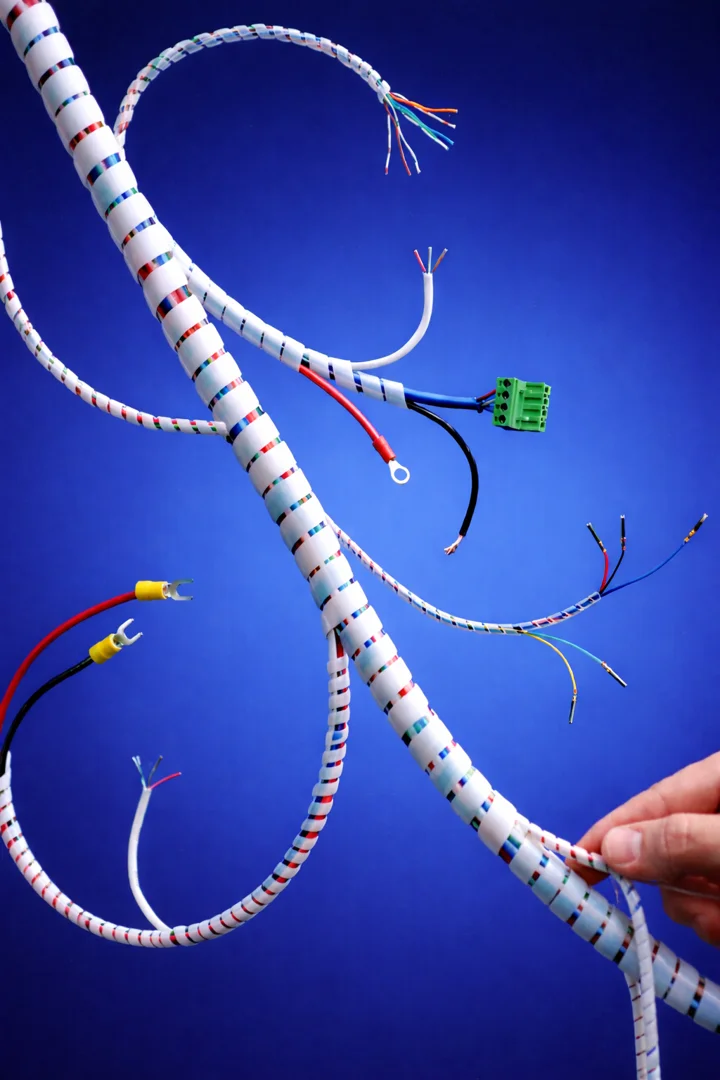
This is where spiral cable wrap has a practical role. Heli-Tube® spiral cable wrap from M.M. Newman Corporation is used to organize and protect wires, hoses, cables, and tubing while still allowing individual wires to exit the bundle. Because it is not a solid sleeve, technicians can inspect, reroute, and create breakouts without fully enclosing the harness.
That matters in aircraft and aerospace-adjacent workplaces where access is not a luxury. It is the difference between a straightforward maintenance task and a mechanic becoming one with the avionics bay for the afternoon.
Other aircraft wire protection systems serve different roles. Grommets protect wires from sharp edges. Braided sleeving protects harnesses from chafe. Convoluted tubing provides more complete enclosure around cable runs. Safety wire locks fasteners against vibration-related loosening. Wire strike protection systems help protect helicopters from external hazards such as power lines.
A strong protection strategy often combines multiple solutions based on the actual installation environment.
Step 1: Assess the Aircraft Wiring Environment
Before selecting a wire protection product, the installation environment should be reviewed carefully. The best product in the wrong location is still the wrong product.
Start by identifying the main wear points:
- Where does the bundle touch aircraft structure?
- Does it pass through a panel, bracket, or bulkhead?
- Are there sharp edges, fastener heads, standoffs, or clamp points nearby?
- Does the bundle move during operation or maintenance?
- Are there repeated access points for inspection or repair?
- Are individual wire breakouts needed along the run?
- Is the bundle exposed to chemical splash, cleaning fluids, oils, or hydraulic fluids?
- What operating temperature range is expected?
- Is color-coded identification useful for maintenance?
Bundle diameter matters too. A wrap that is too small can be difficult to install and may compress the bundle. A wrap that is too large may not provide the desired positioning or abrasion resistance.
Maintenance access is another key point. Some cable protection products fully enclose the harness, which can be useful in harsh locations but less convenient when technicians need access to individual wires. Spiral wrap is often helpful where a bundle needs abrasion resistance and organization while still allowing inspection and rerouting.
Color-coded identification should be considered early. M.M. Newman supplies Heli-Tube® spiral cable wrap in multiple colors, depending on material, which can help identify systems, circuits, zones, or maintenance categories. In complex aircraft, robotics, automated manufacturing, and public utility environments, fast identification helps reduce service time.
Step 2: Choose Heli-Tube® Spiral Cable Wrap for Bundle Protection
Heli-Tube® spiral cable wrap is spirally cut tubing that wraps around wires, cables, hoses, and pneumatic tubes. It wraps on like tape, can be reused, and allows individual wire breakouts in any orientation.
For aircraft wire protection, its most useful features include:
- Bundling and organizing cable groups
- Physical abrasion resistance for wire bundles
- Support for individual wire exits along the bundle
- Reusability during maintenance, rerouting, and repair
- Availability in different sizes
- Color options for identification requirements
- Forward cut and reverse cut options
- Ability to clamp bundles to standoffs and robotic components
- Specials available for pitch, diameter, wall thickness, color, packaging, length, or material
- Made in the USA
- Certificates of conformance available for applicable requirements
M.M. Newman Corporation has manufactured and distributed Heli-Tube® spiral cable wrap since 1956. The company is based in Marblehead, Massachusetts, and supplies customers worldwide with a focus on practical cable protection, reduced downtime, and long equipment service life.
For more background on aerospace cable protection, see The High Flying Guide to Aerospace Cable Protection.
| Heli-Tube® Material | Temperature Range | Abrasion Resistance | Color Availability | Typical Use Conditions |
|---|---|---|---|---|
| Polyethylene | -76°F to 190°F / -60°C to 88°C | General-purpose protection | Natural, black, blue, brown, green, and other options | General bundling, color identification, moderate temperature areas |
| Ultraviolet-resistant black Polyethylene | -76°F to 190°F / -60°C to 88°C | General-purpose outdoor protection | Black | Outdoor exposure where ultraviolet resistance is required |
| Nylon | -40°F to 250°F / -40°C to 121°C | High abrasion resistance | Natural and black | Enclosed environments where self-extinguishing performance is considered |
| PTFE | -320°F to 500°F / -200°C to 260°C | Strong performance in demanding conditions | Natural standard; black and other colors upon request | High-temperature and chemically demanding applications |
| Fire-Resistant Polyethylene | -4°F to 176°F / -20°C to 80°C | General protection with self-extinguishing material | White or black | Applications requiring a self-extinguishing polyethylene option |
Temperature values are guidelines only. Final material selection should be based on engineering review, routing conditions, exposure, and applicable requirements.
Step 3: Select the Right Heli-Tube® Material for Aircraft Wire Protection
Different aircraft wire protection applications need different materials. A wrap near a moderate-temperature access panel does not face the same conditions as a wrap near higher heat, aggressive fluids, or enclosed areas where fire behavior must be considered.
The main Heli-Tube® material options include PTFE, Nylon, Polyethylene, and Fire-Resistant Polyethylene. Each one balances abrasion resistance, temperature capability, chemical compatibility, and color availability differently.
PTFE Heli-Tube® Spiral Wrap
PTFE Heli-Tube® spiral wrap is the high-performance choice when temperature and chemical exposure are major concerns.
Key characteristics include:
- PTFE material
- Chemically inert
- Non-flammable
- UL VW-1 flammability rating
- Meets ASTM-D3295 Group 4
- Temperature range of -320°F to 500°F / -200°C to 260°C
- Standard Natural color
- Black and other colors available upon request
- RoHS compliant
- Made in the USA
PTFE is widely valued in demanding wire protection applications because it resists many chemicals and handles a broad temperature range. It is often selected where common materials may not provide enough heat or chemical resistance.
Related reading: PTFE Spiral Wrap Bundles and Protects Wiring in Laboratory Environments and Protect Instrument Wires with PTFE Spiral Wrap Tubing.
Nylon Heli-Tube® Spiral Wrap
Nylon Heli-Tube® spiral wrap is lightweight, highly abrasion-resistant, and self-extinguishing. It is suitable for enclosed environments where the possibility of fire must be considered.
Key characteristics include:
- Nylon material
- Lightweight construction
- High abrasion resistance
- Self-extinguishing behavior
- Natural and Black options
- RoHS compliant
- Maximum operating temperature: 250°F / 121°C
- Minimum operating temperature: -40°F / -40°C
Nylon is useful where abrasion resistance is the leading priority and the temperature range is within the material guidelines. It can be a strong option for protected cable bundles that need durability without unnecessary bulk.
Polyethylene Heli-Tube® Spiral Wrap
Polyethylene Heli-Tube® spiral wrap is a versatile general-purpose option with broad color availability.
Key characteristics include:
- Polyethylene material
- Color options including natural, black, blue, brown, and green
- Ultraviolet-resistant black Polyethylene available for outdoor exposure
- Maximum operating temperature: 190°F / 88°C
- Minimum operating temperature: -76°F / -60°C
Color is a major advantage of Polyethylene Heli-Tube® spiral wrap. Color-coded labeling can help technicians identify systems faster, which supports maintenance efficiency and reduces troubleshooting time.
For outdoor exposure topics, see UV Resistant Spiral Wrap That Withstands Sunlight Salt. For edge-related applications, see Spiral Wrap Protects from Edges.
Fire-Resistant Polyethylene Heli-Tube® Spiral Wrap
Fire-Resistant Polyethylene Heli-Tube® spiral wrap is suitable where a self-extinguishing material is required and the application falls within its temperature guidelines.
Key characteristics include:
- Fire-Resistant Polyethylene material
- Available in White or Black
- Suitable for applications requiring a self-extinguishing material
- Maximum operating temperature: 176°F / 80°C
- Minimum operating temperature: -4°F / -20°C
This option can be useful where polyethylene handling and installation characteristics are preferred, but a self-extinguishing material is required.
Step 4: Plan Bundle Size, Breakouts, and Identification
Once the material is selected, the next step is planning the physical installation.
Important planning questions include:
- What is the outside diameter of the wire bundle?
- Will the bundle diameter change along the route?
- Where do individual wires need to break out?
- Do breakouts need to exit upward, downward, or sideways?
- Is the bundle routed around standoffs, supports, or robotic components?
- Should colors identify voltage, system type, inspection priority, or service zone?
- Are custom pitch, wall thickness, diameter, color, length, or packaging requirements needed?
The spiral design is the practical advantage here. Unlike a fully closed tube, Heli-Tube® spiral cable wrap allows individual wires to exit in any orientation. That makes it useful for harnesses with multiple branches or service points.
M.M. Newman can supply Heli-Tube® spiral cable wrap in different sizes and colors, and specials may be available for pitch, diameter, wall thickness, color, packaging, length, or material. Cut lengths are also available subject to factory quotation.
Color-coded identification is especially useful in industries such as Aerospace, Robotics, Public Utilities, and Automated Manufacturing, where downtime can be expensive and troubleshooting speed matters. See Spiral Wrap Creates Safety Identifiers for more on identification uses.
Step 5: Install Spiral Wrap Without Blocking Inspection Access
Heli-Tube® spiral cable wrap installs by wrapping around the bundle like tape. The goal is to protect and organize the bundle while preserving service access.
Good installation practices include:
- Start with a clean, inspected cable bundle.
- Confirm the selected material and size match the application.
- Wrap steadily around the bundle without forcing the material.
- Avoid over-tightening or compressing wires.
- Maintain proper clearance from sharp edges.
- Use grommets or edge protection where wires pass through panels or bulkheads.
- Plan breakouts before wrapping long sections.
- Confirm that individual wires exit smoothly without stress.
- Check bend areas to ensure the wrap does not interfere with routing.
- Inspect the bundle after installation.
- Reuse or reroute the wrap during maintenance when appropriate.
Spiral wrap is especially useful when technicians need to inspect the bundle later. Because it has gaps, it does not hide the cable run the way a fully enclosed product might. That can simplify visual inspection and future modifications.
However, the same open spiral design means it is not a sealed covering. It should not be used as the only protection when complete environmental isolation is required.
For additional application examples outside aircraft, see Heli-Tube® for the Marine Industry and Hydraulic Hose Protector PTFE Spiral Wrap Prevents Chafing.
Step 6: Understand What Spiral Wrap Does and Does Not Do
This is where clear expectations matter.
Heli-Tube® spiral cable wrap can help with:
- Physical abrasion resistance
- Cable bundle organization
- Wire grouping and routing
- Insulation support
- Bundle positioning
- Individual wire breakouts
- Reusable access during maintenance
- Color-coded identification
It is not:
- A sealed environmental covering
- A complete barrier against fluids or dust
- A full enclosure for every section of the wire
- A substitute for approved aircraft routing practices
- A complete vibratory dampening solution
- A replacement for clamps, grommets, standoffs, or edge protection where those are required
Because spiral wrap has gaps, wires may still be exposed to fluids, dust, and environmental factors. The material selected may withstand certain environmental conditions, but that does not mean the wrap fully shields the wires from those conditions.
Also, spiral wrap should not be treated as a complete solution for vibration. Aircraft installations still need proper routing, spacing, clamps, strain relief, and inspection practices. In other words, Heli-Tube® spiral cable wrap is a valuable member of the protection team, but it should not be asked to play every position.
High-Performance Materials and Compliance Considerations
Aircraft wire protection products often need to satisfy strict performance requirements. Depending on the aircraft, location, and use case, requirements may address flammability, smoke density, toxicity, abrasion resistance, temperature range, and chemical compatibility.
Common aviation-related standards and specifications may include:
- FAR Part 25 flammability requirements for transport-category aircraft materials
- FAR Part 25 Appendix F for flammability testing in certain applications
- SAE AS81914 for plastic convoluted tubing requirements
- ABD0031 for flammability, smoke, and toxicity considerations in aerospace applications
- BSS7230 for smoke density in relevant material testing contexts
Not every wire protection product is designed for every aviation standard. Engineers should verify the exact requirement for the aircraft program, installation location, and material type.
For M.M. Newman products, important compliance and quality points include:
- ISO 9001:2015 Certified, Certificate Reg. No. C2018-00027
- REACH compliant options
- RoHS compliant options
- UL recognized component listed under category UZKX2, Component Wire Positioning Devices
- UL file card number E83405 (M)
- Certificates of conformance available
- Certifications to various applicable Military Specifications available
- Made in the USA
M.M. Newman also provides material options that support different engineering priorities. PTFE provides high-temperature performance and chemical inertness. Nylon provides lightweight abrasion resistance and self-extinguishing behavior. Polyethylene provides broad color choices and general-purpose bundling. Fire-Resistant Polyethylene supports applications requiring a self-extinguishing material.
For RoHS information, see Heli-Tube® Spiral Wrap Complies Fully with RoHS.
Frequently Asked Questions
What are the primary threats to aircraft wiring systems?
The primary threats are abrasion, vibration-related movement, temperature extremes, chemical exposure, wire strikes, sharp edge contact, repeated movement during maintenance, improper routing, and bundle wear over time.
Abrasion is one of the most common problems because a cable bundle may slowly rub against structure, brackets, standoffs, or other components. Over time, this can wear through insulation. Temperature cycles can also stress materials, while chemicals and fluids can degrade certain jackets or coverings.
Wire strikes are a separate but serious hazard for helicopters. Historical data shows how dangerous they can be: between 1974 and 1979, wire strike accidents accounted for 8% of United States Army Aviation aircraft damage, 6% of aircraft-related injuries, and 16% of aircraft-related fatalities. In civil helicopter accidents during the 1970s, 208 helicopters were involved in wire strike accidents, and 88 were destroyed.
How does Heli-Tube® spiral cable wrap support aircraft wire protection?
Heli-Tube® spiral cable wrap helps organize and protect wire bundles from physical abrasion while allowing individual wire breakouts in any orientation. It can be reused, rerouted, supplied in different sizes, and ordered in colors for identification requirements.
The spiral format is especially helpful for harnesses that need service access. Technicians can route, inspect, and branch wires without fully enclosing the bundle. This supports maintenance efficiency and can help reduce downtime.
Does spiral wrap protect cables from environmental factors?
Spiral wrap can withstand selected environmental conditions depending on the material, but it does not fully protect cables from environmental exposure. Because the spiral design has gaps and is not a complete covering, wires may still be exposed to fluids, dust, and other environmental factors.
If an application requires complete environmental sealing, the installation should use an approved protection method designed for that purpose.
Does Heli-Tube® spiral cable wrap provide vibratory dampening?
Heli-Tube® spiral cable wrap supports cable organization and abrasion resistance, but it should not be treated as a complete vibratory dampening solution. Aircraft installations should still use approved routing, spacing, fastening, clamping, and inspection practices to manage vibration.
Which Heli-Tube® material is best for high-temperature aircraft applications?
PTFE Heli-Tube® spiral wrap offers the widest operating temperature range, from -320°F to 500°F (-200°C to 260°C), and is chemically inert and non-flammable. It also has a UL VW-1 flammability rating and meets ASTM-D3295 Group 4.
Final material selection should consider temperature, chemical exposure, abrasion risk, routing, maintenance access, and applicable engineering requirements.
Can Heli-Tube® be supplied in special sizes or colors?
Yes. Heli-Tube® spiral cable wrap can be supplied in different sizes and colors, and specials may include changes to pitch, diameter, wall thickness, color, packaging, length, or material.
This is useful when installations require color-coded labeling, unusual bundle sizes, specific packaging, or custom material characteristics.
Additional Aircraft Wire Protection Resources
For readers researching broader aircraft wire protection practices, these resources provide additional background on cable security, wire edge protection, aerospace cable management, aircraft protection concepts, and aviation suppliers:
- Aerospace supplier background reference
- Aircraft cable security reference
- Aerospace cable management reference
- Aircraft protection news reference
- Wire edge protection safety reference
Conclusion
Aircraft wire protection is a system-level decision. No single product solves every hazard, but the right combination of materials, routing practices, edge protection, fastening, and inspection access can make aircraft wiring safer and easier to maintain.
Heli-Tube® spiral cable wrap from M.M. Newman Corporation supports this strategy by providing abrasion resistance, reusable routing, individual wire breakouts, color-coded labeling, and multiple material options including PTFE, Nylon, Polyethylene, and Fire-Resistant Polyethylene.
For Aerospace, Robotics, Public Utilities, and Automated Manufacturing applications, Heli-Tube® spiral cable wrap helps reduce downtime and support longer equipment lifespan without blocking practical maintenance access.
M.M. Newman Corporation has supplied Heli-Tube® spiral cable wrap since 1956, with ISO 9001:2015 certification, REACH and RoHS compliance, UL recognition, Made in the USA manufacturing, and certificates of conformance available for applicable requirements.
To explore more aerospace-focused articles from M.M. Newman, visit M.M. Newman Aerospace Articles.