

Last updated on November 10th, 2026 at 04:05 pm
Understanding Robotic Cable Management and the Role of robotic cable wrap
Industrial automation relies on the seamless movement of six-axis robots. These machines perform complex, high-speed tasks that impose immense physical stress on the cell’s “nervous system”: the cables and hoses. Proper robotic cable management is the practice of organizing and protecting these lines to ensure they withstand constant twisting, bending, and high-speed cycles without failure.
The robotic cable wrap serves as the primary line of defense. Unlike rigid conduits or restrictive tape, a spiral-cut wrap provides a flexible architecture. It bundles multiple lines—electrical, pneumatic, and data—into a single, manageable unit while allowing each component to move slightly within the bundle to reach its natural curvature. This reduces the internal friction that leads to “corkscrewing,” a common failure where cables twist around each other until the internal copper strands snap.
For a deeper dive into the fundamentals, see Cable Management 101.

The High Cost of Cable Failure
With just-in-time manufacturing and integrated Industry 4.0 lines, a single cable failure on one robot can halt an entire production wing. System integrators consistently report that cable issues remain the leading cause of unplanned stops.
When a cable fails, the costs extend beyond the price of the replacement part. Facilities face:
- Lost production revenue per minute of downtime.
- Labor costs for emergency maintenance and diagnostics.
- Potential damage to the robot’s internal motors if a snagged cable creates resistance.
- Safety risks to human operators if a cable sags or snaps during a high-speed cycle.
Investing in high-quality Heli-Tube® spiral wrap significantly extends the equipment lifespan by preventing the abrasion and tension that cause these failures.
Why Spiral Design Is Essential for Robotics
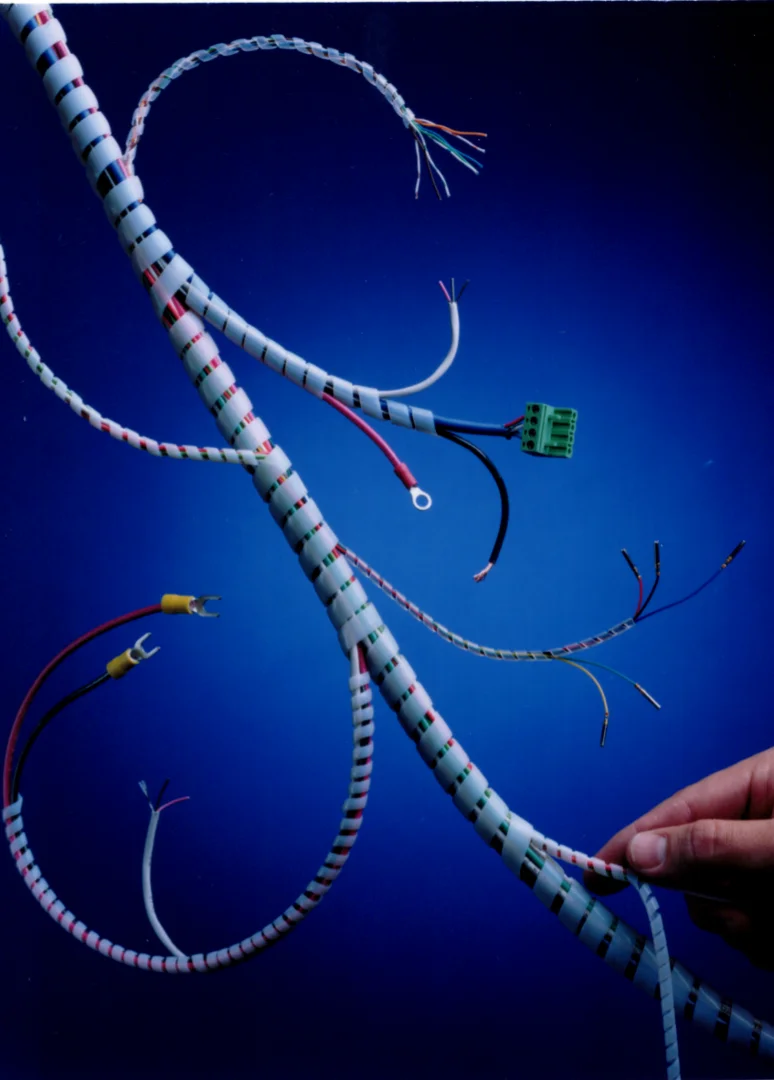
The “spiral” in Heli-Tube® spiral wrap is its most functional feature for robotics. Unlike a solid tube or a zippered sleeve, the spiral design allows for individual breakouts. In a six-axis setup, different cables often need to exit the main bundle at different joints (axes) to connect to sensors or actuators.
With robotic cable wrap, a technician can pull a single wire out through the spiral gap at any point without cutting the protection or compromising the integrity of the rest of the bundle. This design also makes the wrap reusable; it can be wrapped on like tape and removed quickly for cable inspections or rerouting.
Key Materials for High-Performance robotic cable wrap
Selecting the right material is the most critical decision in designing a cable management system. M.M. Newman Corporation manufactures Heli-Tube® in several technical materials to meet the specific demands of diverse industrial environments.
PTFE Heli-Tube® for Extreme Temperature Ranges
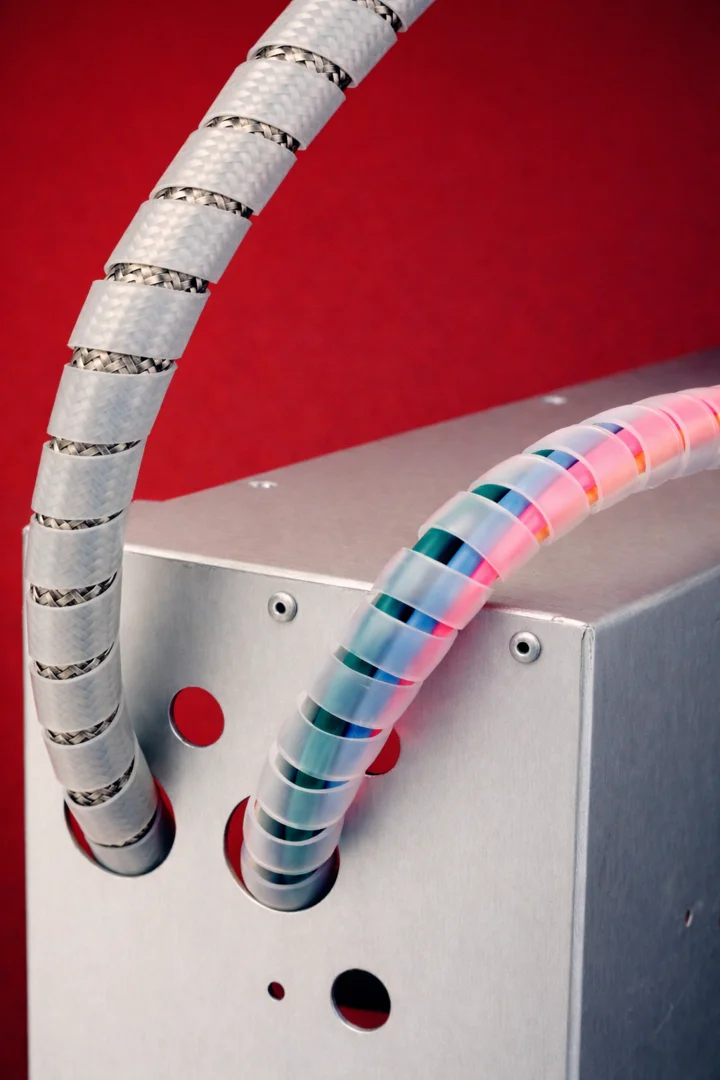
For the most demanding environments, PTFE Heli-Tube® Spiral Wrap is the industry standard. This material features the widest operating temperature range of any plastic, functioning reliably from -320°F to 500°F (-200°C to 260°C).
Beyond temperature resistance, PTFE is:
- Chemically Inert: It will not react with oils, fuels, or industrial solvents.
- Non-flammable: It carries a UL VW-1 flammability rating.
- Compliant: It meets ASTM-D3295 Group 4 specifications.
In a robotic cell where heat or chemical exposure is constant, PTFE provides the necessary durability to keep cables operational.
Abrasion-Resistant Nylon and Polyethylene Options
For general industrial use, Nylon and Polyethylene offer excellent protection at a different performance profile.
Nylon Heli-Tube® Spiral Wrap is the preferred choice for enclosed environments where fire safety is a concern. It is self-extinguishing and does not produce toxic byproducts when exposed to high heat. It is also highly abrasion-resistant, making it ideal for robots that move against stationary objects or other machinery. More details can be found in the Nylon Heli-Tube® Spiral Wrap technical guide.
Polyethylene Heli-Tube® Spiral Wrap is a versatile, lightweight option. It is available in a variety of colors for easy identification and labeling. For outdoor applications, M.M. Newman Corporation offers an ultraviolet-resistant black Polyethylene that withstands direct sunlight for extended periods without becoming brittle.
To help determine which material fits your specific application, review the Spiral Cable Wrap Sizes & Materials guide.
Material Comparison Table
| Material | Min Temp | Max Temp | Key Benefit |
|---|---|---|---|
| PTFE | -320°F (-200°C) | 500°F (260°C) | Extreme heat/Chemical resistance |
| Nylon | -40°F (-40°C) | 250°F (121°C) | Abrasion resistance/Self-extinguishing |
| Polyethylene | -76°F (-60°C) | 190°F (88°C) | General purpose/UV resistant options |
| Fire-Resistant Polyethylene | -4°F (-20°C) | 176°F (80°C) | Self-extinguishing/Cost-effective |
Best Practices for Installing Robotic Cable Wrap on Six-Axis Arms
Installing robotic cable wrap is not just about bundling wires; it is about engineering movement. A “less is more” approach is often best, focusing on dynamic flexibility rather than rigid, heavy packages.
Segmenting Cables for Optimal Movement
Industry experts recommend treating a six-axis robot as three separate segments. This prevents the cables from wrapping around the robot’s base or snagging during 360-degree rotations.
- Sixth-to-Third Axis: Manage the cables near the end-of-arm tooling.
- Third-to-Second Axis: The mid-section of the arm.
- Second-to-First Axis: The base of the robot.
By segmenting the robotic cable wrap at these points and using strain relief with one- to two-foot service loops, you allow the cables to “breathe.” This prevents the lines from being pulled tight (tension) or bunched up (compression) during movement. For more on organization, see How to Organize Cables and Wires. Properly managing these segments is a recognized industry standard, as detailed in Robotic Cable Management Made Easy.
Avoiding Common Installation Mistakes
One of the biggest blunders in robotic cable management is the use of zip ties for permanent attachment. Zip ties create “pinch points” that concentrate stress on a single section of the cable, leading to internal wire breakage. Furthermore, over-tightened zip ties can void the warranty of high-performance control cables.
Instead, use robotic cable wrap to bundle the lines and secure the bundle using specialized hangers or Velcro straps that distribute pressure evenly. Always work with the cable’s natural curvature and avoid forcing cables into tight 90-degree bends. For a comprehensive look at these strategies, consult The Ultimate Guide to Cable Management.
Environmental Challenges and Robotic Cable Wrap Selection
Robotic cells are rarely clean environments. Whether it is a welding cell or a public utility site, environmental factors dictate which robotic cable wrap will survive.
Protecting Cables in Harsh Industrial Cells
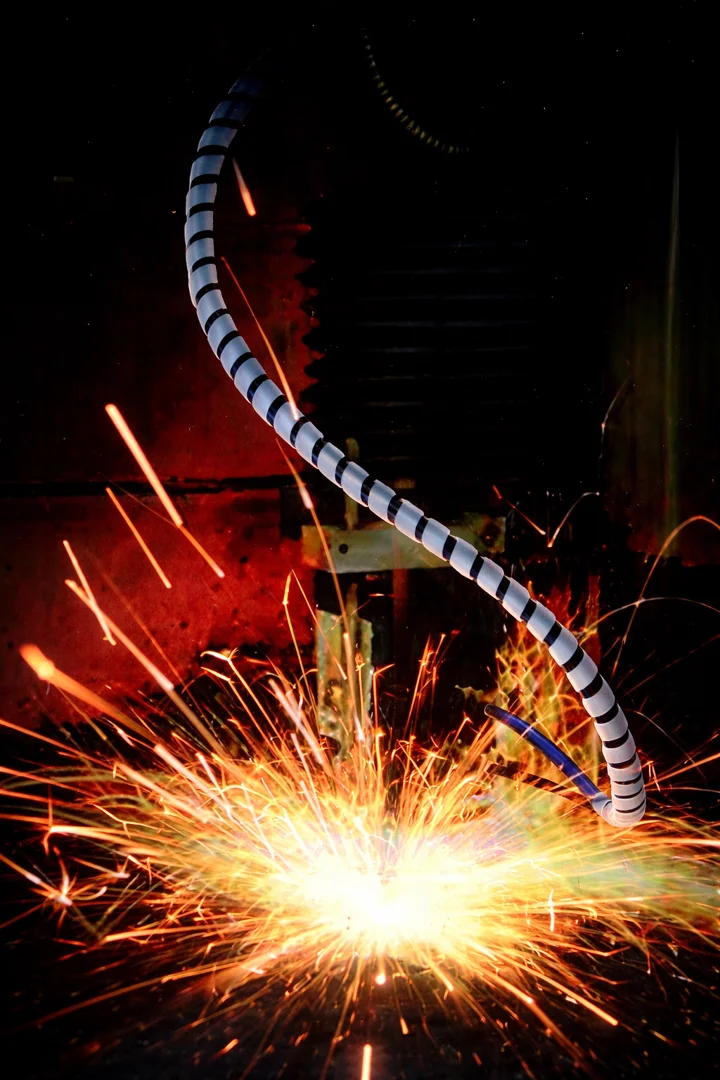
In robotic welding, welding spatter and intense heat are the primary threats. Using Fire-Resistant Heli-Tube® Spiral Wrap ensures that the bundling material will not ignite or melt when stray sparks hit the lines.
In aerospace and public utility applications, cables may be exposed to hydraulic fluids, salt spray, or extreme cold. In these cases, PTFE’s chemical inertness is vital. While the wrap itself does not provide a complete seal (due to the spiral gaps), it prevents the cables from rubbing against abrasive surfaces in these harsh conditions. For more information, see the Detailed Guide to Industrial Cable Protection.
Compliance and Safety Standards
M.M. Newman Corporation maintains the highest quality standards to ensure our products meet the rigorous requirements of the robotics industry. Our manufacturing processes are ISO 9001:2015 Certified (Certificate Reg. No. C2018-00027).
Our Heli-Tube® products are:
- REACH and RoHS Compliant: Ensuring they are free from hazardous substances.
- UL Recognized: Listed under category UZKX2 for wire positioning devices.
- Military Spec Capable: Certificates of conformance to various Military Specifications can be provided upon request.
Maximizing ROI with Professional Robotic Cable Wrap Solutions
The return on investment (ROI) for professional cable management is found in the reduction of “micro-stops”those five-minute production halts that happen several times a day due to tangled lines.
Customization for Industry 4.0 Integration
Modern manufacturing requires precision. M.M. Newman Corporation offers extensive customization for Heli-Tubeae to fit specific robotic models or Industry 4.0 standards:
- Color-Coded Labeling: Use different colors of Polyethylene wrap to identify power, data, and pneumatic lines at a glance, speeding up troubleshooting.
- Variable Pitch and Diameter: We can alter the spiral pitch, diameter, or wall thickness to meet specific routing, organization, or protection requirements.
- Forward and Reverse Cuts: Depending on the installation method or robot movement, specific cut directions can be supplied.
- Different Sizes and Packaging Options: Heli-Tubeae is available in a range of sizes, lengths, and packaging configurations to match application needs.
These customization options help manufacturers standardize robotic dress packs, reduce troubleshooting time, and support longer equipment life in automated manufacturing environments.
Distinct Tools for Material Preparation
While robotic cable wrap is a wire positioning and protection solution, M.M. Newman Corporation also offers the hot knife. This is a distinct, 60-Watt tool that reaches 9000F, designed for cutting synthetic materials like sailcloth or awnings. It provides a clean, cauterized edge on fabrics, preventing fraying. While it is a separate product from our spiral wrap, it is an essential tool for many industrial facilities that manage diverse materials alongside their robotic lines.
Frequently Asked Questions about robotic cable wrap
What are the temperature limits for PTFE robotic cable wrap?
PTFE Heli-Tube® spiral wrap operates from -320°F to 500°F (-200°C to 260°C). These temperatures are guidelines for the material’s performance in high-stress robotic environments. It remains stable and functional even in the most extreme industrial heat or cryogenic cold.
Can spiral wrap be used for individual wire breakouts in a robotic cable wrap system?
Yes, the spiral design of Heli-Tube® allows for individual wire or hose breakouts at any point along the bundle, facilitating complex routing on multi-axis robots. This is one of the primary advantages over traditional conduit systems, as it allows for precise cable placement at every joint of the robot.
Conclusion
Since 1956, M.M. Newman Corporation has been a world-leading supplier of cable management solutions. Our Heli-Tube® spiral wrap is Made in the USA and backed by a commitment to just-in-time service and ISO 9001:2015 quality. By choosing the right material and following segmentation best practices, manufacturers can virtually eliminate the number one cause of robotic downtime.
For more information and to view our full catalog, visit the Heli-Tube® products page.