

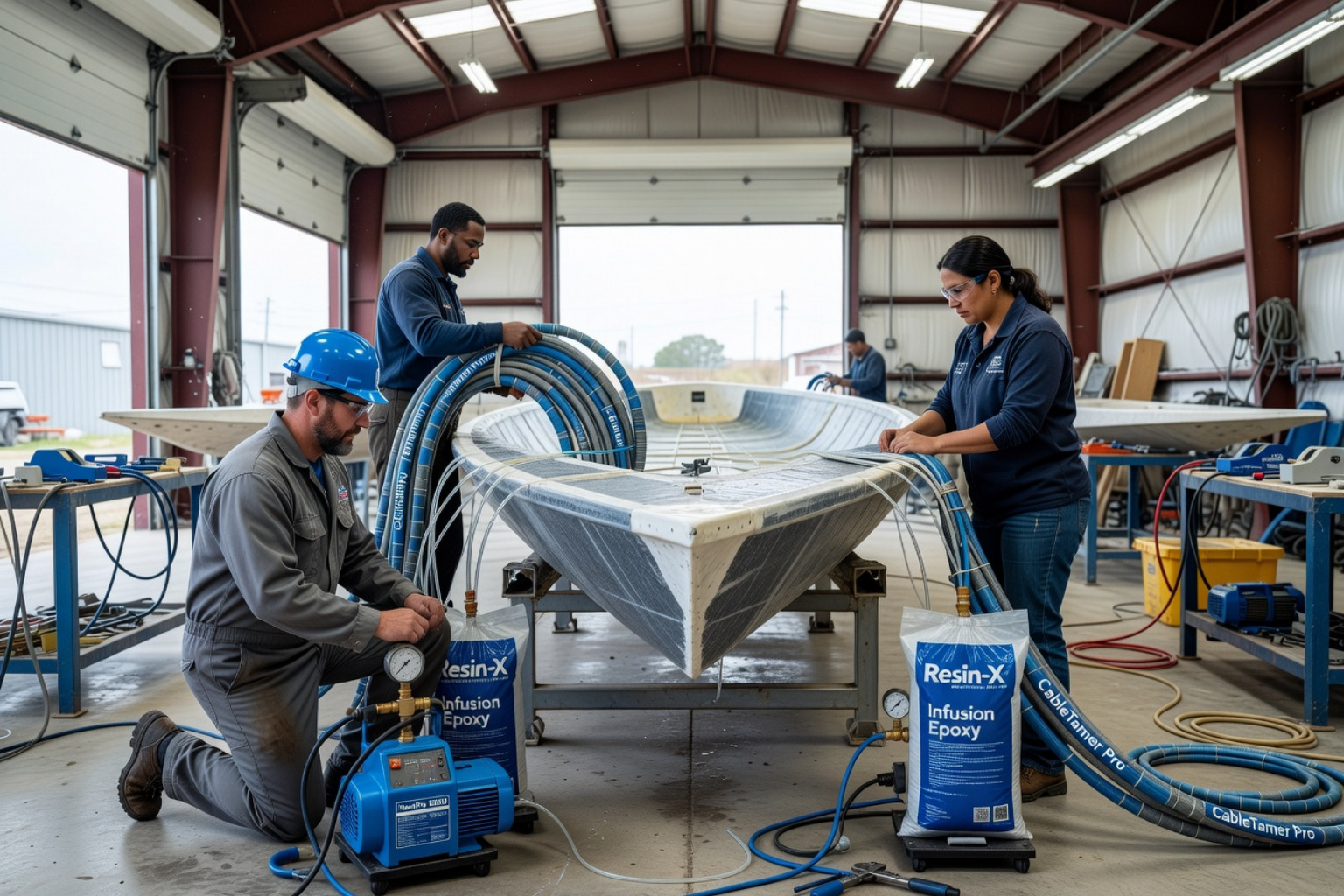
Why Resin Infusion Spiral Tubing Makes or Breaks Your Vacuum Infusion Results
Resin infusion spiral tubing is a spiral-wound plastic tube placed underneath the resin feed line in a vacuum infusion setup to guide resin flow evenly across the full surface of a composite part.
Here is a quick breakdown of what it does and why it matters:
- Distributes resin flow from the feed line into corners and far edges of the mold
- Reduces flow distance on large parts like boat hulls and automotive panels
- Replaces less efficient resin delivery methods that can leave dry spots or voids
- Works alongside peel ply, infusion mesh, and vacuum bagging film
- Sized by ID/OD – smaller diameters for slower, controlled flow; larger diameters for faster distribution on big projects
- Typically disposable – once resin cures inside the tube, it cannot be reused
Getting this one component right can mean the difference between a void-free, high-strength laminate and a part that has to be scrapped.
The vacuum infusion process is already demanding. You are managing resin viscosity, vacuum pressure, flow media placement, and timing all at once. Spiral tubing is the low-profile component that quietly does the heavy lifting for resin distribution, and choosing the wrong size or material can restrict flow or fail under process temperatures.
This guide explains how Heli-Tube® spiral wrap can be selected, sized, and installed for vacuum infusion layouts while staying aligned with broader composite processing principles such as vacuum bagging. For manufacturers, marine fabricators, and composite shops, the right spiral wrap setup supports more consistent resin flow, reduced downtime, and longer service life for surrounding equipment.
Understanding Heli-Tube® Spiral Wrap and Its Role in Vacuum Infusion
In high-performance composites, the goal is always a controlled fiber-to-resin ratio with minimal void content. To support that result, fabricators create a resin transport path that moves resin from the source to the reinforcement stack. This is where Heli-Tube® spiral wrap can serve as an effective infusion manifold.
While many engineers know spiral wrap for organizing and protecting wires, hoses, and tubing, its spiral-cut geometry also makes it useful in vacuum infusion. When placed under vacuum, resin travels through the center of the Heli-Tube® spiral wrap and then exits through the spiral gaps along its length. This helps distribute resin more evenly across the width of the flow media instead of feeding only from a single point.
Heli-Tube® spiral wrap also helps preserve the resin feed path under bag pressure. It reduces the chance of the vacuum bag collapsing directly onto the feed line and restricting resin movement, which can otherwise lead to incomplete wet-out and dry laminate areas. In other M.M. Newman Corporation applications, the same spiral design is valued for routing protection and organized line management, as discussed in Superior Protection with Spiral Hose Wrap.
Positioning Heli-Tube® Spiral Wrap for Optimal Resin Flow
The placement of your resin infusion spiral tubing strongly influences the resin front, meaning the line where resin meets dry fabric. For many projects, the spiral wrap is positioned directly beneath the main feed lines. For more complex molds, placement becomes more strategic.
- Perimeter feeding: In large boat hulls or automotive panels, routing Heli-Tube® spiral wrap around the perimeter can help resin reach distant corners more uniformly.
- The resin break: Fabricators often cut the infusion mesh a short distance before the vacuum port and place a short section of spiral wrap there. This can slow the advancing resin front and help the laminate saturate more evenly before resin reaches the vacuum outlet.
- Individual breakouts: A key advantage of the Heli-Tube® spiral design is that it permits individual breakouts in any orientation. In infusion layouts, that can support smaller resin tributaries directed toward thicker laminate sections or vertical features that need added flow assistance.
Material Performance: PTFE, Nylon, and Polyethylene Heli-Tube® Spiral Wrap
Not all resin systems cure the same way, and not every infusion runs at room temperature. Choosing the right material for your resin infusion spiral tubing is important if you want the feed path to remain open throughout the process and avoid material incompatibility during cure or post-cure.
M.M. Newman Corporation manufactures Heli-Tube® spiral wrap in several material options suited to different operating temperatures and shop environments.
Polyethylene (PE)
Polyethylene is commonly selected for standard room-temperature infusions. It offers good resistance to many shop chemicals and is often a practical choice for disposable infusion setups. The Polyethylene Heli-Tube® spiral wrap line comes in a variety of colors, such as natural, black, blue, brown, and green, among others. An ultraviolet-resistant black Polyethylene option is also available for outdoor applications exposed to direct sunlight.
- Temperature range: -76°F to 190°F (these temperatures are to be used as guidelines only)
- Best for: General composite parts, marine applications, and automotive panels
- Notes: Available in multiple colors for color-coded identification of resin and vacuum line layouts
Nylon
For higher-temperature processing or where added abrasion resistance is needed, Nylon is a strong option. Nylon Heli-Tube® spiral wrap is self-extinguishing and does not produce any toxic or irritating byproducts, even when exposed to an open flame or excessive operating temperatures. It is recommended for use in enclosed environments where the possibility of fire exists.
- Temperature range: -40°F to 250°F (these temperatures are to be used as guidelines only)
- Best for: Aerospace components, enclosed environments, and parts requiring moderate in-mold post-cure
- Notes: Available in Natural and Black; RoHS Compliant
PTFE (Polytetrafluoroethylene)
For demanding chemical and temperature conditions, PTFE Heli-Tube® spiral wrap provides the widest operating range. PTFE is chemically inert, non-flammable, and appropriate for infusion setups exposed to elevated cure or post-cure temperatures. PTFE Heli-Tube® spiral wrap has a flammability rating of UL VW-1 and meets ASTM D-3295 Group 4.
- Temperature range: -320°F to +500°F (these temperatures are to be used as guidelines only)
- Best for: High-temperature epoxy infusions and parts that remain bagged during elevated-temperature post-cure
- Notes: Standard color is Natural; Black and other colors available upon request; RoHS Compliant; Made in the USA. See Choosing the Right Tubing for Your Application for broader selection guidance
For readers comparing material behavior in demanding process conditions, the underlying chemistry of polytetrafluoroethylene helps explain why PTFE is widely used where thermal stability and chemical resistance are critical.
Sizing Heli-Tube® Spiral Wrap for Large Projects
Selecting the correct diameter is about balancing speed and control. If the tubing is too small, the resin takes too long to travel, risking a “gel-off” before the part is full. If it’s too large, you may waste expensive resin that stays trapped in the lines.
Common sizes for resin infusion spiral tubing include:
- Small (approx. 1/8″ to 1/4″ ID): Ideal for small automotive trim, carbon fiber brackets, or “standard flow” applications where a slower, more controlled resin front is needed.
- Medium (approx. 3/8″ to 1/2″ ID): The “workhorse” size for automotive hoods, spoilers, and medium-sized industrial housings.
- Large (approx. 5/8″ to 3/4″ ID and up): Used for “large flow” requirements in boat hulls, wind turbine blades, and large-scale structural panels.
M.M. Newman Corporation provides Heli-Tube® spiral wrap in various colors, which is helpful for color-coded identification in complex setups. For instance, you might use natural for resin feed lines and blue for vacuum lines to prevent accidental cross-connection during a build. Custom pitch, diameter, wall thickness, color, packaging, length, or material specifications are also available to meet specific project requirements.
Installation Best Practices for Vacuum Infusion with Heli-Tube®
To get the most out of your resin infusion spiral tubing, follow these industry best practices:
- The Peel Ply Wrap: One common issue is the spiral wrap sticking to the finished part or the mold. To prevent this, always wrap the Heli-Tube® spiral wrap in a layer of polyester or nylon peel ply. This ensures that once the resin has cured, the tubing can be pulled away easily without damaging the composite surface.
- Avoid Bridging: When routing the spiral wrap around corners or over vertical steps in the mold, ensure it is firmly pressed into the corner. “Bridging” occurs when the tube spans a gap; under vacuum, the bag may pop or create a resin-rich pool that weakens the part.
- Secure with Sealant Tape: Use small “tabs” of vacuum sealant tape (tacky tape) to hold the spiral wrap in place on top of the peel ply before you lay the vacuum bagging film over the top. This prevents the lines from shifting when the vacuum pump is first turned on.
- Pneumatic Protection: For those also managing the machinery side of the shop, understanding Everything You Need to Know About Pneumatic Tubing Protection can help maintain the vacuum pumps and lines that power the infusion process.
Comparing Flow Rates and Dimensions of Heli-Tube® Spiral Wrap
The wall thickness and internal diameter (ID) of your spiral wrap directly affect infusion behavior. A thicker wall provides greater crush resistance, while a larger ID allows a higher volume of resin to move through the line over time.
| Heli-Tube® Material | Typical ID (inches) | Typical OD (inches) | Max Temp (°F) | Best Application |
|---|---|---|---|---|
| Polyethylene | 0.375″ | 0.500″ | 190°F | Standard Marine/Auto |
| Nylon | 0.500″ | 0.625″ | 250°F | Higher-Temperature/Aerospace |
| PTFE | 0.250″ | 0.375″ | 500°F | High-Temp Epoxy/Post-Cure |
| Fire-Resistant PE | 0.375″ | 0.500″ | 176°F | Enclosed Environments |
Using a larger diameter Heli-Tube® spiral wrap is generally recommended for higher-viscosity resins or very large surface areas. Smaller diameters are often better for thin cosmetic carbon fiber parts where a more controlled resin front is preferred.
In practice, flow behavior is also influenced by media permeability, vacuum level, resin viscosity, and laminate architecture. Those relationships are commonly discussed under Darcy’s law, which is a useful reference point when comparing distribution speed and pressure drop through an infusion setup.
Frequently Asked Questions
Is Heli-Tube® spiral wrap reusable in resin infusion?
In most cases, no. Because the resin cures inside the spiral and within the gaps of the wrap, it becomes a solid plastic rod once the process is complete. While Heli-Tube® spiral wrap can be reused in wire, hose, and cable management applications – where it wraps on like tape and can be removed quickly and simply – it is generally treated as a disposable consumable in composite infusion work.
What are the temperature limits for Heli-Tube® spiral wrap?
Temperature limits depend on the material selected. Polyethylene is typically used up to 190°F, which covers many room-temperature cures. If your process includes post-cure or a hotter resin system, Nylon 66 at 250°F or PTFE at 500°F may be more appropriate. These temperatures are to be used as guidelines only and should be matched to the full process conditions.
Which fittings are compatible with Heli-Tube® spiral wrap?
Heli-Tube® spiral wrap is commonly used with standard T-connectors, resin infusion hubs, and silicone top-hat style connectors. Because the spiral construction can accommodate a range of routing needs, the best fit should be confirmed against the specified ID and OD of the selected Heli-Tube® size.
Does Heli-Tube® spiral wrap help with line organization outside infusion?
Yes. Beyond composite processing, Heli-Tube® spiral wrap is widely used to bundle and protect wires, hoses, cables, and tubing in Aerospace, Robotics, Public Utilities, and Automated Manufacturing environments. Its spiral design permits individual breakouts in any orientation and supports color-coded identification, both of which can help reduce downtime and support equipment longevity. Heli-Tube® spiral wrap is also a UL recognized component listed under category UZKX2, Component Wire Positioning Devices.
Can Heli-Tube® spiral wrap be customized for specific infusion setups?
Yes. M.M. Newman Corporation can alter pitch, diameter, wall thickness, color, packaging, length, or material to meet your specifications. Cut lengths are available subject to factory quotation.
Conclusion
Mastering the use of resin infusion spiral tubing is a hallmark of a professional composite fabricator. By selecting the right Heli-Tube® spiral wrap material—whether it’s the versatile Polyethylene, the self-extinguishing Nylon 66, or the high-temperature PTFE—you ensure that your resin distribution is consistent, controlled, and efficient.
M.M. Newman Corporation has been a world-leading manufacturer since 1956, providing industrial-grade Heli-Tube® spiral wrap and the 60-watt hot knife capable of reaching 900°F for cutting materials like awnings and sailcloth. Our products are ISO 9001:2015 certified (Certificate Reg. No. C2018-00027), as well as REACH and RoHS compliant, ensuring they meet the strictest standards for Aerospace, Robotics, Public Utilities, and Automated Manufacturing.
Whether you are building a world-class racing yacht or a lightweight aerospace component, the quality of your consumables often determines the quality of the finished part. With the ability to permit individual breakouts in any orientation, color-coded identification for complex line layouts, and consistent flow distribution, Heli-Tube® spiral wrap is the reliable partner your vacuum infusion process deserves.
For more information on our full range of products, or to discuss custom pitch, diameter, and material requirements, contact M.M. Newman Corporation today.