

Why Hydraulic Hose Protection Matters More Than You Think
Hydraulic hose protection is the practice of shielding high-pressure hoses from abrasion, impact, heat, and chemical exposure to prevent failure and protect operators.
Quick answer — the most important facts:
- 70% of hydraulic hose failures are caused by external abrasion or physical damage
- Unprotected hoses are a direct safety hazard — it takes only 100 psi to puncture human skin with a hydraulic fluid injection injury
- Protection options range from spiral wraps and nylon sleeves to fire sleeves and spring guards
- Spiral wrap is the only option that can be retrofitted onto existing hose assemblies without disconnecting lines
- Choosing the right material (Polyethylene, Nylon, or PTFE) depends on temperature range, chemical exposure, and application
Most equipment failures don’t start from the inside. They start on the outside — a hose rubbing against a metal frame, another hose, or a sharp edge. Over thousands of cycles, that friction wears through the outer cover and eventually causes a failure.
As one industry source puts it: “70% of [hydraulic hose] failures are a direct result of abrasion or external damage — yet many could be prevented.”
The good news? Most of these failures are preventable with the right protection in place before damage occurs.
This guide covers every major hydraulic hose protection option available, how to choose the right one for your application, and why spiral wrap — specifically Heli-Tube® spiral wrap — stands out as one of the most practical and versatile solutions for industrial, aerospace, robotics, and automated manufacturing environments.
The Critical Role of Hydraulic Hose Protection in Industrial Systems
In high-pressure industrial environments, hydraulic systems serve as the lifeblood of machinery. Because these systems operate under extreme pressures, a single ruptured hose can result in catastrophic equipment downtime, expensive environmental cleanup, and severe operator injuries. Implementing a proactive preventative maintenance strategy that includes proper hydraulic hose protection is not just a best practice; it is a operational necessity.
When an unprotected hydraulic hose rubs against concrete, steel frames, or adjacent hoses, the outer protective rubber cover slowly grinds away. Once the inner steel wire reinforcement is exposed to the elements, moisture begins to rust the wires. Over time, the weakened reinforcement can no longer contain the system pressure, leading to a sudden, high-velocity blowout.
Beyond the physical damage to the machinery, operator safety is the most critical reason to safeguard these lines. Pinhole leaks in high-pressure lines can release highly atomized, virtually invisible streams of hydraulic fluid. Because it takes only 100 psi of pressure to puncture human skin, these fluid injection injuries can cause severe internal tissue damage before an operator even realizes what has occurred. Utilizing protective wraps to bundle, organize, and shield these high-pressure lines creates an essential secondary containment barrier, mitigating hazards and significantly extending the service life of the entire system.
Primary Causes of Hydraulic Hose Failure
To effectively protect hydraulic lines, one must first understand the environmental and mechanical threats they face daily. While internal pressure spikes and fluid incompatibility can cause failures, the vast majority of issues originate externally.
- External Abrasion: This is the single largest cause of hose failure, accounting for 70% of all field replacements. It occurs when hoses rub against machine frames, sharp structural edges, or other hoses during normal dynamic operation.
- Physical Impacts: Hoses on mobile equipment, construction machinery, and agricultural implements are constantly exposed to falling rocks, debris, and accidental crushing.
- UV Exposure: Sunlight degrades standard synthetic rubber covers over time, causing them to crack, stiffen, and lose their resilience. This accelerated aging leaves the hose vulnerable to cracking under pressure.
- Chemical Degradation: Exposure to harsh degreasers, corrosive industrial chemicals, and incompatible oils can dissolve or weaken the outer cover of the hose, accelerating physical wear.
Analyzing External Abrasion and Chafing
To understand how abrasion destroys a hose, consider the dynamics of line-on-line rubbing. In complex machinery, multiple hydraulic lines are often routed through the same narrow pathways. As the machine operates, pressure pulses cause the hoses to expand, contract, and flex. This continuous movement results in micro-chafing between the hoses.
Furthermore, many operators overlook the physical phenomenon of hose shrinkage. Under high pressure, hydraulic hoses naturally shrink by at least 2% in length. In tight spaces or boom applications, this shrinkage pulls the hose taut, dragging it across sharp metal edges or tight brackets. If this mechanical movement is not accounted for during installation, the friction will rapidly saw through the outer cover, exposing the structural wire braid beneath.
Why Spiral Wrap is the Superior Hydraulic Hose Protection Option
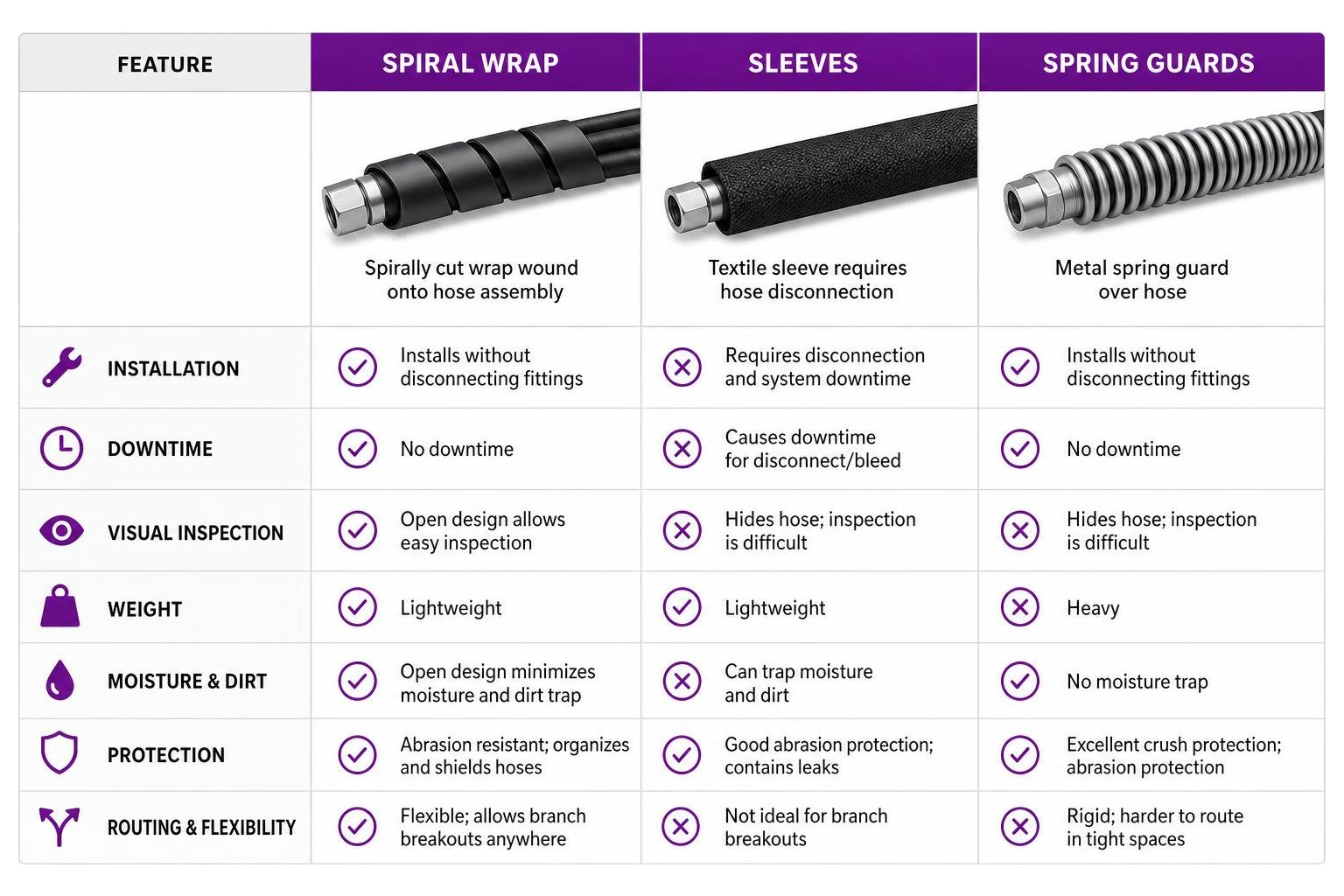
When evaluating ways to shield hydraulic lines, engineers have several choices, including textile sleeves, metal spring guards, and molded plastic shields. However, many of these non-spiral options fall short in practical industrial environments.
Textile sleeves, while excellent for containing high-pressure bursts, typically require the operator to disconnect the hydraulic fittings to slide the sleeve over the hose assembly. This disconnect process introduces air and contaminants into the hydraulic system, requires system bleeding, and causes costly operational downtime. Additionally, textile sleeves can trap moisture and fine abrasive dirt particles against the hose cover, acting like sandpaper during dynamic cycles.
Metal spring guards provide robust defense against crushing, but they add substantial weight to the assembly, can be difficult to route through tight spaces, and do not allow for easy visual inspection of the underlying hose.
In contrast, spirally cut wrap offers a unique balance of physical protection, ease of installation, and system organization. Because of its open design, spiral wrap can be wound directly onto completed assemblies without disconnecting a single fitting, enabling rapid field retrofits with zero system downtime.
Benefits of Heli-Tube® Spiral Wrap for Hydraulic Hose Protection
M.M. Newman Corporation manufactures Heli-Tube® spiral wrap, an expandable plastic cable harness designed specifically to bundle and protect hoses, wires, and pneumatic lines.
The primary advantage of the Heli-Tube® design is its ability to permit individual breakouts in any orientation. This means a single bundle of hydraulic and pneumatic lines can run together along a machine arm, with individual lines cleanly branching off exactly where they need to connect to actuators or valves.
Additionally, Heli-Tube® is available in a wide variety of sizes and colors, which is highly beneficial for color-coded labeling. This allows operators to easily identify specific pressure lines, return lines, or electrical controls in complex automated systems, streamlining troubleshooting and routine maintenance. To learn more about how this design optimizes industrial assemblies, read about Superior Protection with Heli-Tube® Spiral Hose Wrap.
Selecting the Right Material for Your Application
Selecting the correct protective material is critical to ensuring the longevity of your hydraulic system. Different operating environments present unique challenges, from extreme thermal swings to aggressive chemical exposure. Heli-Tube® spiral wrap is manufactured in several distinct polymer formulations to meet these diverse needs. For an in-depth breakdown of material characteristics, you can refer to The Right Heli-Tube® Spiral Wrap Material for Your Application.
- Polyethylene: This is the standard, highly versatile material for general industrial and outdoor applications. It offers excellent resistance to abrasion and basic chemicals. For outdoor equipment exposed to direct sunlight, ultraviolet-resistant black Polyethylene is highly recommended, as it contains UV-absorbing additives that prevent the material from becoming brittle over long periods.
- Temperature Range: -76°F to 190°F (-60°C to 88°C)
- Nylon: Nylon spirally cut tubing is highly recommended for enclosed environments where fire hazards exist. It is self-extinguishing and does not produce toxic or irritating byproducts when exposed to open flame. It is lightweight and provides exceptional abrasion resistance.
- Temperature Range: -40°F to 250°F (-40°C to 121°C)
- PTFE: PTFE (Polytetrafluoroethylene) features the widest operating temperature range of any available material. It is chemically inert, non-flammable, and boasts a flammability rating of UL VW-1. It is ideal for demanding applications in chemical processing, marine, and high-heat environments.
- Temperature Range: -320°F to 500°F (-200°C to 260°C)
- Fire-Resistant Polyethylene: Suitable for applications requiring self-extinguishing properties in moderate temperature environments.
- Temperature Range: -4°F to 176°F (-20°C to 80°C)
Industry-Specific Demands: Aerospace, Robotics, and Automated Manufacturing
High-tech industries such as Aerospace, Robotics, Public Utilities, and Automated Manufacturing demand high-performance materials that comply with strict global safety and environmental regulations.
In robotics and automated manufacturing, multi-axis arms move continuously, subjecting hoses to millions of rotational and torsional cycles. While spiral wrap does not offer vibratory dampening, its low coefficient of friction prevents hoses from binding or wearing against one another during high-speed movements.
To meet the stringent quality standards of these industries, Heli-Tube® products comply with:
- ISO 9001:2015 (Certificate Reg. No. C2018-00027)
- REACH and RoHS environmental standards
- UL Recognition under category UZKX2, Component Wire Positioning Devices (File E83405 (M))
Frequently Asked Questions About Hose Protection
Can hose protection be installed without disconnecting the lines?
Yes. One of the greatest operational benefits of spiral wrap is its retrofitting capability. Unlike continuous textile sleeves or metal spring guards, which must be slid over the ends of uncoupled hoses, spiral wrap can be applied directly to fully assembled and connected hydraulic lines.
To install, simply anchor one end of the spiral wrap near a fitting and wind the coil around the hose body. This straightforward installation process eliminates the need to bleed hydraulic lines, prevents fluid spills, and ensures zero system downtime. For detailed techniques on wrapping existing systems, see How Heli-Tube® Spiral Wrap is Used for Abrasion Protection.
Does spiral wrap protect hoses from all environmental factors?
No. It is important to note that while spiral wrap is highly effective at resisting mechanical abrasion and organizing bundles, it does not completely seal the hoses from environmental elements.
Because spiral wrap is a spirally cut product, it naturally has gaps between the coils once installed. These gaps permit individual breakouts and maintain routing flexibility, but they also mean the wrap is not a liquid-tight barrier. Moisture, fine dust, and chemical sprays can still penetrate the gaps and contact the outer rubber cover of the hose. Therefore, the underlying hose must still be rated for its chemical and fluid environment. For more information on how spiral wrap behaves in wet or corrosive environments, read Hydraulic Hose Protector PTFE Heli-Tube® Spiral Wrap Prevents Chafing.
What are the most common mistakes when selecting hose protection?
The most common mistakes when implementing hose protection include:
- Sizing Errors: Purchasing a wrap that is too small or too large for the hose bundle. When spiral wrap is expanded to its maximum limit, the gaps between the coils widen, leaving large sections of the hose exposed to abrasion. Conversely, a wrap that is too large will slide loosely, failing to secure the bundle.
- Ignoring Temperature Limits: Using standard Polyethylene in close proximity to high-temperature engine manifolds or hydraulic pumps, which can cause the plastic to soften and degrade.
- Misunderstanding Performance Characteristics: Assuming spiral wrap provides vibratory dampening. While it excels at preventing chafing and organizing lines, it does not absorb or dampen structural vibrations.
- Failing to Account for Hose Shrinkage: Wrapping a hose too tightly without leaving a small amount of slack can cause the assembly to bind or pull out of its fittings when the hose shrinks under high pressure.
For guidance on selecting the perfect fit, refer to Find the Right Heli-Tube® Spiral Wrap Material.
Conclusion
Protecting your hydraulic systems is a critical component of maximizing machine uptime, ensuring workplace safety, and extending the operational lifespan of your equipment. By preventing the leading cause of hydraulic hose failure — external abrasion — industrial operators can avoid costly unplanned maintenance and hazardous fluid leaks.
Since 1956, M.M. Newman Corporation has been a trusted global manufacturer of premium Heli-Tube® spiral wrap. Operating from Marblehead, Massachusetts, they provide high-quality, ISO 9001:2015 certified protective solutions to industries worldwide.
In addition to their extensive range of spirally cut wraps, M.M. Newman Corporation manufactures other specialized industrial products, such as their distinct heavy-duty hot knife. Operating at 60 Watts and reaching temperatures up to 900°F, this hot knife is specifically designed for clean, fray-free cutting of synthetic materials like awnings, sailcloth, and heavy fabrics.
To explore the full range of materials, colors, and sizes available for your hydraulic, pneumatic, and electrical systems, visit the Heli-Tube® Spiral Wrap Product Category today.