


Last updated on July 20th, 2026 at 10:50 am
The Practical Guide to Cable Spiral Wrap for Industrial Applications
Cable spiral wrap is a spirally cut tube that winds around wire bundles, hoses, and cables to bundle, organize, and protect them — while still allowing individual wires to exit the bundle at any point.
If you need a quick answer, here’s what matters most:
- What it is: A split, helical tube that wraps around cable bundles without needing to thread cables through
- Key benefit: Allows wire breakouts at any point along the bundle length
- Main materials: Polyethylene, Nylon, PTFE, and Fire-Resistant Polyethylene
- Typical sizes: Bundle diameters from under 1/4 inch up to several inches
- Who uses it: Aerospace, robotics, public utilities, automated manufacturing, marine, and boat manufacturing
- Important note: Spiral wrap organizes and bundles cables — it is not a complete enclosure and does not seal cables from environmental exposure
Disorganized or unprotected cable bundles are more than an eyesore. In industrial environments, tangled or unprotected hoses, cables, and pneumatic tubes are a direct cause of equipment damage, unplanned downtime, and costly maintenance delays.
The right spiral wrap solution changes that. By firmly bundling cables while still permitting easy access and individual wire routing, Heli-Tube® spiral wrap from M.M. Newman Corporation helps extend equipment lifespan and keep operations running.
M.M. Newman Corporation manufactures Heli-Tube® spiral wrap in the USA, with compliance to ISO 9001:2015, REACH, and RoHS standards — and with material options ranging from standard polyethylene to PTFE rated for extreme temperatures.
This guide covers everything you need to choose, size, and install the right cable spiral wrap for your application.
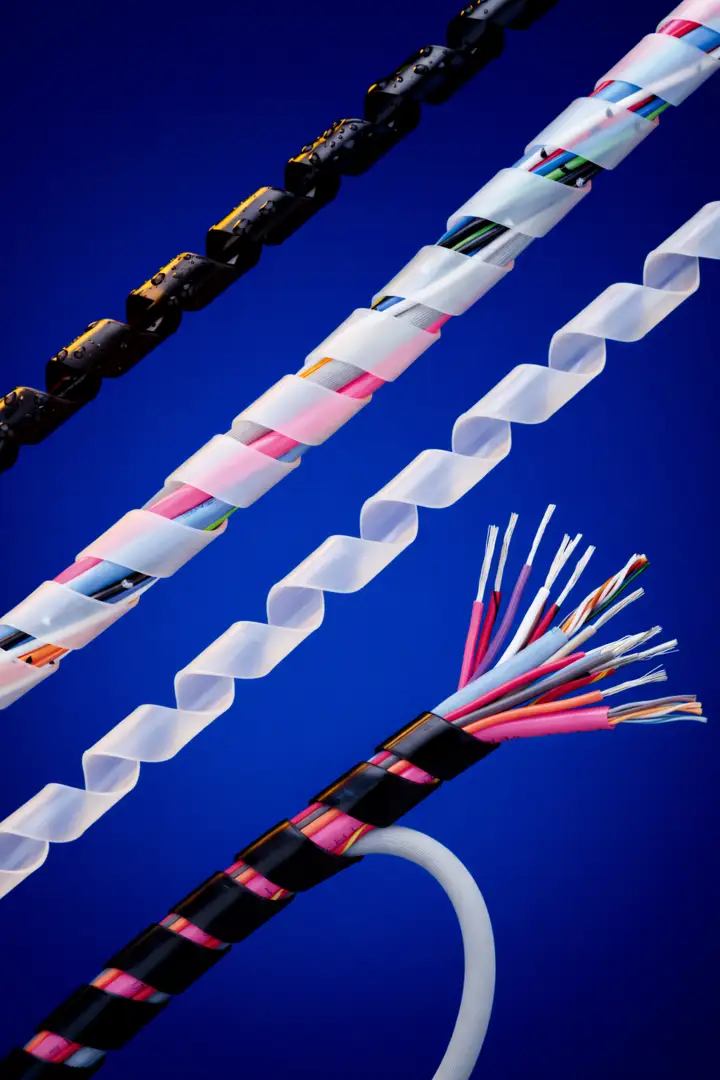
What is Heli-Tube® Cable Spiral Wrap and How Does It Work?
Heli-Tube® cable spiral wrap features a unique helical cut that allows it to wrap around wires, hoses, and pneumatic tubes like tape. Unlike expandable sleeves or rigid wire looms that require you to thread cables from end to end, spiral wrap can be applied to pre-terminated cables without dismantling your existing setup.
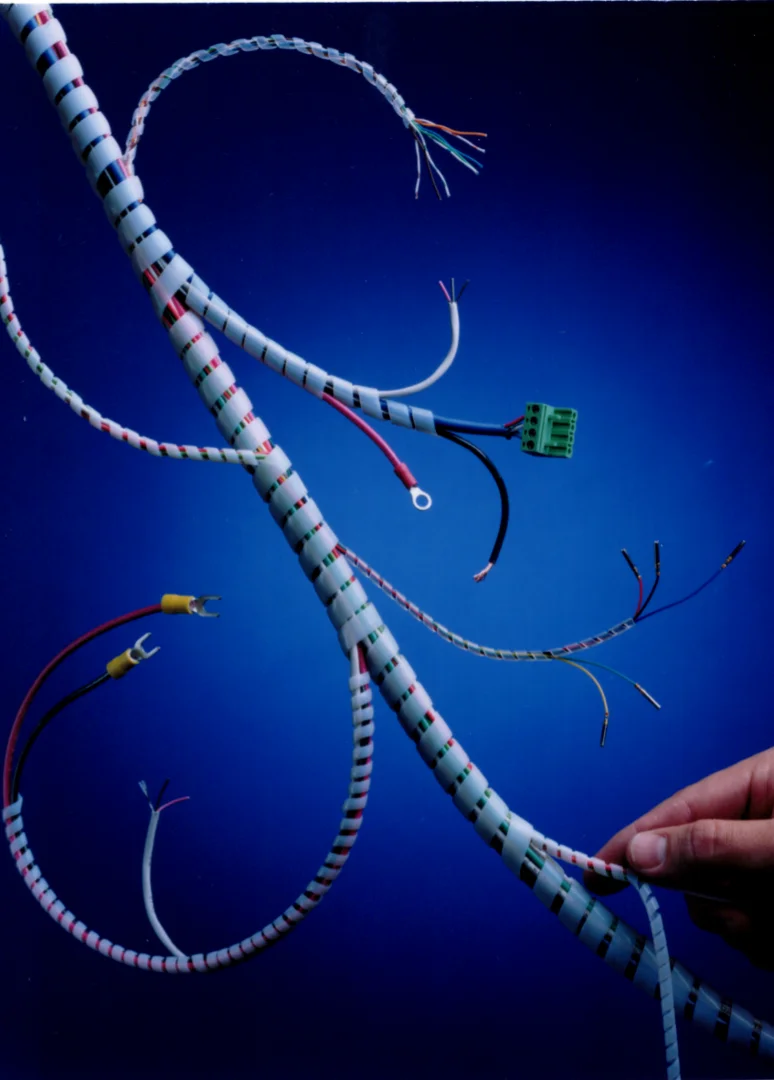
The primary advantage of the spiral design is its ability to support individual wire breakouts. If a single wire or hose needs to branch off to a specific component midway through a long run, it can easily exit through the natural gaps of the spiral wrap at any orientation. This provides unparalleled routing versatility for complex electrical harnesses and multi-lead systems.
However, it is important to understand the physical limitations of this design. A common misconception is that spiral wrap provides vibratory dampening. In reality, Heli-Tube® spiral wrap does not offer vibratory dampening for your cables.
Additionally, because of the open spaces between the wrapped coils, it is not a complete covering. It does not seal the enclosed bundle from environmental exposure. Dust, moisture, and chemical splashes can still penetrate the gaps, meaning the wrap is meant for structural bundling and abrasion resistance rather than environmental sealing.
To learn more about the basic mechanics of this cable management solution, check out the resources on About Spiral Cable Wrap.
Material Specifications and Performance Standards
Selecting the correct material is the most critical step to ensure your cable spiral wrap survives its operating environment. M.M. Newman Corporation manufactures Heli-Tube® spiral wrap using high-grade, technical materials designed to meet rigorous industrial standards.
- PTFE: For extreme environments, PTFE (Polytetrafluoroethylene) offers the widest operating temperature range of any material, performing reliably from -320°F to 500°F (-200°C to 260°C). It is chemically inert, non-flammable, and boasts a flammability rating of UL VW-1 while meeting ASTM-D3295 Group 4 specifications.
- Nylon: Nylon is lightweight, highly abrasion-resistant, and self-extinguishing. It does not produce toxic or irritating byproducts when exposed to open flames, making it highly recommended for enclosed spaces where fire safety is paramount. The operating temperature range for Nylon Heli-Tube® spiral wrap is -40°F to 250°F (-40°C to 121°C). Please note that standard Heli-Tube® products utilize high-quality Nylon, not Nylon 66.
- Fire-Resistant Polyethylene: This material is suitable for applications requiring self-extinguishing properties at a lower operating temperature range, performing between -4°F and 176°F (-20°C to 80°C).
All Heli-Tube® spiral wrap products are manufactured under strict quality controls. M.M. Newman Corporation is ISO 9001:2015 Certified (Certificate Reg. No. C2018-00027), and the products are fully REACH and RoHS compliant, ensuring they meet global environmental and safety standards.
For a deeper dive into selecting materials, read about the 3 Factors to Consider When Choosing Spiral Cable Wrap.
Material Properties of Polyethylene Heli-Tube® Spiral Wrap
Polyethylene is the most common and versatile material used for general-purpose cable spiral wrap. Standard polyethylene operates reliably within a temperature range of -76°F to 190°F (-60°C to 88°C).
For outdoor applications, standard plastics degrade quickly under solar radiation. To prevent this, M.M. Newman Corporation offers ultraviolet-resistant black polyethylene. This material incorporates UV-absorbing properties that protect the polymer chain, allowing the wrap to withstand direct sunlight and outdoor exposure for extended periods.
Polyethylene Heli-Tube® spiral wrap is also available in a wide variety of colors—including natural, black, blue, brown, and green—which are highly effective for color-coded labeling and visual identification in complex control panels.
You can explore the full range of sizes and colors in the Heli-Tube® Spiral Wrap Product Category. For industrial-grade options, you can also view polyethylene spiral wrap or general spiral wrap tubing specifications.
Selecting and Sizing Your Wrap
Choosing the right size of cable spiral wrap requires balancing three dimensions: bundle diameter, wall thickness, and pitch.
- Bundle Diameter: The total outer diameter of the cables or hoses you need to group together.
- Wall Thickness: Thicker walls provide greater resistance against physical wear and abrasion, though they reduce the overall flexibility of the wrapped bundle.
- Pitch: The distance between each spiral cut. A smaller pitch allows for easier bending around tight corners, while a wider pitch provides more coverage and rigidity.
M.M. Newman Corporation can accommodate custom specifications, altering the pitch, diameter, wall thickness, color, packaging, or length to meet your precise engineering requirements. If you want to understand these dimensions better, consult The Ultimate Guide to Choosing Spiral Cable Wrap.
Selecting the Right Size of Heli-Tube® Spiral Wrap
To achieve a snug fit that prevents slipping, select a spiral wrap with an inner diameter slightly smaller than the outer diameter of your cable bundle.
Commonly available sizes accommodate bundle diameters ranging from 1/16 inch up to 7 inches. If the wrap is too large, it will slide along the cables; if it is too small, the gaps between the coils will widen excessively, reducing protection and leaving the cables exposed.
For a comprehensive breakdown of standard dimensions, refer to Understanding Spiral Cable Wrap Sizes. You can also compare industry-standard dimensions by checking spiral wire wrap cord covers online.
Comparing Heli-Tube® Spiral Wrap Materials
Different industrial environments demand different material properties. While polyethylene is excellent for general organization, demanding applications in aerospace or automated manufacturing require the advanced thermal and chemical resistance of Nylon or PTFE.
The table below outlines how these materials compare across key performance categories:
| Material | Temperature Range | Chemical Resistance | Key Advantage |
|---|---|---|---|
| Polyethylene | -76°F to 190°F (-60°C to 88°C) | Moderate | Cost-effective general bundling, UV-resistant options |
| Nylon | -40°F to 250°F (-40°C to 121°C) | High | Self-extinguishing, excellent abrasion resistance |
| PTFE | -320°F to 500°F (-200°C to 260°C) | Outstanding | Chemically inert, extreme temperature tolerance |
| Fire-Resistant Polyethylene | -4°F to 176°F (-20°C to 80°C) | Moderate | Self-extinguishing economy option |
Industrial Applications and Installation Best Practices
Heli-Tube® cable spiral wrap is a staple across industries where electrical and mechanical failures are not an option.
In Aerospace and Robotics, where moving parts are constantly flexing, the wrap provides essential protection for wire harnesses without restricting dynamic movement. In Public Utilities and Automated Manufacturing, it organizes control cabinet wiring and protects critical pneumatic lines from wear. The Marine and Boat Manufacturing sectors rely heavily on UV-resistant and chemically inert wraps to bundle hydraulic steering hoses and electrical cables exposed to saltwater and fuel.
Note on Tools: It is important to distinguish Heli-Tube® spiral wrap from other products manufactured by M.M. Newman Corporation. The company’s heavy-duty hot knife (60 Watts, 900°F) is a specialized thermal cutting tool designed for materials like industrial awnings and sailcloth. It is not used for cutting or installing spiral wrap, which can be easily cut to size with standard shears.
To learn more about implementing these systems, check out How to Install Spiral Cable Wrap.
Step-by-Step Installation Guide
Applying spiral wrap is straightforward, but following these steps ensures a secure, professional fit:
- Organize the Cables: Gather the cables, hoses, or tubes into a tight, uniform bundle.
- Determine Wrap Direction: It is standard practice to wrap in a clockwise direction.
- Apply the Spiral Wrap: Start at one end of the bundle. Twist the wrap so that the cables spiral into the open gap, moving progressively down the length of the run.
- Manage Breakouts: When a wire needs to exit the bundle, simply pull it through the nearest spiral gap and continue wrapping the remaining cables.
- Secure the Ends: To prevent any shifting over time, secure both ends of the spiral wrap using standard cable ties or clamps.
For alternative manual bundling methods, you can also read about general cable wraps and organizers or check out retail spiral cable sleeves for low-demand environments.
Frequently Asked Questions about Cable Spiral Wrap
Can Heli-Tube® spiral wrap be reused?
Yes. One of the primary benefits of Heli-Tube® spiral wrap is its reusability. Unlike adhesive tapes or single-use zip ties, it can be easily unwrapped and re-applied multiple times. It retains its original spiral shape and tensile strength, making it highly cost-effective for systems that require frequent maintenance, re-routing, or upgrades.
Does spiral wrap protect cables from environmental factors?
No. Because of its spiral cut design, there are inherent gaps between the coils. Heli-Tube® spiral wrap is not a complete covering and does not protect cables from moisture, dust, chemical spills, or direct weather. Its primary functions are physical bundling, organization, and abrasion resistance.
What industries benefit most from Heli-Tube® spiral wrap?
The industries that benefit most include Aerospace, Robotics, Public Utilities, Automated Manufacturing, and Marine and Boat Manufacturing. These sectors utilize the wrap to bundle pneumatic tubes, hydraulic hoses, and electrical wires on dynamic, high-wear machinery.
Conclusion
Since 1956, M.M. Newman Corporation has been a world-leading manufacturer of high-quality cable management solutions. Heli-Tube® spiral wrap is proudly made in the USA and complies with strict ISO 9001:2015, REACH, and RoHS standards.
Whether you need standard polyethylene for general organization, UV-resistant options for marine environments, or high-performance PTFE for extreme aerospace temperatures, Heli-Tube® can be tailored to your exact specifications.
Ready to protect your equipment and minimize operational downtime? Browse the Heli-Tube® Spiral Wrap Product Category to find the perfect fit for your application.