

Last updated on June 25th, 2026 at 03:53 pm
Why Abrasion-Resistant Cable Wrap Is Critical for Equipment Longevity
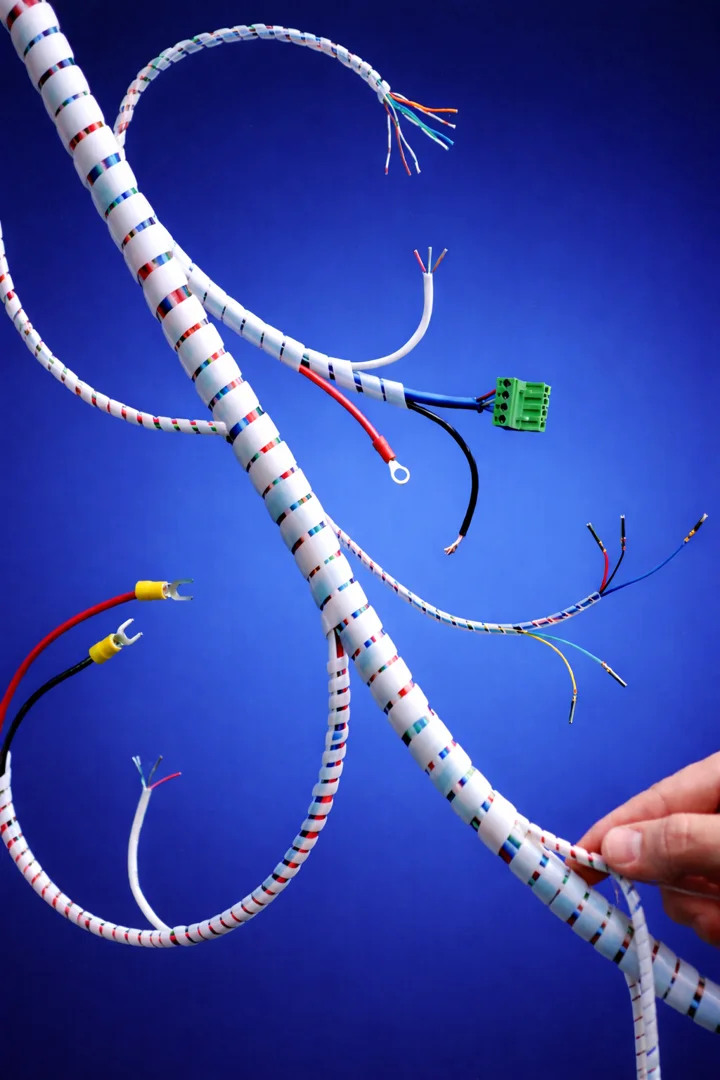
Abrasion-resistant cable wrap is protective sleeving or spirally cut wrap applied around wires, cables, hoses, and tubing to shield them from surface wear, friction, and mechanical damage.
Here’s a quick look at the most common types and what they do best:
| Type | Best For | Key Benefit |
|---|---|---|
| Spiral wrap | Bundling with breakouts | Easy install, reusable, individual wire access |
| Braided sleeving | Enclosed cabinets, harnesses | High cycle abrasion resistance |
| Wrap-around sleeve | Retrofit on existing assemblies | No disconnection needed |
| Hook-and-loop sleeve | Hose management access | Fast opening and closing |
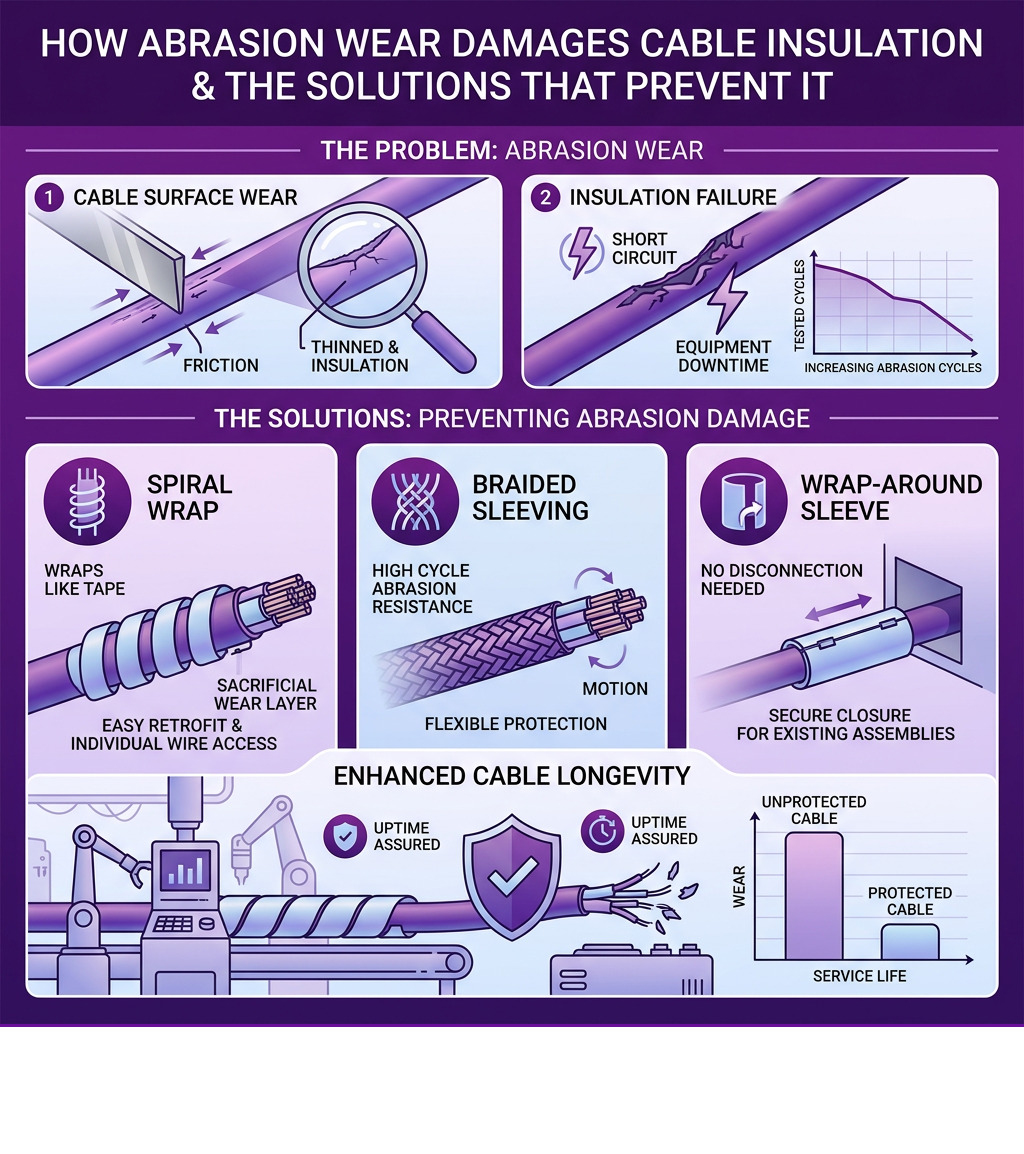
Cables and hoses in industrial environments take a beating. They drag across metal edges, rub against machine frames, and flex thousands of times a day. Without protection, insulation wears through – and when insulation fails, equipment goes down.
The cost of cable protection is small compared with the cost of unplanned downtime.
Industry abrasion testing helps quantify that risk. Products rated for demanding service are often tested for thousands of cycles under standardized conditions. Some protective sleeving products are evaluated using the Taber Abraser, a widely recognized abrasion test method for comparing wear performance. That kind of durability can translate to longer equipment life and fewer maintenance interruptions when the right product is selected for the environment.
For industries like aerospace, robotics, automated manufacturing, and public utilities, protecting cable bundles is not optional – it is part of keeping operations running. For M.M. Newman Corporation, that protection centers on Heli-Tube® spiral cable wrap, manufactured to organize and protect wires, hoses, cables, and tubing while supporting equipment uptime.
Heli-Tube® Spiral Cable Wrap: Engineered for Superior Abrasion Protection
When it comes to maintaining the integrity of complex wiring systems, Heli-Tube® spiral cable wrap stands out as a proven solution. Unlike standard sleeving that requires a free end for installation, this spirally cut tubing wraps on like tape. This design allows it to be applied to existing installations without disconnecting hardware, which helps reduce maintenance downtime.
The primary function of abrasion-resistant cable wrap in a spiral configuration is to provide a sacrificial wear layer. In automated manufacturing or robotics, cables are often in constant motion. As they move, they rub against each other or against the machine chassis. Heli-Tube® absorbs this friction, helping prevent the underlying insulation from thinning or cracking. By maintaining bundle integrity, it helps keep wires organized and protected from the surface wear that leads to electrical faults.
Understanding How Spiral Wrap is Used for Abrasion Protection involves looking at the mechanical hold it creates around a bundle. It helps prevent internal wires from shifting against one another, reducing internal chafing in high-vibration environments. Heli-Tube® is used to protect and organize the bundle; it should not be selected with the expectation that it will provide vibration damping on its own.
Heli-Tube® Spiral Cable Wrap for Individual Wire Breakouts
One of the most significant advantages of the spiral design is the ability to facilitate individual wire breakouts. In complex industrial panels or aerospace wiring harnesses, not every wire in a bundle needs to go to the same destination. The gaps in the spiral allow a single wire or a sub-bundle to exit the main wrap at any point.
This feature makes routing and rerouting wires much simpler. If a component needs to be replaced or a circuit modified, a technician can guide the wire through the spiral at the required orientation. Heli-Tube® can also be unwrapped and reapplied, which is useful during maintenance and system changes.
M.M. Newman Corporation offers Heli-Tube® in both forward- and reverse-cut versions. This versatility is important for specialized applications where wrap direction may affect installation or routing. It is also available in different sizes and colors to support bundle diameter requirements and identification needs. For more details on these features, you can explore Spiral Cable Wrap Protector Common Uses & Benefits.
High-Performance Materials for Extreme Environments
Not all abrasion resistant cable wrap is created equal. The environment dictates the material choice. While standard polyethylene might work in light-duty settings, an engine room or a chemical processing area requires more demanding material performance. M.M. Newman Corporation manufactures Heli-Tube® using materials such as nylon, PTFE, and specialized Polyethylene to meet these application demands.
Selecting the right material is a balance of temperature resistance, chemical inertness, UV resistance, and mechanical strength. In outdoor applications, UV resistance is especially important. Without it, the material can become brittle and lose protective performance over time. To dive deeper into material selection, see our guide on how to Find the Right Spiral Wrap Material.
Selecting the Right Abrasion-Resistant Cable Wrap Material
Each material in the Heli-Tube® lineup has a specific strength:
- Polyethylene: A versatile option for general-purpose applications. M.M. Newman Corporation provides ultraviolet-resistant black Polyethylene that can withstand direct sunlight for extended periods, making it well-suited for outdoor utilities. It operates effectively between -76°F and 190°F.
- Nylon: Known for high abrasion resistance and self-extinguishing properties. Nylon is a strong choice for enclosed environments where fire safety is a concern. It does not produce toxic or irritating byproducts even when exposed to open flame or excessive operating temperatures. It handles temperatures from -40°F up to 250°F.
- PTFE: The broadest temperature performer. PTFE (Polytetrafluoroethylene) has an operating range from -320°F to +500°F. It is chemically inert and non-flammable, making it valuable for aerospace, laboratory, and other demanding applications.
For those working with sensitive equipment, it is often necessary to Protect Instrument Wires with PTFE Spiral Wrap Tubing to help ensure that extreme heat or corrosive chemicals do not compromise the installation.
Specialized Fire-Resistant and Color-Coded Variants
Safety and organization often go hand in hand. In complex systems, color-coding can identify different lines – such as power, data, pneumatic tubes, or hydraulic hose groupings – at a glance. Heli-Tube® is available in a wide variety of colors, including natural, black, blue, brown, and green, to meet identification requirements.
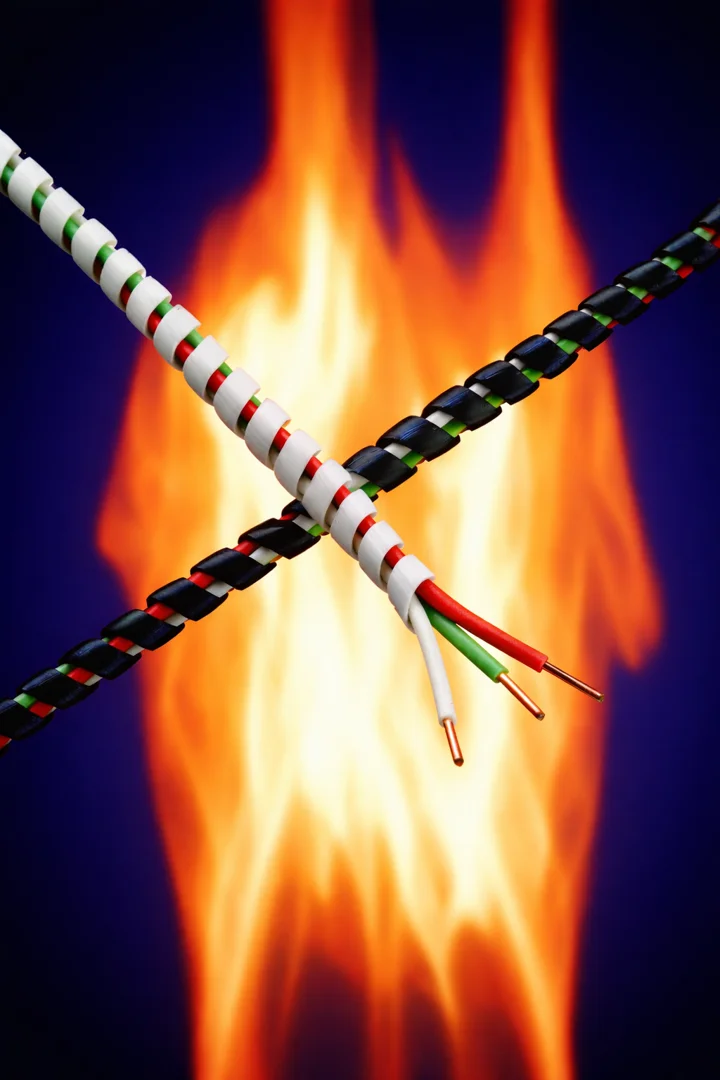
In industries like public transportation, industrial equipment, and mining, self-extinguishing materials may be required. Fire-Resistant Polyethylene Heli-Tube® is designed for those applications and is available in white or black. It provides an added safety margin in the event of an electrical fault. You can find specific specifications for these products on the Fire Resistant Heli-Tube® Spiral Wrap product page.
Critical Standards and Testing for Abrasion-Resistant Cable Wrap
To ensure that the abrasion-resistant cable wrap can handle field conditions, it must undergo rigorous testing. One common method for measuring surface wear is the Taber Abraser test. This involves rotating a specimen under a weighted abrasive wheel to evaluate wear over a defined number of cycles.
Abrasion-cycle metrics help engineers compare materials for high-wear environments. Depending on product type and construction, protective wraps and sleeving may be rated for thousands or even tens of thousands of cycles. These data points are useful when estimating service life in applications where repeated contact and rubbing are expected.
Other critical standards include:
- UL94 Flammability: Measures how the material reacts to flame.
- ASTM-D3295: Relevant to PTFE tubing materials and specifications.
- Military Specifications: Such as A-A-59602 Type II for nylon, for applications that require conformance to established defense-related requirements.
- UL recognition: Heli-Tube® is a UL-recognized component listed under category UZKX2, Component Wire Positioning Devices, file card number E83405 (M).
Compliance with ISO 9001:2015 and RoHS
M.M. Newman Corporation is ISO 9001:2015 certified, which means its manufacturing processes meet international standards for quality management. This supports consistent dimensions and material properties across Heli-Tube® production.
Furthermore, compliance with REACH and RoHS helps confirm that the products meet important environmental and material restrictions. This is particularly important for global manufacturers that must satisfy regulatory requirements across multiple regions. For those needing Nylon variants that meet these standards, the Nylon Heli-Tube® Spiral Wrap is an excellent choice.
Performance Metrics for Industrial Protection
When comparing abrasion-resistant cable wrap options, technical specifications such as wall thickness and pitch are important. A thicker wall provides more material to wear through, which can extend service life in high-friction zones. The pitch refers to the distance between the spiral cuts; a wider pitch offers greater coverage, while a tighter pitch helps with routing characteristics around bends.
Expansion range is another key metric. Heli-Tube® is designed to be expandable, allowing it to bundle a range of diameters firmly while still permitting breakouts where needed. M.M. Newman Corporation can also alter pitch, diameter, wall thickness, color, packaging, length, or material to meet application requirements. For specific data on polyethylene variants, consult the Polyethylene Heli-Tube® Spiral Wrap technical sheet.
Industrial Applications: Aerospace, Robotics, and Utilities
In automated manufacturing and robotics, abrasion-resistant cable wrap is an important part of system protection. Robotic arms operate in constant, repetitive motion. The cables powering these machines are subjected to torsional stress and continual rubbing. Without a protective spiral wrap, the outer jackets of these cables can wear prematurely, leading to repairs and downtime.
Public utilities also rely heavily on these solutions. Whether protecting control wires in an electrical substation or managing hydraulic hoses and pneumatic tubes on service equipment, spiral wrap helps critical infrastructure remain operational. In these settings, Hydraulic Hose Protector PTFE Spiral Wrap Prevents Chafing describes a common application in which hose protection is important, as hydraulic systems often operate under high pressure and temperature.
Marine and Boat Manufacturing Solutions
The marine environment is one of the most demanding settings for cables and hoses. Saltwater is highly corrosive, and engine rooms generate significant heat. Hoses on boats are often routed through tight bulkheads where they can chafe against fiberglass or metal edges.
Heli-Tube® provides a practical solution for bundling hoses and protecting them from wear caused by vibration and repeated contact. UV-resistant materials are especially important here, as many cables and hoses are exposed to direct sunlight on deck. Marine engineers often find that Superior Protection with Spiral Hose Wrap is an efficient way to organize engine room plumbing while supporting long-term durability.
Frequently Asked Questions about Cable Protection
How do I choose the correct size for a cable bundle?
To choose the right Heli-Tube® size, first determine the total outside diameter (O.D.) of your wire, cable, hose, or tubing bundle. You generally want to choose a spiral wrap with an inside diameter (I.D.) slightly smaller than your bundle for a snug fit. Because the wrap is expandable, it will open to securely grip the bundle. M.M. Newman Corporation offers Heli-Tube® in different sizes, and custom options may be available when standard dimensions do not match the application.
Can spiral wrap be used to protect hydraulic hoses?
Absolutely. In fact, it is one of the most common uses for abrasion-resistant cable wrap. Hydraulic hoses are often subjected to external wear from dragging on the ground or rubbing against machine parts. A spiral wrap acts as a protective layer that takes the abrasion and helps extend hose life.
What is the temperature range for PTFE cable wraps?
PTFE offers the broadest temperature resistance in the M.M. Newman Corporation line. It can operate in cryogenic conditions as low as -320°F and withstand heat up to +500°F. This makes it a preferred choice for aerospace, high-temperature industrial equipment, and laboratory applications where other materials would suffer performance degradation.
Conclusion
Since 1956, M.M. Newman Corporation has been a world-leading supplier of high-quality cable management solutions. Their Heli-Tube® spiral cable wrap is more than just an organizer; it is a critical component in protecting the lifespan of expensive industrial equipment. By offering a versatile range of materials—from the chemical inertness of PTFE to the ruggedness of nylon—they ensure that every industry, from robotics to marine manufacturing, has access to the best available protection.
With a commitment to American manufacturing and just-in-time service, M.M. Newman Corporation continues to help businesses reduce downtime and stop the scrape. For those ready to upgrade their cable protection strategy, you can find More info about abrasion resistant solutions on our website.