


The full form of RoHS is Restriction of Hazardous Substances. Originating as European Union legislation, RoHS is a regulatory framework that restricts 10 specific toxic substances in electrical and electronic equipment (EEE) to safeguard human health and facilitate safe e-waste recycling. RoHS compliance requires keeping these hazardous chemical concentrations below strict statutory thresholds, which are measured by weight in homogeneous materials rather than across the total weight of an assembled product.
A homogeneous material is defined as a single material of uniform composition throughout, or a composite of materials that cannot be disjointed or separated by mechanical actions such as unscrewing, cutting, crushing, grinding, or abrasive processes. For example, an insulated electrical wire consists of multiple homogeneous materials: the metal conductor, the primary insulation jacket, and any exterior protective coating. Each distinct layer must satisfy the maximum concentration values (MCVs) independently.
For nine of the restricted substances, the maximum permitted concentration is 0.1% by weight, which equates to 1,000 parts per million (ppm). Cadmium is subject to a significantly stricter limit of 0.01% by weight, or 100 ppm, due to its acute toxicity and high bioaccumulation potential. Official substance limits are established in Annex II of the directive and maintained through continuous technical evaluation by the RoHS Directive – Environment – European Commission .
| Substance Name | CAS Number | RoHS Maximum Concentration Value (MCV) | Common Historical Industrial Uses |
|---|---|---|---|
| Cadmium (Cd) | 7440-43-9 | 0.01% (100 ppm) | Electroplating, plastic pigments, electrical contacts |
| Lead (Pb) | 7439-92-1 | 0.1% (1,000 ppm) | Solder alloys, PVC stabilization, brass machining |
| Mercury (Hg) | 7439-97-6 | 0.1% (1,000 ppm) | Fluorescent lamps, relays, positional switches |
| Hexavalent Chromium (Cr6+) | 18540-29-9 | 0.1% (1,000 ppm) | Passivation coatings, anti-corrosive chromating |
| Polybrominated Biphenyls (PBB) | Various | 0.1% (1,000 ppm) | Flame retardants in structural engineering polymers |
| Polybrominated Diphenyl Ethers (PBDE) | Various | 0.1% (1,000 ppm) | Flame retardants in electronic enclosures and cabling |
| Bis(2-ethylhexyl) phthalate (DEHP) | 117-81-7 | 0.1% (1,000 ppm) | Plasticizer for PVC cable jacketing and vinyl parts |
| Butyl benzyl phthalate (BBP) | 85-68-7 | 0.1% (1,000 ppm) | Softener in vinyl polymers, sealants, and adhesives |
| Dibutyl phthalate (DBP) | 84-74-2 | 0.1% (1,000 ppm) | Plasticizer in elastomeric tubing and coatings |
| Diisobutyl phthalate (DIBP) | 84-69-5 | 0.1% (1,000 ppm) | Specialty plasticizer and processing additive |
Heavy Metals and Flame Retardants
The initial group of restricted substances includes four heavy metals and two classes of brominated flame retardants. Lead has historically served as a primary constituent in tin-lead solders (Sn63/Pb37) and as a thermal stabilizer in basic PVC formulations. Exposure to lead damages neurological systems and persists indefinitely in ecosystems. Cadmium provides corrosion resistance in metal plating and serves as a bright pigment in plastics, but its nephrotoxicity necessitates an ultra-low threshold of 100 ppm.
Mercury, commonly found in cold-cathode fluorescent lamps, switches, and specialized sensors, poses severe neurological hazards when vaporized during incineration or e-waste processing. Hexavalent chromium (Cr6+) provides corrosion resistance when applied as a chromate conversion coating on aluminum and steel chassis; however, it is a known human carcinogen. Trivalent chromium (Cr3+) is permitted as a compliant substitute.
Polybrominated biphenyls (PBB) and polybrominated diphenyl ethers (PBDE) were widely added to electronic enclosures, circuit boards, and cable jackets to slow combustion. When burned in uncontrolled waste facilities, these brominated compounds generate toxic dioxins and furans, making their phase-out a priority for recycling worker safety.
Phthalate Plasticizers
In 2015, the European Commission issued Delegated Directive (EU) 2015/863, which formally added four ortho-phthalate plasticizers to Annex II of the directive: DEHP, BBP, DBP, and DIBP. These chemical additives soften rigid plastics, providing flexibility to vinyl, cable sheaths, and protective wraps.
Phthalates are classified as endocrine disruptors and reproductive toxins. Because they are not chemically bonded to the host polymer matrix, they leach into the environment over time. The electronics industry underwent a major transition to bio-based and green-chemistry plasticizers (such as citrates and terephthalates) to maintain compliance across wire assemblies, extruded polymers, and harness components.
How Has the RoHS Directive Evolved from RoHS 1 to RoHS 3?
Understanding the progression of RoHS legislation helps manufacturers determine which compliance files, markings, and documentation standards apply to their products.
- RoHS 1 (Directive 2002/95/EC): Adopted in February 2003 and enacted on July 1, 2006, the original directive restricted six substances across eight broad categories of consumer and commercial electronics. It operated primarily as an environmental protection measure targeting end-of-life electronic waste.
- RoHS 2 (Directive 2011/65/EU): Enacted in July 2011, RoHS 2 recast the original legislation. It expanded the scope to include medical devices (Category 8) and industrial monitoring and control instruments (Category 9). Crucially, RoHS 2 integrated compliance directly into the CE marking directive family, establishing that electrical products cannot bear the CE mark without full RoHS compliance supported by a formal technical construction file. Statutory guidelines can be reviewed directly in Directive – 2011/65 – EN – rohs 2 – EUR-Lex .
- RoHS 3 (Delegated Directive 2015/863): Known colloquially as RoHS 3, this amendment expanded the restricted substance list from six to 10 by adding the four phthalates (DEHP, BBP, DBP, and DIBP). Full enforcement began on July 22, 2019, for general electrical equipment, followed by Category 8 and Category 9 equipment in 2021.
Specific industrial applications are granted temporary technical exemptions under Annexes III and IV when suitable alternative materials do not exist without compromising functional safety. Examples include lead in high-melting-temperature solders (Category 7a), lead in copper alloys up to 4% by weight (Category 6c), and lead in aluminum alloys up to 0.4% by weight. These exemptions are temporary, lasting 5 to 7 years, and must undergo formal renewal reviews before expiration.
Certain categories remain excluded from the directive’s scope entirely. These exclusions include military and defense equipment, hardware designed specifically for space exploration, large-scale fixed installations, large-scale stationary industrial tools, professional non-road mobile machinery, and active implantable medical devices.
Under RoHS 2 and RoHS 3, proof of compliance requires more than passive self-declaration. Manufacturers must assemble a Technical Construction File (TCF) conforming to harmonised standard EN IEC 63000:2018. This technical standard specifies the procedures necessary to assess materials, collect supplier declarations, and conduct analytical testing.
Global Harmonization and Regional Equivalents
While RoHS originated as European Union legislation, its foundational concepts have been adopted internationally:
- United Kingdom: Post-Brexit, Great Britain regulates hazardous substances under statutory legislation outlined in the RoHS Regulations 2012 (as amended): Great Britain – GOV.UK , maintaining substance restrictions and recognizing both UKCA and CE conformity markings.
- China: China RoHS (Management Methods for the Restriction of the Use of Hazardous Substances in Electrical and Electronic Products) enforces a catalog-based system requiring specific environmental protection use period (EPUP) labeling and material disclosure tables.
- United States: While there is no single federal equivalent, several states have enacted targeted legislation. The California Electronic Waste Recycling Act (EWRA) restricts heavy metals in video displays, and various state green chemistry frameworks restrict phthalates and flame retardants in commercial goods.
- Other Regions: South Korea, India, the United Arab Emirates, and Eurasian Economic Union (EAEU) member states enforce regional RoHS frameworks aligned with EU substance thresholds.
Understanding what is RoHS? is essential for companies aiming to design unified products that can enter worldwide markets without regional material re-engineering.
What Is the Difference Between RoHS and REACH Regulations?
Manufacturers operating in global supply chains frequently encounter both RoHS and REACH. While both are European chemical safety regulations designed to protect public health and the environment, their scope, structure, and enforcement mechanisms differ significantly.
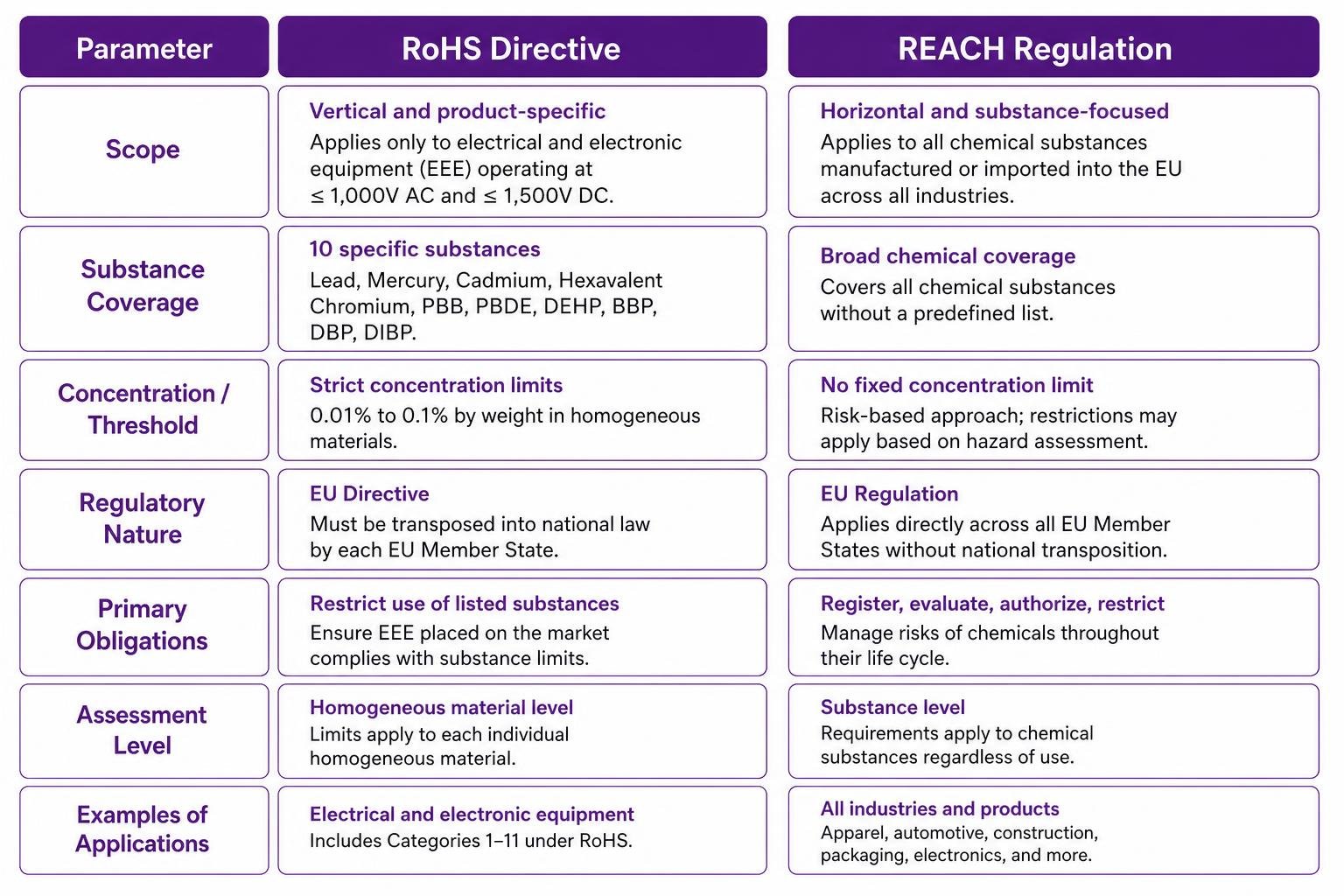
RoHS is a vertical directive focused strictly on electrical and electronic equipment (EEE) operating at voltages up to 1,000V AC and 1,500V DC. It sets strict concentration thresholds (0.01% to 0.1%) across 10 specific substances, evaluated at the individual homogeneous material level. Because it is an EU directive, it must be transposed into national law by each member state.
In contrast, REACH (Regulation EC No 1907/2006) is a horizontal regulation that applies directly across all EU member states without requiring domestic legislative transposition. It governs the registration, evaluation, authorization, and restriction of all chemical substances manufactured or imported into the EU across all industries, including apparel, automotive components, construction materials, and packaging.
| Parameter | RoHS Directive | REACH Regulation |
|---|---|---|
| Legal Structure | EU Directive (transposed into national laws) | EU Regulation (directly binding across member states) |
| Product Scope | Electrical and electronic equipment (EEE) | All chemical substances, articles, and packaging |
| Regulated Substances | 10 specific restricted substances | 200+ Substances of Very High Concern (SVHCs), plus Annex XVII restrictions |
| Evaluation Level | Homogeneous material level (mechanically separable layers) | Article level (the finished component or whole object) |
| Compliance Proof | Technical file (EN IEC 63000), Declaration of Conformity, CE mark | SCIP database notification, supply chain disclosure (>0.1% w/w) |
| Exemptions | Time-limited technical exemptions (Annexes III & IV) | Specific authorization procedures (Annex XIV) |
Under REACH, companies must identify and communicate the presence of any Candidate List Substances of Very High Concern (SVHCs) if they exceed 0.1% by weight of the entire article. If a chemical is regulated under both frameworks, RoHS takes precedence for electrical and electronic assemblies, ensuring that conflicting requirements do not create legal ambiguity.
Non-compliance with either framework carries substantial commercial risks. Customs authorities can seize shipments at international ports of entry, issue severe financial penalties, mandate immediate product recalls, and revoke market access privileges, causing severe reputational and economic damage.
How Do Passive Components and Cable Wraps Comply with RoHS Standards?
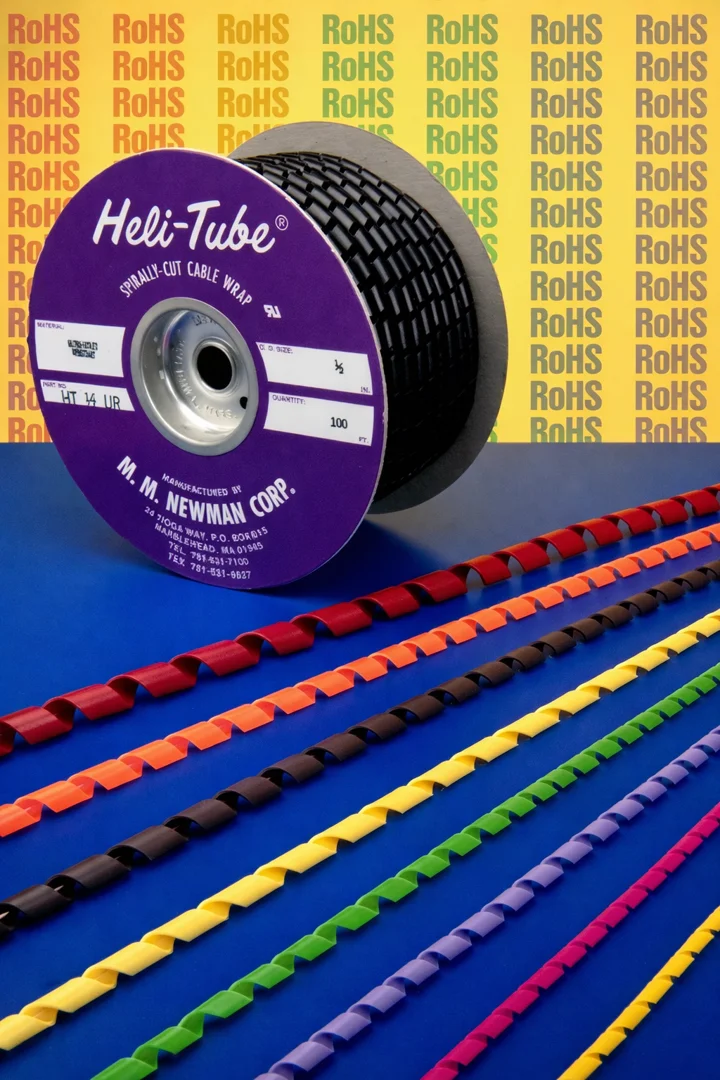
A common misconception in electronics manufacturing is that RoHS applies only to active components like printed circuit boards, microcontrollers, and power supplies. Under statutory definitions, passive components, wire sleeving, fasteners, and cable wrapping accessories integrated into electrical equipment are subject to identical substance thresholds.
Every polymer resin, color masterbatch, plasticizer, and thermal stabilizer used in cable management must meet the 10 substance limits at the homogeneous material level. If a plastic spiral wrap utilizes an unapproved lead-based heat stabilizer or a restricted phthalate plasticizer exceeding 1,000 ppm, the entire finished machine or wire harness can fail regulatory audits.
Ensuring compliance for passive components is critical across demanding sectors:
- Aerospace: High-reliability wiring harnesses inside avionics and airframe control systems require non-toxic materials with verified thermal performance.
- Robotics: Dynamic robotic arms require durable protective wrapping that withstands continuous bending while meeting global material safety guidelines.
- Public Utilities: Substations, control cabinets, and power distribution enclosures require verified, flame-retardant cable management solutions to minimize maintenance downtime.
- Automated Manufacturing: Factory automation sensors, motor leads, and pneumatic tubes require organized, robust protection in harsh industrial workplaces.
- Marine and Boat Manufacturing: Routing hydraulic hoses, steering linkages, and power cables through marine hulls demands chemically resilient bundling materials that do not leach harmful additives into aquatic environments.
Procuring certified Heli-Tube® Spiral Wrap Complies Fully with RoHS specifications ensures that wiring assemblies maintain compliance with ISO 9001:2015, REACH, and RoHS standards from raw resin sourcing to final delivery.
Polymer Selection and Thermal Performance
Selecting the right polymer ensures that wire bundling achieves necessary mechanical and thermal performance without introducing banned substances. M.M. Newman Corporation manufactures Heli-Tube® spiral cable wrap in multiple specialized polymers, available in various sizes and color-coded labeling options to streamline line identification, reduce troubleshooting downtime, and extend equipment lifespan:
- Polyethylene: Polyethylene Heli-Tube® spiral wrap operating temperatures range from -76°F (-60°C) to 190°F (88°C). This standard engineering material offers cost-effective bundling for general commercial and industrial workplace wiring.
- Fire-Resistant Polyethylene: Fire-Resistant Polyethylene Heli-Tube® spiral wrap operates from -4°F (-20°C) to 176°F (80°C) for applications requiring self-extinguishing material that complies with flame-retardant safety standards without restricted brominated additives.
- Nylon: Nylon Heli-Tube® spiral wrap operates from -40°F (-40°C) to 250°F (121°C) and is self-extinguishing. Nylon provides superior abrasion resistance and durability in dynamic, high-wear robotic and industrial automation environments.
- PTFE: PTFE Heli-Tube® spiral wrap operates across an extreme temperature range from -320°F to 500°F (-200°C to 260°C). PTFE exhibits near-universal chemical inertness, making it suited for aerospace systems, high-temperature engine compartments, and specialized industrial processing.
When sourcing components, engineers should verify that their supplier provides fully certified RoHS Compliant Cable Wrap backed by traceable technical documentation.
Physical Limitations of Spiral Cable Wrap
While spiral cable wrap provides mechanical bundling, abrasion protection, and allows for individual wire breakouts in any orientation, understanding its physical limitations is critical for proper system design:
- Environmental Factors: While spiral wrap withstands environmental factors such as UV radiation, thermal swings, and chemical exposure, it does not protect enclosed cables or wires from environmental factors because it has open gaps between each spiral turn. Moisture, dust, and hydraulic fluids will reach the underlying wires.
- Vibration: Spiral wrap organizes and secures bundles to prevent snagging, but it does not offer vibratory dampening. Severe vibration must be addressed through proper mechanical clamping and structural strain reliefs.
- Cutting Procedures: Spiral cable wrap is easily trimmed using standard utility shears or hand cutters. For cutting separate synthetic woven materials such as awnings and sailcloth, M.M. Newman Corporation manufactures a heavy-duty hot knife as a distinct product (60 Watts, 900°F). The hot knife is designed specifically for synthetic fabrics and webbing to seal edges against fraying, not for spiral wrap.
What Are the Most Frequently Asked Questions About RoHS?
What is the simple definition and full form of RoHS?
RoHS stands for Restriction of Hazardous Substances. It is an international regulatory framework originated by the European Union that restricts 10 specific toxic substances—including heavy metals like lead and cadmium, brominated flame retardants, and phthalates—in electrical and electronic equipment to safeguard human health and facilitate environmentally safe recycling.
Does RoHS compliance mean a product is 100% lead-free?
No. RoHS allows up to 0.1% (1,000 ppm) of lead by weight in homogeneous materials to account for unavoidable trace impurities in raw materials. Furthermore, specific temporary technical exemptions allow higher lead concentrations in specialized applications where alternatives do not exist, such as up to 4% lead in copper alloys and 85% or more in high-melting-temperature solders.
Does RoHS apply to non-electrical components used in wire harnesses?
Yes. Passive components, cable management accessories, and protective sleeving integrated into an electrical device or wire harness fall within the scope of RoHS. Every mechanically separable homogeneous material—including the polymer resin and color pigments of spiral wrap—must meet the required concentration limits.
Why Is RoHS Compliance Essential for Modern Global Manufacturing?
RoHS compliance is a fundamental requirement for international commerce, sustainable engineering, and risk mitigation. What began as an EU directive targeting consumer electronics has evolved into a global standard for chemical safety across industrial automation, robotics, aerospace, and commercial equipment.
Designing products with compliant, non-toxic polymers simplifies regulatory approval and protects market access across Europe, Asia, and the Americas. By working with experienced manufacturers like M.M. Newman Corporation, engineering and procurement teams gain access to high-performance, fully certified Heli-Tube® spiral wrap that meets strict RoHS, REACH, and ISO 9001:2015 quality standards. Evaluating components at the homogeneous material level ensures that wire harnesses and complex assemblies remain compliant, durable, and reliable throughout their operational lifecycle.