

Operational Challenges and Mechanical Demands on Spiral Wrap for Wind Turbine Cables
Operating a modern wind turbine places intense physical demands on electrical and hydraulic lines. Inside the nacelle and tower assemblies, power conductors, fiber-optic control lines, and hydraulic hoses endure constant dynamic forces. As wind energy technology advances in 2026, turbines feature larger rotor diameters and taller towers, increasing the baseline mechanical stresses on internal infrastructure. Without proper wind turbine cable protection, cables under continuous movement quickly suffer outer-jacket degradation, leading to short circuits, signal loss, and costly downtime.
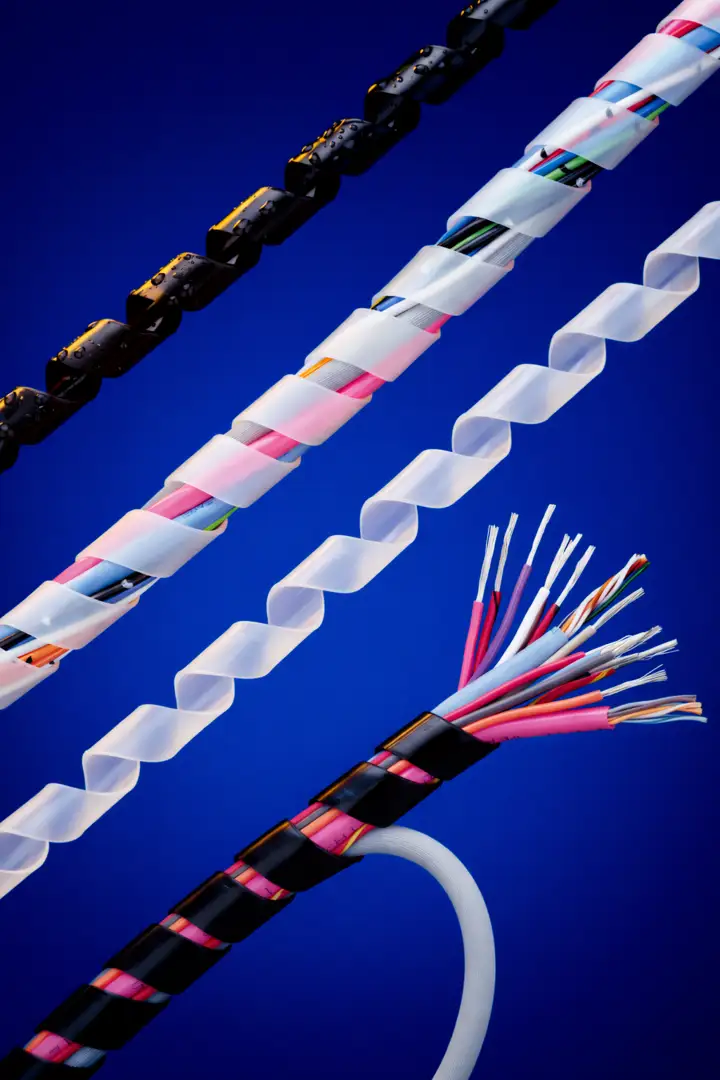
Implementing a strategy based on a detailed industrial cable protection plan that incorporates dedicated abrasion protection helps mitigate these mechanical failure modes. Serving as a rugged abrasion-resistant wrap wind energy systems require, spiral cable wrap operates as a sacrificial mechanical barrier. It wraps firmly around bundles to shield individual conductors from direct friction against steel frames, cable trays, and adjacent lines.
Spiral wrap uses an open, gap-based construction. While the wrap material itself withstands severe environmental exposure, including intense UV radiation, saltwater mist, and temperature swings, it does not seal or protect enclosed cables from moisture, salt spray, or ambient chemicals. The cables must have appropriate jacket ratings, while the spiral wrap absorbs relentless mechanical friction.
Abrasion from Continuous Vibration and Mechanical Movement
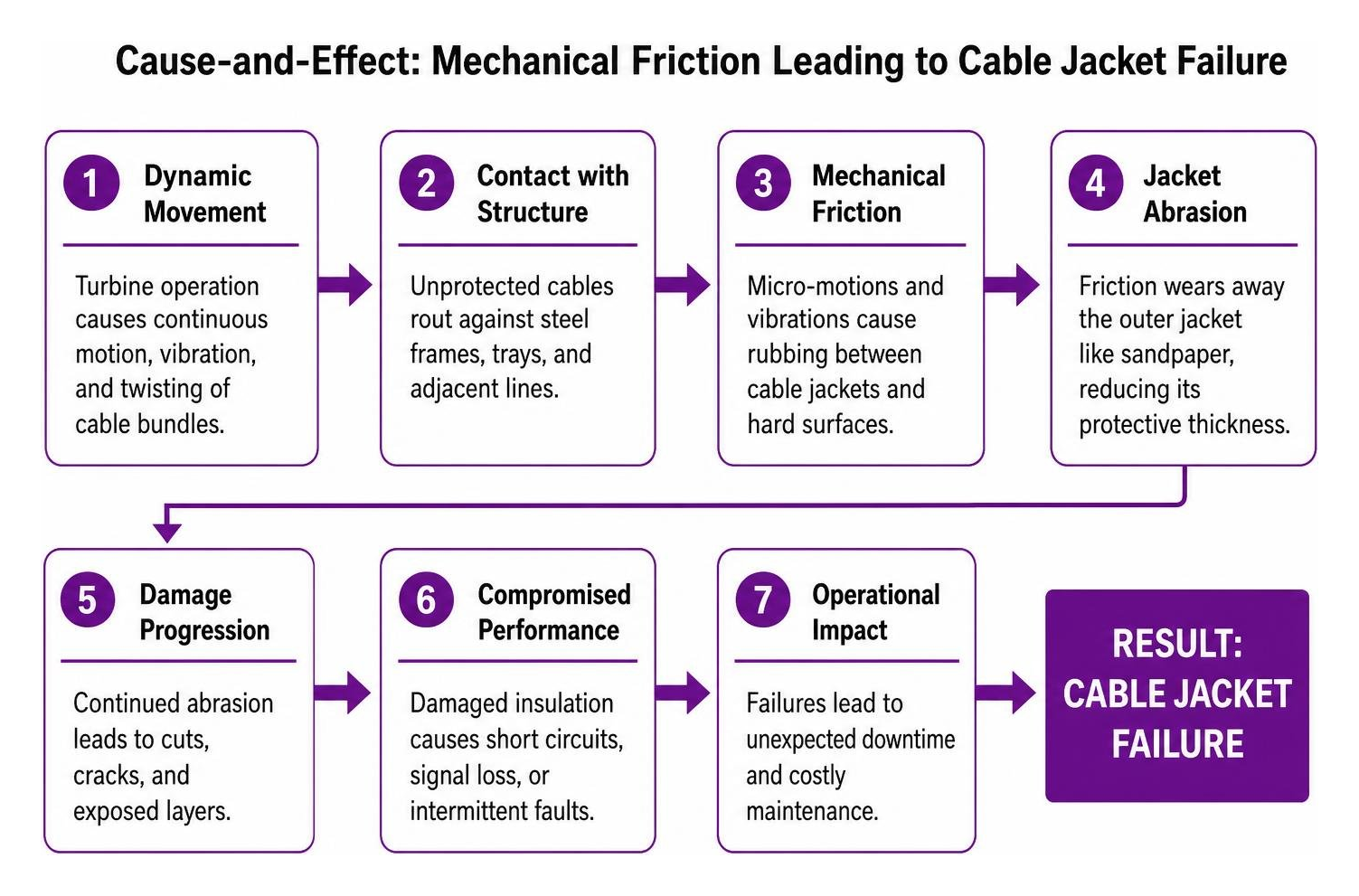
Vibration inside a wind turbine is continuous. Blade rotation, gearbox operation, and high-speed generator spinning transmit high-frequency harmonic vibrations throughout the nacelle and upper tower structure.
When unprotected cable bundles rest against structural metalwork, these vibrations produce micro-motions. Over thousands of operational hours, this rubbing acts like sandpaper on cable jackets:
- Structural Contact Chafing: Cables resting on raw metal edges, brackets, or ladder rungs gradually wear through their outer insulation.
- Cable-on-Cable Friction: Bundles that shift under vibrational loading experience internal friction as adjacent jackets rub together.
- Non-Dampening Barrier: Spiral wrap does not offer vibratory dampening; instead, it prevents direct contact wear by absorbing the surface abrasion that would otherwise compromise the cable insulation.
By bundling conductors inside Heli-Tube® spiral wrap, maintenance teams eliminate cable-on-cable chafing and ensure that structural contact occurs against the rugged polymer wrap rather than the primary insulation of critical circuits.
Torsion Stress and Rotational Yaw Motion
The turbine nacelle must rotate continuously to track wind direction. This yaw motion creates severe torsional stress on the cables that drop from the moving nacelle into the stationary tower below. These dynamic cable loops are engineered to twist repeatedly—often up to several full rotations in either direction—before the yaw mechanism untwists the system.
During yaw rotation, individual cables within a bundle shift, twist, and slide across one another. Cable loops designed with specialized robotic cable wrap solutions demonstrate how spiral wrap accommodates severe multi-axis displacement without binding.
Modern wind energy cables, such as high-torsion control lines designed to endure significant angular displacement per meter, require outer bundling that accommodates dynamic twisting without restricting torsional travel. For instance, dynamic cables built to high-performance cable structure standards often undergo testing exceeding 18,000 torsion cycles. Applying spiral wrap over these service loops ensures that the bundled conductors move uniformly, maintaining the required minimum bend radius and preventing localized pinching during severe torsional displacement.
Key Installation Zones Throughout the Wind Turbine Structure
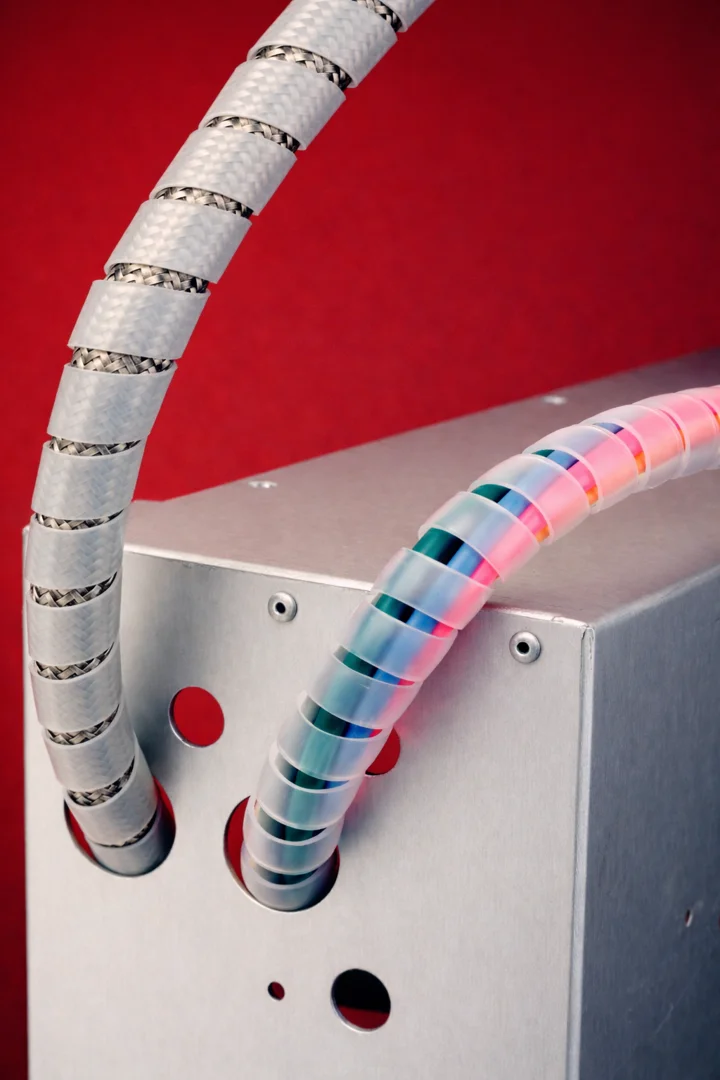
Wind energy systems contain several distinct operational zones, each presenting unique cable routing and management demands. Implementing reliable cable management wind energy protocols using spiral wrap across these zones allows technicians to organize complex circuits, simplify retrofits, and protect vital lines.
Applying Spiral Wrap for Wind Turbine Cables in Nacelles and Pitch Control
The turbine hub and nacelle house critical control mechanisms, including active pitch control systems that continuously adjust blade angles to optimize power output and prevent overspeed conditions. Pitch actuators combine high-voltage power feeds, sensitive sensor lines, and high-pressure hydraulic hoses within cramped rotating hubs.
Within these tight enclosures:
- Hydraulic Line Bundling: Spiral wrap secures high-pressure hydraulic lines alongside electrical harnesses, preventing friction points between rigid hoses and delicate signal wires.
- Breakout Routing: The open spiral design lets individual sensor or actuator wires exit the main bundle exactly where needed, without cutting the wrap or compromising bundle integrity.
- Torsion Resistance: Pitch control wiring relies on specialized multi-conductor lines, such as HELUWIND ® WK 135-TORSION-MULTI cabling, which require external wraps that allow natural twisting within dynamic cable trays.
Utilizing Spiral Wrap for Wind Turbine Cables in Tower Cable Runs and Balance of Plant
In the turbine tower, cables drop vertically for distances of 80 meters or more. These long vertical runs experience sway and sway-induced rubbing against intermediate support structures, ladder rungs, and internal platforms.
Applying spiral wrap across these long drops prevents localized wear at clamping transitions where vertical cables enter strain-relief brackets. Selecting the correct diameter using guidelines for spiral cable wrap sizes keeps the wrap compact and easy to anchor without compressing internal conductors.
At the base of the tower and throughout Balance of Plant (BOP) infrastructure—including pad-mounted transformers, converter cabinets, and ground-level switchgear—spiral wrap organizes high-density wiring harnesses. This organization allows rapid circuit tracing and clean breakouts into terminal blocks.
Material Selection: Polyethylene, Nylon, and PTFE for Wind Energy Conditions
Selecting the right polymer is essential to ensure long-term cable management reliability. Different operating zones within the turbine present varying thermal, chemical, and flammability requirements. Consulting an ultimate guide to choosing spiral cable wrap helps match material characteristics to the environmental profile of each specific installation zone, especially when planning for harsh marine atmospheres with UV-resistant wrap for sunlight and salt.
| Material | Temperature Range | Flammability Rating | Primary Environmental Strengths | Typical Wind Turbine Application |
|---|---|---|---|---|
| Standard Polyethylene | -76°F to 190°F (-60°C to 88°C) | Flammable | High UV resistance (Black), general abrasion resistance, saltwater resistance | Outdoor exposed runs, coastal tower vertical drops, nacelle transition points |
| Fire-Resistant Polyethylene | -4°F to 176°F (-20°C to 80°C) | UL 1441 | Self-extinguishing, flame retardant | Nacelle electrical cabinets, enclosed control consoles |
| Nylon | -40°F to 250°F (-40°C to 121°C) | Self Extinguishing | Superior mechanical abrasion resistance, wide thermal window | High-wear dynamic service loops, yaw cable loops |
| PTFE (Polytetrafluoroethylene) | -320°F to 500°F (-200°C to 260°C) | Non-Flammable (UL VW-1) | Chemically inert, extreme temperature tolerance, ASTM-D3295 Group 4 | Generator leads, brake assemblies, extreme high-heat zones |
Standard and Fire-Resistant Polyethylene for Coastal and Offshore Turbines
Standard polyethylene spiral wrap is an economical and versatile choice for general harness bundling. UV-resistant black polyethylene contains carbon black additives, making it resilient to prolonged sunlight and saline air in transition zones where cables run through open nacelle hatches or outdoor pad-mount facilities. For offshore and coastal wind turbines, the material’s inherent resistance to saltwater corrosion prevents the wrap from degrading when exposed to high-humidity marine air. Operating across a temperature window of -76°F to 190°F (-60°C to 88°C), standard polyethylene maintains its protective structure in both Arctic onshore and coastal offshore wind farm environments.
Where fire safety mandates strict adherence to self-extinguishing material standards, fire-resistant polyethylene provides an effective solution. Operating from -4°F to 176°F (-20°C to 80°C), this material meets UL 94 V-0 flammability requirements, making it suitable for enclosed nacelle control cabinets where limiting flame propagation is critical.
Nylon and High-Performance PTFE
For applications demanding high mechanical wear resistance, nylon spiral wrap provides superior abrasion protection compared to standard polymers. Reliable from -40°F to 250°F (-40°C to 121°C), nylon is ideal for dynamic yaw loops, pitch control mechanisms, and high-wear service areas where cables rub continuously against brackets or guiding trays.
In turbine areas subject to extreme thermal spikes—such as generator terminal boxes, power converter cabinets, or mechanical brake housings—PTFE (Polytetrafluoroethylene) delivers unparalleled performance. Operating across an exceptional range of -320°F to 500°F (-200°C to 260°C), PTFE is chemically inert, non-flammable (rated UL VW-1), and fully compliant with ASTM D3295 Group 4 standards. It resists hydraulic oils, brake fluids, and synthetic lubricants, maintaining bundle protection in harsh chemical and thermal operating environments.
M.M. Newman Corporation manufactures Heli-Tube® spiral wrap in accordance with ISO 9001:2015 quality management standards (Certificate Reg. No. C2018-00027), REACH, and RoHS environmental directives. Products are Made in the USA and carry UL recognized component status under category UZKX2 (file card E83405 (M)). Options include multiple sizing profiles, forward and reverse cut options, custom color coding, and tailored specifications to meet specific engineering designs.
Frequently Asked Questions About Wind Turbine Cable Protection
What makes spiral wrap effective for accommodating continuous yaw torsion?
Spiral wrap features an open, helical cut profile that naturally expands, contracts, and twists alongside the bundled cables. As the nacelle rotates through hundreds of yaw cycles, the wrap lets internal conductors slide smoothly across one another without creating rigid pinch points or exceeding the cables’ minimum bend radius.
Does spiral wrap protect enclosed cables from environmental exposure?
No. Because spiral wrap has open gaps between the coils, it does not create an airtight or watertight seal. It does not protect enclosed cables from ambient humidity, rain, saltwater mist, or UV radiation entering through the gaps. The wrap material itself resists these environmental elements, acting strictly as a mechanical and abrasion barrier, while enclosed cables rely on their own rated jackets for environmental protection.
How does spiral wrap simplify cable breakouts and turbine maintenance?
Unlike continuous sealed conduit or heat-shrink tubing, spiral wrap permits individual conductors, sensor taps, or hydraulic branches to lead out between coils at any point along the run. During routine maintenance or retrofits, technicians can unwrap and reapply Heli-Tube® without using cutting blades near live insulation, facilitating rapid visual inspections of cable jackets and significantly reducing maintenance downtime.
Which spiral wrap materials are recommended for offshore wind installations?
For offshore wind energy installations, black UV-resistant polyethylene and nylon are the primary choices. Black polyethylene withstands prolonged sunlight and saltwater exposure without embrittlement, while nylon provides greater mechanical toughness in dynamic service loops where offshore wave-induced tower motion adds extra vibration and wear.
How does proactive cable wrapping reduce wind farm operating expenses?
Unscheduled offshore or high-altitude nacelle service visits represent a major operational expense for wind operators. Installing sacrificial spiral wrap prevents outer insulation wear and localized pinching before conductor degradation occurs, directly extending cable service life and eliminating emergency maintenance dispatches.
Proactive Cable Protection: Extending Service Life and Lowering Maintenance Costs
In utility-scale wind power generation, unscheduled service visits represent one of the largest drivers of operational expenditure. Climbing a tower or dispatching an offshore crew vessel to repair a chafed yaw loop or damaged pitch control sensor cable can cost thousands of dollars per incident in labor, specialized equipment, and lost generation revenue.
By implementing Heli-Tube® wind energy cable protection strategies during turbine assembly and scheduled maintenance overhauls, wind farm operators gain measurable advantages. Proactive wrapping shields dynamic lines from micro-vibration rubbing and torsional friction, preventing insulation breach before it triggers ground faults or controller errors. This preventative layer extends overall cable service life and substantially decreases unbudgeted maintenance calls.
As a trusted, world-leading supplier since 1956, M.M. Newman Corporation manufactures Heli-Tube® spiral wrap to provide versatile protection backed by extensive manufacturing experience and efficient, just-in-time service. Explore the complete line of Heli-Tube® spiral wrap products to select the right material, size, and cut for your wind energy installations.
To discover how tailored bundling solutions optimize your turbine reliability, explore our wind energy capabilities or contact an Application Specialist today.