

Last updated on February 11th, 2026 at 10:04 am
What is Spiral Wrap and Why is it Essential for Cable Management?
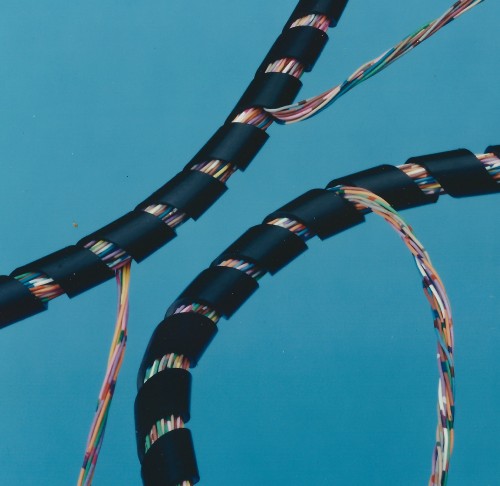
Spiral cable wrap is a flexible, tubular solution designed to bundle, organize, and protect wires, hoses, and cables from abrasion and damage. Here’s what makes it essential:
Quick Answer: Spiral Cable Wrap Key Benefits
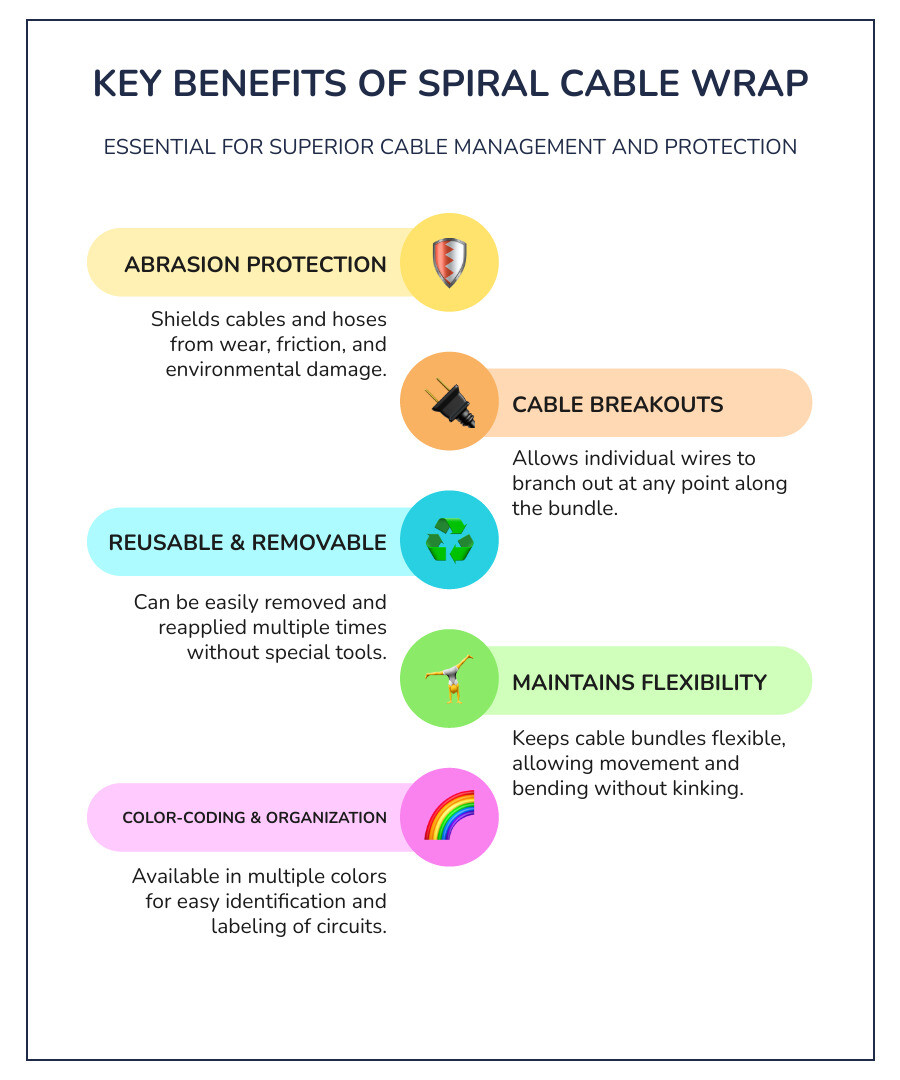
- Protection: Shields cables and hoses from abrasion, wear, and environmental damage.
- Organization: Bundles multiple cables together while maintaining flexibility.
- Flexibility: Allows cables to move and bend without kinking or restricting movement.
- Breakouts: Individual wires can branch out at any point along the bundle.
- Reusability: Can be removed and reapplied multiple times without tools or damage.
- Color-coding: Available in multiple colors for wire and cable labeling.
Tangled wires and damaged hoses don’t just look messy—they create real operational problems, from equipment downtime to safety hazards. Poor cable management can lead to snagged, worn, and damaged components in any setting, from server racks to construction equipment.
Unlike rigid conduits that trap cables or cable ties that can stress wiring, spiral cable wrap offers a unique solution. Its helical design wraps around a cable bundle like a spring, creating a protective barrier while allowing flexibility and easy access. You can pull individual wires out at any point, reroute bundles without complete disassembly, and adjust the wrap’s tightness for either more flexibility or maximum abrasion resistance.
The wrap is effective in diverse environments, from industrial floors with pneumatic tubes and hydraulic hoses to offices with computer cables. Different materials handle specific challenges: standard polyethylene for general use, PTFE for extreme temperatures, and specialized formulations for fire safety, chemical exposure, or UV resistance.
Whether protecting robotics wiring, organizing automation systems, or managing workspace cables, spiral cable wrap delivers adaptable protection. To learn more about how this versatile solution can benefit your operations, explore What is the Purpose of Spiral Cable Wrap?.
How to Select the Perfect Spiral Cable Wrap for Your Needs
Choosing the right spiral cable wrap requires evaluating your specific needs, environment, and the demands on your cables. The material, size, and installation method all play a role in ensuring optimal performance and protection. Think of it as finding the right armor for your wires.
This section will guide you through selecting the ideal spiral cable wrap by covering material composition, key features, sizing, and installation. For an in-depth look, consider these 3 Factors to Consider When Choosing Spiral Cable Wrap. You can also find helpful installation tips by watching this video: Cable Organiser Spiral Wrap Tubes Best Tips – YouTube.
Choosing the Right Material: From Polyethylene to PTFE
The material is a crucial decision, as it dictates resistance to temperature, chemicals, UV light, and abrasion. M.M. Newman Corporation, a world-leading supplier since 1956, offers Heli-Tube® spiral cable wrap in various high-quality materials. Understanding each material’s properties will help you make an informed choice. You can dig deeper into material selection with The Right Spiral Wrap Material for Your Application.
- Polyethylene (PE): A versatile choice for general-purpose applications.
- Standard Polyethylene: Ideal for indoor use, offering good abrasion protection and organization. Operates from -76°F (-60°C) to 190°F (88°C).
- Weatherable Black Polyethylene (UV Resistant): Best for outdoor environments exposed to sunlight, offering improved durability against UV degradation.
- Fire-Resistant Polyethylene: For fire safety concerns, this material boasts a UL 94 V-0 flammability rating (self-extinguishing). It operates best between -4°F (-20°C) and 176°F (80°C).
- Nylon: Known for its robustness, nylon offers high chemical, impact, and thermal resistance, plus superior abrasion resistance. Its self-extinguishing properties make it a sound choice for confined spaces. Nylon operates from -40°F (-40°C) to 250°F (121°C).
- Polytetrafluoroethylene (PTFE): For the most demanding conditions, PTFE stands out. It is non-flammable, chemically inert, and ideal for environments with toxic chemicals or extreme temperatures. PTFE withstands continuous temperatures up to 500°F (260°C) and operates down to -320°F (-200°C). This makes it suitable for critical applications in aerospace, medical, and high-temperature industrial processes. M.M. Newman Corporation offers PTFE Heli-Tube® spiral wrap, which you can explore further here: PTFE Heli Tube Spiral Wrap.
M.M. Newman Corporation ensures all their Heli-Tube® products are compliant with ISO 9001:2015, REACH, and RoHS standards.
Key Features and Sizing Your Spiral Cable Wrap
Beyond material, specific features and proper sizing are paramount. Spiral cable wrap offers unique advantages over other solutions.
One of its most praised features is the ability to allow for cable breakouts. The spiral structure lets individual wires branch out from the main bundle at any point. This is incredibly useful in complex setups like control panels or robotic systems, saving time and effort.
Another benefit is color-coding. M.M. Newman Corporation’s Heli-Tube® spiral cable wrap comes in various colors, allowing you to identify specific wire bundles or circuits. This visual organization improves maintenance, troubleshooting, and safety. For more tips, check out Wire and Cable Labeling Tips.
When it comes to sizing, you need to match the wrap to your cable bundle’s diameter. M.M. Newman Corporation’s Heli-Tube® is designed for bundles from 0.063 inches to 7 inches (1.6 mm to 177.8 mm). For larger bundles, Heavy Duty Spiral Cable Wrap Tubing is also available.
M.M. Newman Corporation also offers extensive customization for Heli-Tube® spiral cable wrap. You can specify color, diameter, length, material, packaging, pitch (spacing between spirals), and wall thickness. They even offer forward or reverse cuts to accommodate right- or left-handed bundling. These options ensure you get the exact solution for your application. More details on sizing can be found in Spiral Cable Wrap Sizes and Materials.
Installation Methods and Special Considerations
Installing spiral cable wrap is straightforward, and its reusability is a key advantage. For a helpful guide, refer to How to Use Spiral Wrapping Bands for Cable Management.
Manual wrapping is the most common method: simply start at one end and twist the wrap around the bundle. It can be removed just as easily by unwinding it, without needing tools or causing damage.
A critical aspect of installation is spacing, which controls the bundle’s properties:
- For greater flexibility: Install the wrap with gaps between the spirals. This allows the bundle more freedom to bend, which is crucial for applications with frequent movement.
- For maximum abrasion resistance: Install the wrap butted closely together with no gaps. This creates a denser, more protective layer, ideal for environments with constant rubbing or friction.
For demanding environments, remember to choose the right material:
- High Temperatures & Chemical Exposure: As discussed, PTFE is the top choice.
- Flame Retardancy: Use flame-retardant polyethylene (UL 94 V-0 rated) or nylon in areas with significant fire risk.
- UV Resistance: For outdoor applications, black UV-resistant polyethylene is essential to prevent degradation from sunlight.
The versatility of spiral cable wrap ensures that regardless of your environment, there’s a solution to provide robust, flexible, and reusable cable protection.
Applications, Comparisons, and Your Next Steps
Now that we’ve covered how to choose the right spiral cable wrap, let’s look at where this versatile solution shines. From robotics to construction, spiral cable wrap proves its worth across countless industries. We’ll also see how it stacks up against other cable management methods. For a broad overview, check out Industry Applications.
Top Applications for Spiral Cable Wrap
The practical applications of spiral cable wrap are as diverse as the industries it serves:
- Robotics and Automation: It protects wiring and pneumatic tubes from abrasion caused by the constant motion of robotic arms, while allowing for clean cable breakouts to sensors and components. M.M. Newman Corporation supports these advanced systems, contributing to Automation and Manufacturing: A Partnership in Technology.
- Hydraulic Hoses and Pneumatic Tubes: In industries like mining and construction, it acts as a robust shield against chafing, cuts, and punctures that could lead to costly downtime. PTFE wrap is particularly effective with high-pressure fluids and harsh chemicals. Learn more at Hydraulic Hose Protector: PTFE Spiral Wrap Prevents Chafing.
- Electrical Control Systems: It bundles large numbers of wires in complex electrical panels, preventing tangles and making it easier to trace individual circuits for maintenance.
- Computer Wires and Office Cable Management: From server racks to workstations, it tames cable clutter, prevents accidental disconnections, and creates an organized, professional appearance.
- Public Utilities: It provides an effective, long-lasting solution for protecting cables and wires from environmental factors in infrastructure management.
- Transportation: It organizes and protects wiring harnesses and brake cables in vehicles and on bicycles.
- Pest Prevention: The tough material can act as a deterrent, protecting critical wiring from being chewed by rodents or other pests.
How Spiral Wrap Compares to Other Cable Management Methods
Spiral cable wrap often emerges as a superior choice due to its unique combination of features. Here’s how it compares to common alternatives:
| Feature | Spiral Cable Wrap | Cable Ties | Conduits (Rigid Tubing) | Braided Sleeving |
|---|---|---|---|---|
| Flexibility | High (adjustable spacing allows custom flexibility) | Low (can cinch tightly, restricting movement) | Very Low (rigid, can kink, not flexible) | High (flexible, but uniform along bundle) |
| Reusability | Excellent (removable & re-applicable without tools) | None (single-use, must be cut) | Moderate (can be reused if not damaged) | Low (can be difficult to remove, may fray) |
| Installation Ease | Easy (manual wrapping) | Very Easy (quick to apply) | Moderate to Difficult (requires fittings, tools) | Moderate (can be tricky to feed cables through) |
| Cable Breakouts | Excellent (individual wires can exit anywhere) | None (all cables bundled together) | None (all cables contained within) | None (all cables contained within) |
| Abrasion Protection | High (adjustable tightness for max protection) | Low (offers no protection, can cause abrasion) | High (rigid physical barrier) | High (good all-around abrasion resistance) |
| Retrofitting | Excellent (can be applied to existing bundles) | Moderate (can add new ties, but not easily modify existing bundle) | Low (difficult to add cables to existing conduit) | Low (difficult to add cables to existing sleeving) |
Spiral cable wrap provides non-compressive protection, unlike cable ties that can stress sensitive wires. Its key advantage is dynamic flexibility; you can control the bundle’s turning radius by adjusting the gap width during installation. While conduits offer rigid protection, they are inflexible and can kink. Other tubing also lacks the breakout capabilities and adjustable flexibility of spiral wrap. This unique blend of features makes it a cornerstone of effective cable management, which is vital for preventing costly breakdowns. Learn more at Importance of Cable Management.
Find Your Ideal Cable Protection Solution
Choosing the right spiral cable wrap is a strategic decision that impacts the safety and efficiency of your systems. By understanding the materials, sizing, and installation techniques, you can give your cables the custom protection they deserve.
M.M. Newman Corporation, a trusted, world-leading supplier since 1956, is dedicated to providing superior Heli-Tube® spiral cable wrap solutions. Their versatile product range and just-in-time service ensure you get what you need, when you need it.
Don’t let unprotected cables lead to downtime. Safeguard your investments with the robust, flexible, and reusable protection of spiral cable wrap.
Ready to find the perfect spiral cable wrap for your application? Explore our full range of Heli-Tube® spiral wrap products and experience the difference that quality cable management can make.