

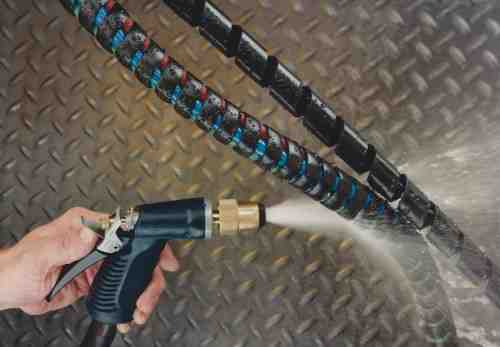
Protecting Cables and Hoses During Vacuum Infusion
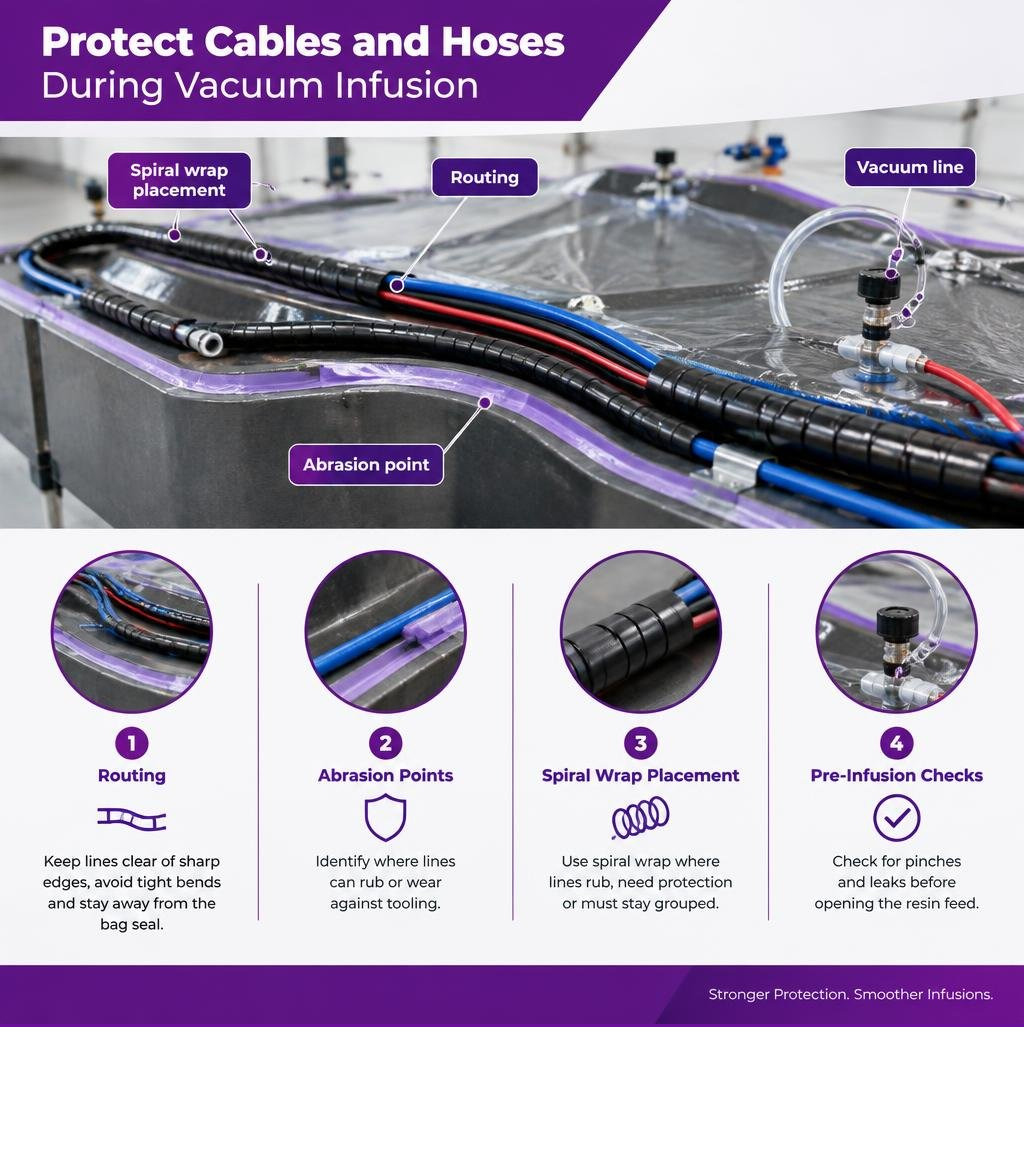
To protect cables and hoses during vacuum infusion, start by routing them. Keep lines clear of sharp mold edges, avoid bends tighter than the hose maker allows, and keep bundles away from the vacuum bag seal. Add correctly sized Heli-Tube® spiral wrap where lines rub against tooling or need to stay grouped. Then check for pinches and leaks before opening the resin feed. Effective cable protection vacuum infusion practices reduce unplanned downtime and extend the service life of vacuum lines, resin transfer hoses, and sensor leads.
This matters on a busy shop floor: one damaged line can interrupt an infusion. Spiral wrap helps manage wear and gives cables and hoses accessible breakout points, but it cannot seal a leak or make a kinked hose flow properly.
Solving Common Hose and Line Failures in Vacuum Infusion
In composite manufacturing facilities across the aerospace, marine, automated manufacturing, and public utilities sectors, vacuum-assisted resin infusion has become standard practice. First developed by Scott Bader in the UK in 1946, the process uses atmospheric pressure (a pressure differential of about 0.9 bar, from 1 bar ambient to roughly 0.1 bar under the bag) to draw liquid thermoset resin into dry fiber reinforcements. This closed-mold method consistently delivers low void content below 1–2% and fiber volume fractions of 50–60%, vastly outperforming traditional open-mold wet lay-up (which typically achieves only 35–45%) while drastically reducing volatile organic compound (VOC) emissions.

However, achieving high fiber-to-resin ratios and pristine laminates requires strict process control. A single vacuum breach, pinched transfer line, or kinked vacuum drop can ruin a high-value layup. Production managers running large industrial operations understand that physical line failures on the shop floor cause substantial unplanned downtime and high scrap rates. For comprehensive details on workplace line defense, reviewing a detailed guide to industrial cable protection helps contextualize broad physical hazards before examining mold-specific dynamics.
Preventing Vacuum Line Kinking and Flow Path Collapse
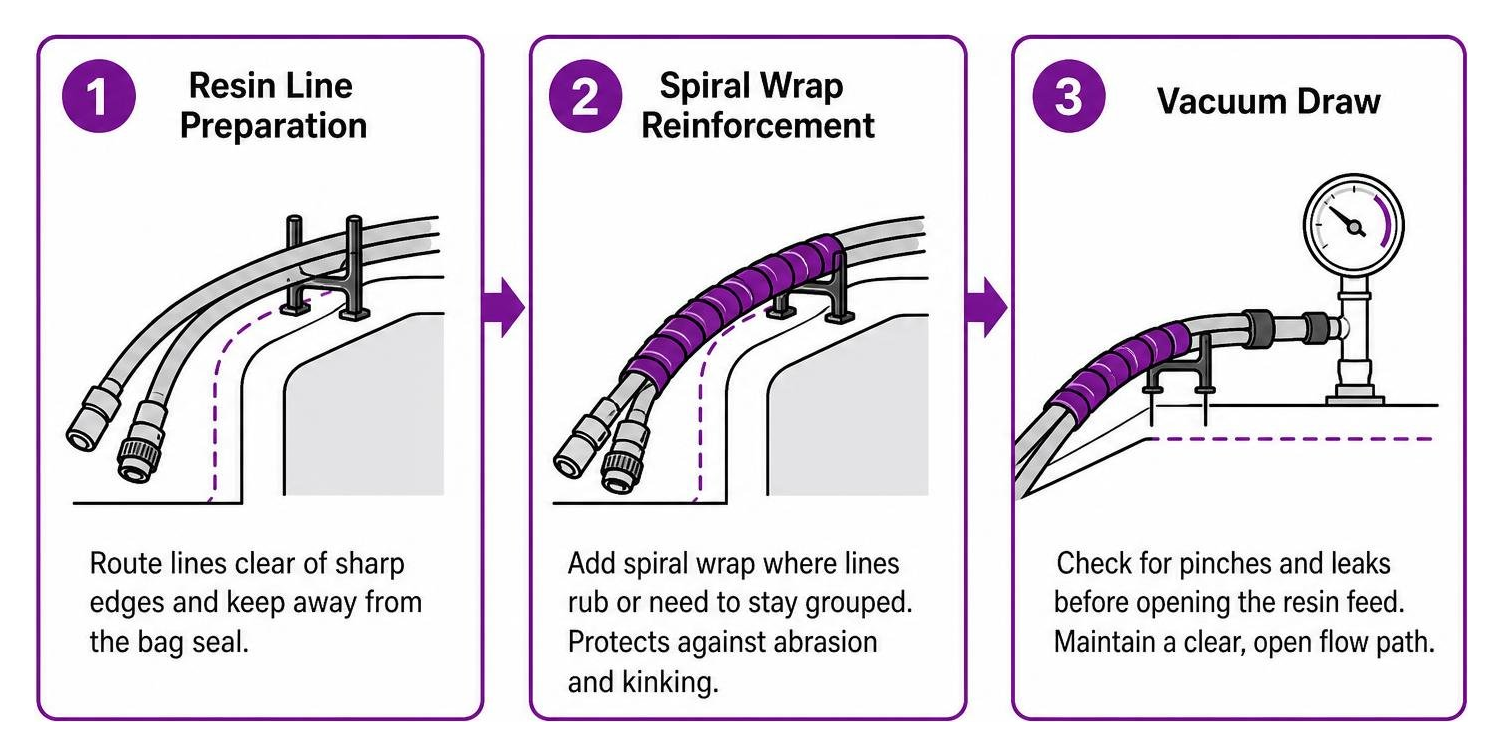
Maintaining uncompromised suction throughout the infusion sequence is critical to laminate consolidation. When vacuum bagging film is drawn tight, deep pleats and atmospheric compaction exert substantial mechanical load on lines bridging over mold flanges. If a thin-walled evacuation line drops below its minimum allowable bend radius, it can collapse locally. This constriction traps air pockets and disrupts the uniform pressure gradient dictated by Darcy’s Law, which governs fluid permeability through dry preforms.
Constricted vacuum paths frequently cause incomplete wetting, dry spots, and localized resin boiling or void formation. Advanced composite research shows how sensitive these closed-infusion dynamics are; for instance, studies evaluating Vacuum Chamber Infusion for Fiber-Reinforced Composites show how critical balanced differential pressure and uninterrupted evacuation channels are to keeping void content near zero (Grisin et al., 2024). Wrapping critical vacuum supply hoses in protective spiral wrap fortifies the outer hose wall against sharp crushing loads from bag bridges, preventing localized kinking without adding unnecessary bulk.
Protecting Lines Against Mold Flange Abrasion and Sharp Tooling Edges
Large composite molds—such as multi-piece tooling for wind turbine blades exceeding 80 meters or massive hull molds—feature wide perimeter flanges (often 10 to 12 inches wide) machined with sharp 90-degree outer corners. Throughout multi-hour infusion cycles and repeated setups, vacuum lines, pneumatic lines, and sensor leads continuously drag across these composite or metal edges.
Over dozens of production shifts, friction cuts into outer line walls, creating micro-leaks that ruin vacuum integrity. Composite technicians learning how to infuse a boat hull like a pro prioritize bundling and shielding vacuum drop lines across perimeter edges. Wrapping lines with durable Heli-Tube® spiral wrap creates a resilient sacrificial layer against tooling abrasion, extending line service life and protecting shop equipment across hundreds of infusion runs.
Advanced Cable Protection Vacuum Infusion Strategies on the Production Floor
Implementing targeted cable protection vacuum infusion strategies on active production floors bridges the gap between delicate control electronics and heavy industrial processing. Modern composite manufacturing relies on sophisticated sensor arrays, heated tooling leads, and automated meter-mix dispensing equipment.
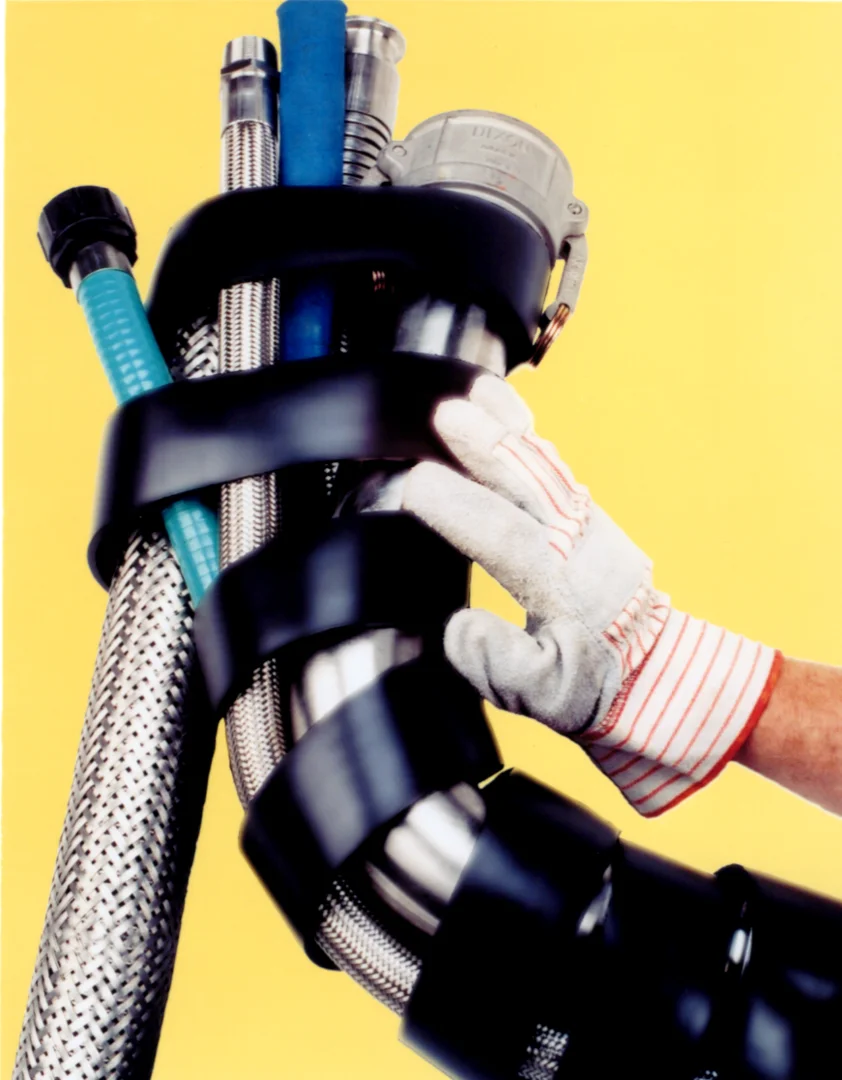
Understanding the vacuum infusion process explained for perfect parts means recognizing that every external utility line—from thermocouple sensor harnesses to catch-pot exhaust tubes—must remain organized, cleanly routed, and shielded from mechanical hazards.
Cable Protection Vacuum Infusion Methods for Resin Dispensing Equipment
Automated dispensing units, pneumatic injection heads, and high-precision meter-mix pumps utilize complex umbilical bundles that deliver polyester, vinyl ester, epoxy, or hybrid polyurethane-acrylic resins. These umbilicals combine high-pressure fluid lines, electrical power cables, grounding wires, and digital pressure transducer leads.
If resin drips directly onto bare electrical cables, aggressive reactive monomers (such as styrene in vinyl esters or amine hardeners in epoxies) can degrade synthetic jackets over time. Furthermore, dragging unbundled lines across shop floors causes premature outer sheath rupture. Integrating Heli-Tube® spiral wrap allows technicians to bundle hydraulic, pneumatic, and electrical conduits into single, well-organized harnesses. As detailed in the guide on unraveling protection and cable and hose wraps, consolidating messy utility lines protects equipment cables from shop floor abrasion while significantly reducing trip hazards around the mold.
Managing Multi-Line Bundles Across Large Composite Tooling
Complex, multi-port infusion setups rely on intricate manifolds feeding multiple resin supply lines and vacuum evacuation points. Managing dozens of individual plastic lines across a massive mold surface can quickly become tangled chaos, creating confusion when clamping lines sequentially as resin arrives.
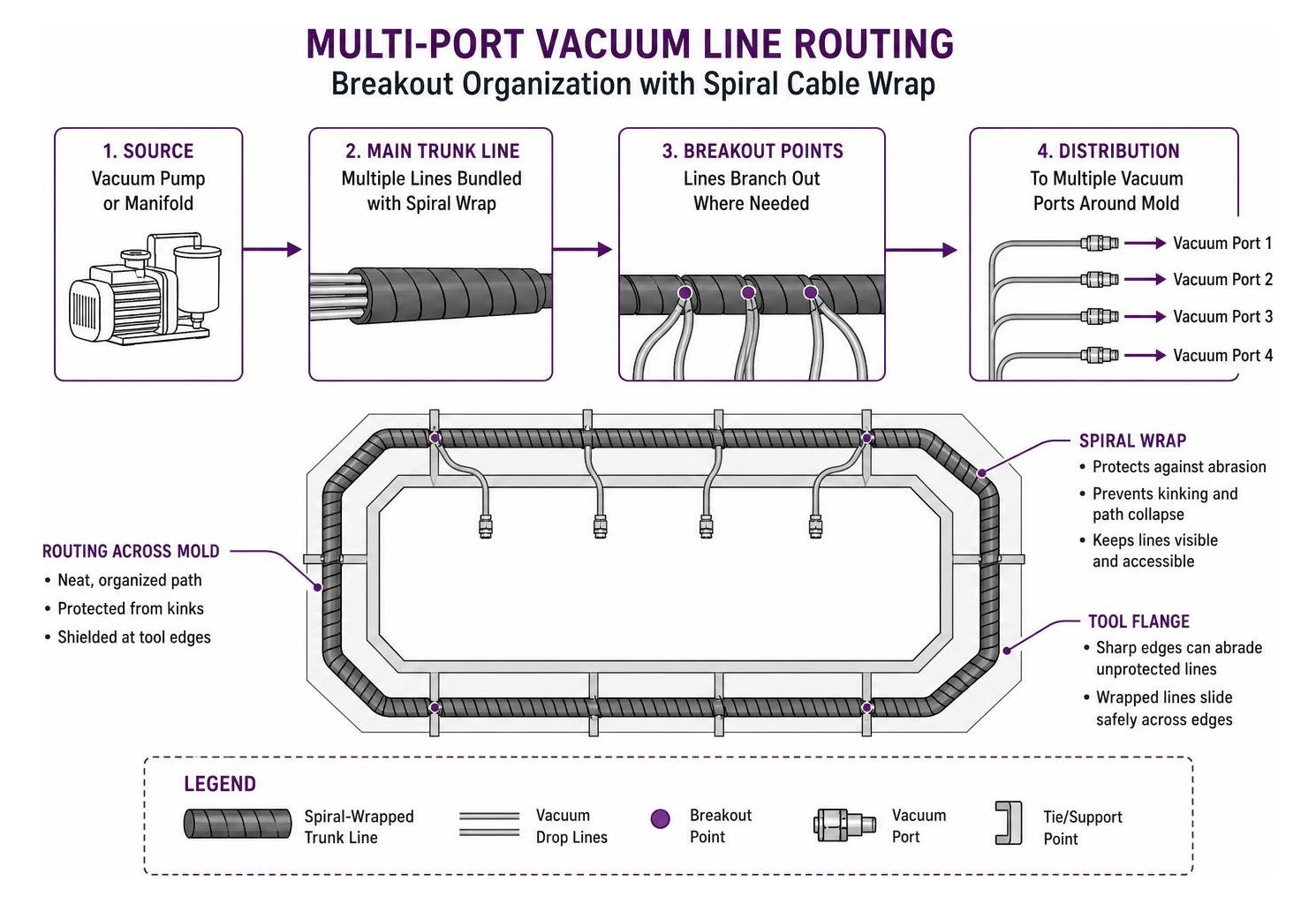
Spiral wrap lets manufacturing teams organize multi-line manifolds cleanly while using individual breakout points. Because spiral wrap features continuous spiral slots, individual vacuum or resin feed lines can cleanly branch out exactly where needed along the tool perimeter. This maintains neat shop routing while keeping critical lines visible. Furthermore, modern infusion technology, such as the synchronized continuous systems described in US Patent 11298895 for composite infusion devices, emphasizes stable flow control and tight process integration. Heli-Tube® is manufactured to strict quality standards, with ISO 9001:2015 certification (Certificate Reg. No. C2018-00027), full REACH and RoHS compliance, Made in the USA quality, and UL-recognized component status under category UZKX2 (file card E83405 (M)). It can be specified with forward or reverse cuts, custom pitch dimensions, and color-coded materials to streamline line identification during complex, high-stakes infusions.
Material Selection Guide for Infusion Environments
Selecting the proper spiral wrap material ensures maximum operational durability across varied thermal and chemical exposure profiles. Resin infusion creates diverse operating environments, ranging from ambient room-temperature boat hull cures to high-temperature aerospace autoclave or oven post-cures.
When selecting spiral wrap for industrial composite shops, engineers must evaluate specific operating limitations. Spiral wrap withstands harsh environmental conditions and mechanical abrasion; however, because it features open spiral gaps rather than a solid, continuous seal, it does not seal enclosed cables or wires against direct environmental immersion or chemical vapor exposure. Additionally, spiral wrap does not provide vibratory dampening.
| Material Type | Operating Temperature Range | Chemical & Solvent Resistance | Flammability & Standards | Primary Infusion Use Case |
|---|---|---|---|---|
| Standard Polyethylene | -76°F to 190°F (-60°C to 88°C) | Moderate; resists general shop oils, fuels, and washdown chemicals | Flammable | General shop floor line bundling, ambient infusion manifolds, perimeter hose organization |
| Fire-Resistant Polyethylene | -4°F to 176°F (-20°C to 80°C) | Moderate; resistant to general industrial solvents | Enhanced fire resistance; self-extinguishing characteristics | Enclosed control cabinets, robotic automated dispensing cells requiring fire retardancy |
| Nylon | -40°F to 250°F (-40°C to 121°C) | High; excellent abrasion resistance and solvent durability | Self-extinguishing | High-wear floor umbilical bundles, moderate-temperature mold heating lines |
| PTFE (Polytetrafluoroethylene) | -320°F to 500°F (-200°C to 260°C) | Exceptional; chemically inert to all commercial resins, hardeners, and solvents | Non-flammable (UL VW-1); meets ASTM-D3295 Group 4 | High-temperature prepreg/infusion tooling leads, heated cure cycles, direct resin splash zones |
Selecting Materials for Cable Protection Vacuum Infusion Setups
- Standard Polyethylene: Operating reliably from -76°F to 190°F (-60°C to 88°C), standard polyethylene spiral wrap provides an economical, durable solution for everyday shop-floor hose routing, vacuum drop lines, and ambient resin infusion lines.
- Fire-Resistant Polyethylene: Rated for continuous operation from -4°F to 176°F (-20°C to 80°C), this material provides specialized flame-retardant properties suitable for plant areas with strict fire-safety mandates.
- Nylon: Operating from -40°F to 250°F (-40°C to 121°C), standard nylon spiral wrap provides superior mechanical toughness and enhanced heat tolerance for demanding automated manufacturing and robotic dispenser arms.
- PTFE (Polytetrafluoroethylene): Engineered for extreme processing environments, PTFE wrap operates from -320°F to 500°F (-200°C to 260°C). It is chemically inert, non-flammable (UL VW-1), and fully meets ASTM-D3295 Group 4 standards. It is ideal for thermocouple harnesses on heated molds, heated debulking tables, and in aggressive resin-mixing zones.
Production Economics and Wrap Reusability Across Cycles
In production facilities manufacturing composite sandwich panels with foam or balsa cores, managing material overhead is critical to profitability. Grooved and perforated cores already increase resin consumption by roughly 25% to ensure full wet-out across structural skins. Adding single-use consumable waste further erodes margins.
Unlike single-use tapes or disposable sleeves that must be discarded after every run, durable spiral wrap can be removed, cleaned of external overspray, and reused across multiple production cycles. Its expanding spiral geometry allows rapid installation and tool-free removal during mold demolding. Process engineers mastering spiral tubing secrets for better vacuum infusion realize that durable, reusable spiral wrap substantially lowers annual consumable expenditures while improving shop organization.
Frequently Asked Questions About Vacuum Infusion Hose and Cable Management
How does Heli-Tube® prevent hose kinking during composite vacuum infusion?
Heli-Tube® spiral wrap wraps securely around the outer diameter of vacuum drop lines and resin tubing. By reinforcing the hose exterior, it helps maintain the manufacturer’s recommended minimum bend radius when lines route over sharp mold edges or sit beneath compacting vacuum bag pleats. This prevents localized line collapse, ensuring steady vacuum draw and smooth resin advancement without flow interruptions.
Can Heli-Tube® spiral wrap be reused across multiple resin infusion production cycles?
Yes. Heli-Tube® spiral wrap is manufactured from resilient thermoplastic polymers (including polyethylene, nylon, and PTFE) that retain their dimensional elasticity. After completing an infusion and demolding the part, technicians can quickly unwrap Heli-Tube® from utility lines and reinstall it on subsequent setups, lowering recurring consumable costs and reducing shop floor waste across high-volume production schedules.
Which Heli-Tube® spiral wrap material do you recommend for high-temperature resin curing?
For high-temperature resin systems, heated composite tooling, or elevated post-cure oven cycles up to 500°F (260°C), Heli-Tube® PTFE (Polytetrafluoroethylene) is recommended. PTFE spiral wrap operates continuously from -320°F to 500°F (-200°C to 260°C), meets ASTM-D3295 Group 4 specifications, is non-flammable (UL VW-1), and remains completely chemically inert against aggressive thermoset resins, hardeners, and release solvents.
Conclusion
Achieving consistent, void-free composite laminates requires rigorous attention to every physical variable on the production floor. By establishing disciplined line routing, protecting external vacuum and resin lines from sharp mold flanges, and preventing hose collapse, composite fabricators eliminate costly infusion interruptions, lower scrap rates, and maintain peak manufacturing efficiency.
M.M. Newman Corporation has been a trusted, world-leading supplier of cable management solutions since 1956. With extensive manufacturing expertise, versatile product configurations, and rapid, just-in-time delivery, M.M. Newman Corporation provides top-tier Heli-Tube® spiral wrap engineered to withstand demanding industrial, aerospace, marine, and robotic environments. To explore high-temperature fluid handling and specialized tubing solutions for advanced composite setups, review our extensive line of PTFE extruded tubing or contact an application specialist today to optimize your production workflow.
Scientific References
Grisin B, Carosella S, Middendorf P. “Vacuum Chamber Infusion for Fiber-Reinforced Composites..” Polymers, 2024. PMCID PMC11479195.