

Last updated on September 9th, 2025 at 04:47 pm
Wood burning, or pyrography, is an art form that allows you to create intricate designs on wood surfaces using heated tools. The key to achieving professional-quality results lies in understanding and utilizing the right wood burning tool tips. Whether you’re a beginner or an experienced artist, selecting the appropriate tip for your project is crucial.
At M.M. Newman Corporation, we provide a range of high-quality wood burning tools and accessories designed to meet the needs of artists and craftsmen alike. Our products are engineered for precision, durability, and ease of use, ensuring that your creative visions come to life seamlessly.
For best results, you will want quick heating tools with adjustable tips that can burn at variable temperatures. To get started with the exciting, creative and fun hobby of pyrography, here’s what you need to know:
What Do I Need to Start Wood Burning?
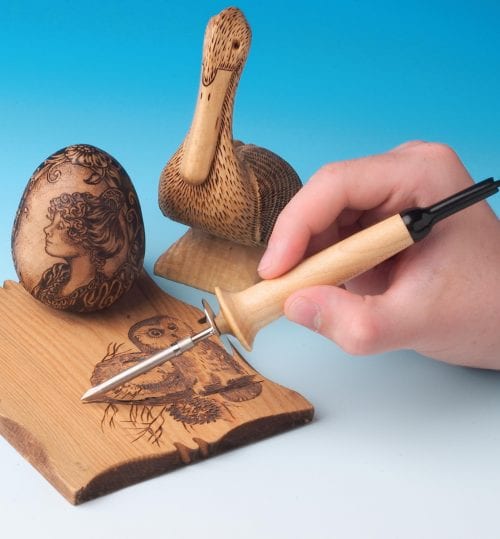
Pyrography is practiced with a woodburner, a heated metal pen with interchangeable tips that allow for different types of effects and brushstrokes to be burned into the medium. M.M. Newman Corporation introduced the Hot Tools Woodburner in 1978 and today it is regarded as the premier woodburner on the market. Our woodburner is a lightweight wood burning pen with a thin varnished wooden handle for easy grip and attention to detail. The woodburner reaches 800 °F within two minutes but stays cool in your hand because it is designed with the heating element directly under the tip.
Understanding Different Wood Burning Tool Tips
Each wood burning tool tip serves a specific purpose and can dramatically affect the outcome of your project. Here’s an overview of common tips and their best uses:
- Universal Point (Chisel Tip): Ideal for straight lines and shading. It’s versatile but may not be suitable for intricate details.
- Calligraphy Point: Perfect for creating elegant lettering and fine lines. Its design allows for varied stroke widths, making it a favorite among those who enjoy adding text to their designs.
- Flow Point: Offers smooth, consistent lines, making it great for outlining and detailing. It’s particularly useful for curved lines and soft shading.
- Mini Flow Point: A finer version of the flow point, this tip is excellent for detailed work and small-scale designs.
- Cone Point: Best for fine lines and dot work. Its sharp point allows for precision in detailed designs.
- Shading Point: Leaf-shaped and flat, this tip is designed for creating smooth gradients and shading effects. It’s versatile and can be used for both fine and broad shading.
- Tapered Point: Offers a sharp, pointed end for fine details and intricate designs. It’s suitable for detailed line work and small-scale designs.
Selecting the right tip depends on the specific requirements of your project. Experimenting with different tips can help you understand their unique effects and how they contribute to your overall design.
Hot Tools from M.M. Newman Corporation
Our Woodburner has 13 specialty tips available. The Standard Tip, which is included with the Woodburner, has an outside diameter of 3/16” and can be applied for drawing straight lines, burning in veins on feathers for decoys, curving lines, or lettering. Other specialty tips allow for further creativity. There are needle sharp pointed tips used for making fine lines, intricate details or even small eyes in animals and birds. The fine lines of M.M. Newman Corporation’s Multigroove Tips allow for burning veins and feathers of medium-sized songbirds or full-size ducks. For intricate details, sizes and lengths of tips can offer various temperatures based on their actual sizes. A full review of individual tips for our wood burner tool is available if you are looking for additional information.
Hobbyists and artists alike will benefit from M.M. Newman Corporation’s complete wood burning kit. The kit contains the Woodburner, 13 different specialty tips, the Hot Tools Stand which provides a handy resting place for any of our tools, and the Dial-Temp precision temperature controller that allows you to adjust your own tip temperature. The Dial-Temp features an easy-to-use dial on top to adjust tip temperatures from 150°F to full heat. The Dial-Temp controller plugs into any grounded 115 VAC outlet, and your tool plugs into the Dial- Temp.
Tips for Using Wood Burning Tools Effectively
To achieve the best results with your wood burning tools, consider the following tips:
- Adjust Temperature Settings: Different woods and techniques require varying temperatures. Adjust your tool’s temperature to suit the material and desired effect.
- Use Light Pressure: Applying too much pressure can cause uneven burns and damage the wood. Use light, consistent pressure for smooth, controlled lines.
- Maintain Tool Cleanliness: Regularly clean your tips to prevent buildup that can affect performance. Use a brass brush or a damp cloth to remove residue.
- Practice on Scrap Wood: Before starting your project, practice on a piece of scrap wood to familiarize yourself with the tool and tip.
- Work in a Well-Ventilated Area: Ensure proper ventilation to avoid inhaling fumes produced during the burning process.
- Allow Tips to Cool Before Changing: Always let your tips cool before switching them out to prevent burns and ensure safety.
Ready to Elevate Your Pyrography Skills?
Understanding and utilizing the right wood burning tool tips can significantly enhance your pyrography projects. At M.M. Newman Corporation, we’re committed to providing high-quality tools and accessories to support your creative endeavors. Explore our range of wood burning products and take your artistry to the next level.
Have questions about our Hot Tools products? Contact us at M.M. Newman Corporation to speak with our experienced team today.
Frequently Asked Questions
What is the best wood for wood burning?
Light-colored hardwoods like birch, maple, and basswood are ideal for wood burning. They provide a smooth surface and show burn marks clearly.
How do I prevent my wood burning tips from overheating?
Use an adjustable temperature wood burner and allow the tips to cool between uses. Regularly clean the tips to maintain optimal performance.
Can I use wood burning techniques on materials other than wood?
Yes, wood burning can be applied to materials like leather and gourds. Ensure that the material is suitable for pyrography and adjust the temperature accordingly.
Are there safety precautions I should take when wood burning?
Always work in a well-ventilated area, wear protective gear, and keep flammable materials away from your workspace. Follow the manufacturer’s instructions for your wood burning tools.