

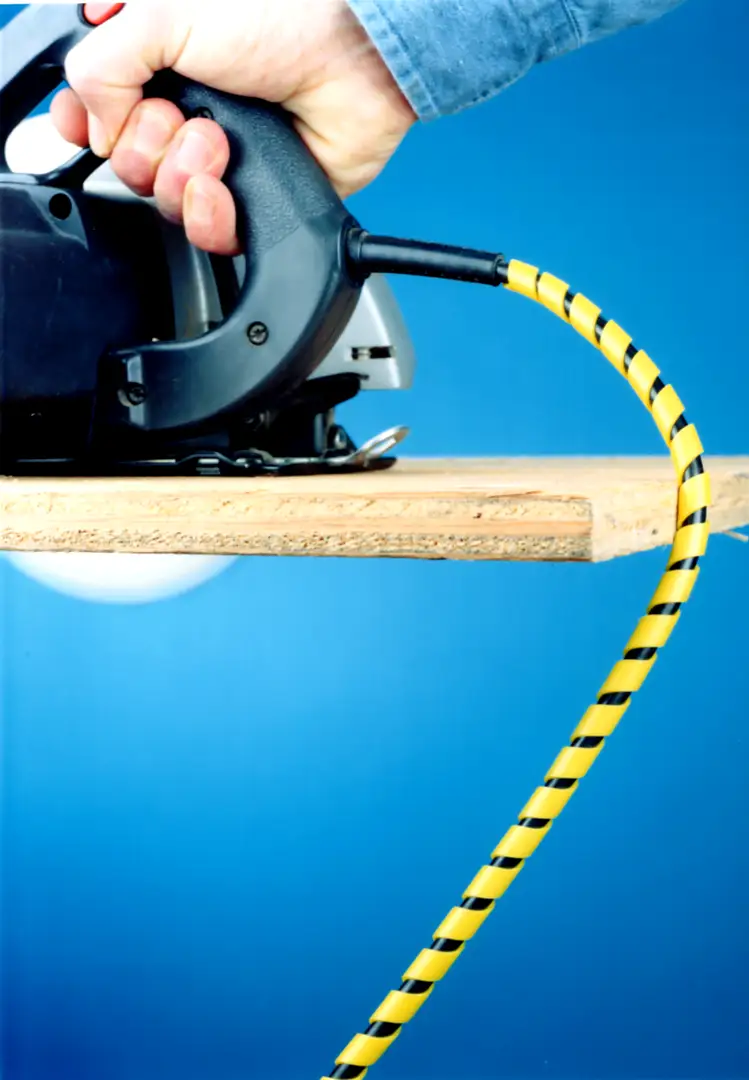
Cable management techniques are the methods used to organize, route, protect, and secure cables, hoses, and pneumatic tubing in a system — preventing damage, reducing downtime, and extending equipment life.
For industrial, marine, and boat manufacturing environments, the most effective techniques include:
- Wrapping bundles with spiral cable wrap (like Heli-Tube®) to protect against abrasion and allow wire breakouts at any point
- Routing cables away from sharp edges and high-traffic areas to prevent wear and mechanical stress
- Using color-coded identification for rapid troubleshooting of complex wiring harnesses
- Selecting materials matched to the environment — such as options chosen for chemical resistance or fire safety
- Documenting cable runs and labeling every segment to simplify maintenance and reduce service time
If you manage cables in a factory, shipyard, or boat manufacturing line, you already know what unprotected wiring costs you. Frayed insulation, a severed control line, or a failed sensor connection can halt an entire production line in minutes.
Studies consistently link disorganized and unprotected cabling to increased downtime, safety hazards, and costly repairs — problems that hit industrial operations harder than anywhere else.
The good news: the right cable management approach doesn’t just tidy things up. It actively protects critical infrastructure, helps your systems comply with standards like ISO 9001:2015, REACH, and RoHS, and keeps your equipment running longer between service intervals.
This guide walks you through practical, industrial-grade techniques — from material selection to installation — so you can reduce risk and get more life out of every cable, hose, and pneumatic tube in your facility.
The Industrial Importance of Cable Management Techniques
In a high-stakes industrial environment, cable management is far more than an aesthetic choice. It is a fundamental engineering requirement. Whether it is a robotic arm in a manufacturing plant or a complex wiring harness in an aircraft, the way cables are handled directly impacts the bottom line.
Studies have shown that disorganized environments can increase stress and impact productivity. In an industrial context, this “clutter” translates to “cable spaghetti,” which obscures access to critical components and makes routine maintenance a nightmare. When a technician cannot identify a faulty line quickly, every minute spent searching is a minute of lost revenue.
The importance of cable management extends to equipment maintenance and signal integrity. Without proper support and protection, cables are subject to mechanical stress, environmental degradation, and electromagnetic interference. Implementing robust cable management techniques ensures that data flows without interruption and power reaches its destination safely.
Enhancing Reliability with Cable Management Techniques
Reliability in a network or electrical system depends on the physical health of the medium. In fiber optic or high-speed data applications, improper handling can lead to micro-bending. These tiny kinks in the cable cause signal attenuation, leading to intermittent connectivity or total data loss.
Industrial uptime is often threatened by “death by a thousand cuts”—quite literally. Vibration from heavy machinery can cause unprotected cables to rub against metal frames or other wires. Over time, this friction wears through the insulation, leading to short circuits. By using protective sleeving and organized routing, these hazards are mitigated.
Common industrial hazards include:
- Chemical exposure that dissolves standard plastic insulation.
- Heat from nearby furnaces or engines that causes melting.
- Mechanical pinching in moving parts like gantry cranes or robotic joints.
- Accumulation of dust and debris that can lead to overheating.
Safety Protocols for Industrial Cable Management Techniques
Safety is the highest priority in any industrial facility. Unmanaged cables on a shop floor are more than just an eyesore; they are significant tripping hazards. Beyond physical trips, electrical fires are a real threat when cables are allowed to tangle and overheat. Dense “nests” of wires trap heat, which can lead to insulation failure and combustion.
Adhering to life safety codes and international standards is essential. M.M. Newman Corporation maintains ISO 9001:2015 compliance, ensuring that their Heli-Tube® spiral cable wrap meets the rigorous quality management standards required by global industries. Furthermore, ensuring products are REACH and RoHS compliant means they are free from hazardous substances, protecting both the environment and the workers who handle them.
Essential Cable Management Techniques for Industrial Environments
When dealing with complex machinery, traditional methods like plastic zip ties often fall short. They can be too restrictive, causing “cold flow” or indentation in cable insulation, and they do not provide any protection against external abrasion. This is where advanced cable management techniques, such as the use of Heli-Tube® spiral cable wrap, become indispensable.
Heli-Tube® is designed to bundle cables while providing a durable barrier against the environment. Unlike rigid conduit, it remains suitable for applications involving repetitive motion, such as machine axes and automated assembly lines. It also provides a critical layer of protection for pneumatic tubing and hydraulic hoses, which are often susceptible to punctures and wear in harsh settings. Learning how to organize cables and wires effectively involves understanding where the system is most vulnerable and applying protection accordingly.
Protecting Critical Infrastructure with Advanced Cable Management Techniques
Critical infrastructure in sectors like industrial automation and marine manufacturing requires a level of protection that standard consumer-grade products cannot provide. On production equipment and onboard vessels, space is limited and routes can include tight corners, exposed edges, and service access points. Protective wrap must hold up to abrasion, splashes, and frequent maintenance while keeping bundles easy to inspect.
In automated manufacturing, the focus is often on the longevity of the harness. A machine might perform thousands of cycles a day. Without protective wrap to shield control lines, repeated contact points can fray wires over time.
| Feature | Heli-Tube® Spiral Wrap | Standard Plastic Ties |
|---|---|---|
| Abrasion Protection | Excellent (Full Coverage) | None |
| Breakout Flexibility | High (Any point) | Low (Only at ends) |
| Reusability | Yes | No |
| Cable Stress | Low (Even distribution) | High (Point-load stress) |
| Application | Rapid (No tools) | Requires cutting tools |
Managing Individual Wire Breakouts in Complex Systems
One of the most significant advantages of the spiral design is the ability to facilitate wire breakouts. In complex electrical control systems, a main bundle may need to travel across a machine, but individual wires must break out to reach specific sensors, motors, or switches along the way.
With Heli-Tube® spiral cable wrap, a technician can simply lead a wire through any opening in the spiral. This eliminates the need to cut the wrap or use multiple connectors, maintaining the integrity of the main bundle while allowing for precision routing. This is especially useful in industrial machinery, marine control panels, and boat builds where clean routing and serviceability matter.
Specialized Materials for High-Performance Protection
Not all industrial environments are created equal. A food processing plant has different requirements than an engine room, a shipyard, or a boat manufacturing facility. Selecting the right material is a core component of effective cable management techniques.
M.M. Newman Corporation offers Heli-Tube® in a variety of high-performance materials. Understanding the environment is the first step in finding the right spiral wrap material. For example, Polyethylene is a cost-effective choice for general-purpose applications, but for more demanding scenarios, specialized polymers are required.
Material Selection for Harsh Environments
For environments where fire safety is a primary concern, such as in public utilities, engine compartments, or confined marine spaces, Nylon is a preferred choice. It is self-extinguishing and is also highly resistant to abrasion with a high melting point.
In outdoor applications or marine environments, UV resistance is critical. Standard plastics can become brittle and crack when exposed to prolonged sunlight. UV-resistant materials help the protective wrap remain intact even in constant solar exposure.
Material Specifications at a Glance:
- Polyethylene: Durable, cost-effective, and highly versatile for general industrial use.
- Nylon: Self-extinguishing, abrasion-resistant, and ideal for confined spaces.
- Fire-Resistant Polyethylene: Offers a balance of economy and safety for flame-sensitive areas.
- UV-Resistant Materials: Specifically formulated to prevent degradation from sunlight in outdoor or marine settings.
Step-by-Step: Implementing an Industrial Cable Management Project
A successful cable management project begins long before the first wrap is applied. It requires a systematic approach to ensure that the system is not only organized but also easy to maintain for years to come.
The first step is a thorough inventory assessment. Identify every cable, hose, and tube in the system. Determine the routing path, taking note of any moving parts, heat sources, or sharp edges. Once the plan is in place, the installation can begin. For those new to the process, reviewing cable management 101 can provide a solid foundation.
Planning and Labeling for Rapid Troubleshooting
In a complex system, a wire that isn’t labeled is a mystery waiting to cause trouble. Effective cable management techniques always include a robust labeling system. Using an alphanumeric code that corresponds to a master wiring diagram is the most reliable method.
Color-coded identification is another powerful tool. By using different colors of Heli-Tube® or colored markers, technicians can identify the function of a bundle at a glance. For example:
- Red: High-voltage power lines.
- Blue: Data and communication lines.
- Yellow: Safety and emergency stop circuits.
- Orange: Sensor and feedback loops.
Implementing these wire and cable labeling tips ensures that when a fault occurs, the technician can bypass the search phase and go straight to the repair phase, significantly reducing downtime.
Securing and Protecting the Bundle
When applying Heli-Tube® spiral cable wrap, start at one end of the bundle and wrap in a circular motion. The wrap should be snug. As you progress, ensure that any necessary breakouts are guided out of the spiral at the correct locations.
Pay close attention to bend radius control. Every cable has a minimum radius it can be bent without sustaining damage. If a bundle is forced into a sharp turn, the internal conductors can stretch or break. Heli-Tube® helps maintain a consistent bend radius by providing structural support to the bundle.
Finally, manage any excess slack. Excess cable should be coiled neatly and secured in a location where it won’t interfere with moving parts. Industrial durability is the goal—every connection should be secure, every bundle protected, and every route clearly defined.
Frequently Asked Questions about Cable Management Techniques
How does Heli-Tube® spiral wrap improve industrial safety?
Heli-Tube® improves safety by eliminating tripping hazards, preventing electrical shorts through abrasion resistance, and reducing the risk of fire. By organizing cables into neat, protected bundles, it also prevents “cable spaghetti” which can lead to overheating. Materials like Nylon or fire-resistant Polyethylene add an extra layer of protection by being self-extinguishing.
What are the benefits of PTFE in cable protection?
PTFE (Polytetrafluoroethylene) is used for the most demanding environments. Its primary benefits are its extreme temperature resistance (from -320°F to 500°F) and its near-total immunity to chemicals and solvents. It is non-flammable and provides excellent electrical insulation, making it ideal for aerospace, public utilities, and chemical processing.
Can Heli-Tube® spiral wrap be used for hydraulic hoses?
Yes, it is an excellent solution for hydraulic and pneumatic hoses. In industrial and marine settings, these hoses are often subjected to friction against other hoses or machine parts. Heli-Tube® acts as a sacrificial wear layer, taking the brunt of the abrasion and extending the life of the expensive hoses underneath.
Conclusion
Mastering cable management techniques is an investment in the longevity and safety of your industrial operations. By moving beyond simple neatness and focusing on protection, performance, and material selection, you can transform a vulnerable system into a more robust, serviceable asset.
M.M. Newman Corporation has been the world-leading supplier of Heli-Tube® spiral cable wrap since 1956. Their commitment to quality, extensive experience, and versatile product range makes them a trusted partner for industrial workplaces as well as marine and boat manufacturing applications—protecting cables, hoses, and pneumatic tubes where abrasion and service access are daily realities.
To explore the full range of protection solutions, check out Heli-Tube® spiral wrap products and find the perfect material for your specific application.