

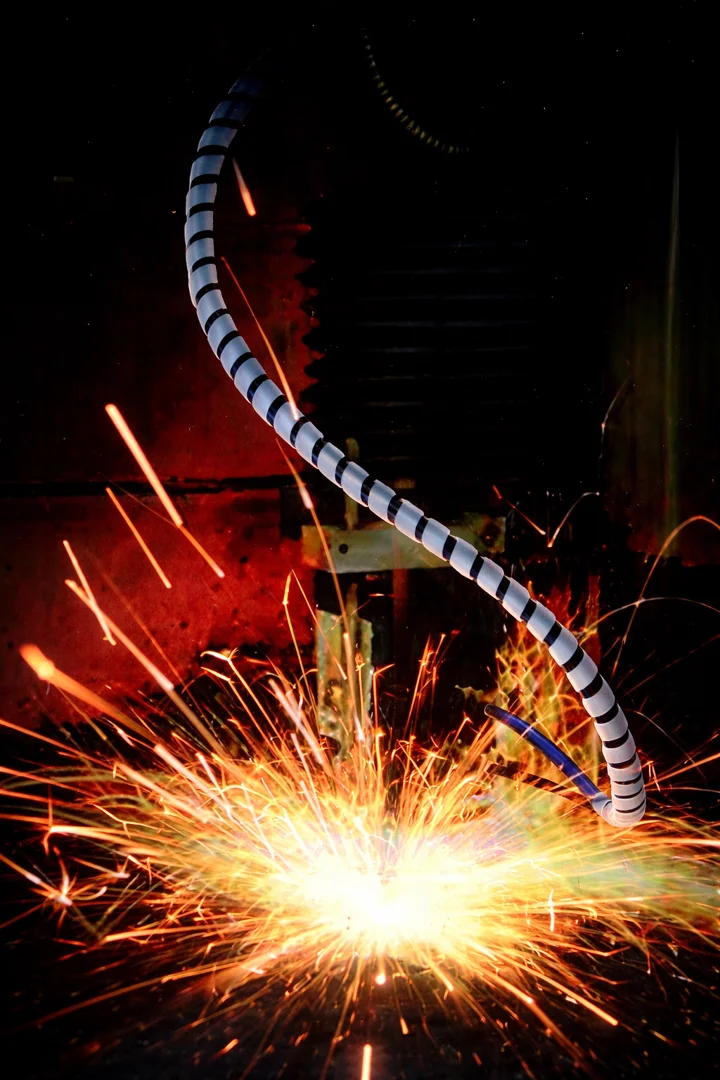
Protecting Robot Arm Cables from Flex Wear and Abrasion with Heli-Tube® Spiral Wrap
Industrial robots run hundreds of thousands of motion cycles per year. Each cycle flexes the cables along the arm, stresses connectors at the base and tool flange, and generates friction between adjacent conductors in unprotected bundles. That accumulated mechanical stress is one of the most common causes of unplanned downtime in robotic production cells, and cable degradation often starts long before an external failure becomes visible.
Heli-Tube® spiral cable wrap is used in industrial robot cable management to protect and organize cables and hoses running along robot arms, through cable carrier systems, and into control connections, reducing flex wear and abrasion that cause premature cable failure in high-cycle automated systems.
How Robot Cables Fail
Robot cable failure is primarily a fatigue issue, not a one-time impact or abrasion event. Cables on a six-axis robot flex repeatedly at the same locations through every motion cycle: the base rotation point, the upper arm joint, the wrist transition, and the tool flange connection. Without organization and protection, cables grind against each other and against the robot housing through each cycle, wearing through insulation and fatiguing conductors over time.
Unprotected cable bundles also shift position during rapid motion sequences, pulling at connectors and creating stress concentrations at termination points. By the time a cable shows external signs of jacket damage, the conductors inside may already be partially fatigued. The economic case for proactive protection is straightforward: cable replacement in a robotic cell means a production stoppage, not just a maintenance event. See also: why your automation cable protection strategy may be overdue.
Where Heli-Tube® Is Applied on Industrial Robots
Robot Arm Cable Runs
Heli-Tube® wraps the cable bundle running along the arm, holding it together as an organized assembly through each motion cycle. The spiral construction maintains bundle integrity while remaining flexible enough to flex with the arm through its full range of motion without restricting movement or adding significant stiffness to the assembly.
Cable Carrier Entry and Exit Points
Cable carrier entry and exit points are high-stress transitions where cables move from the organized carrier environment to the robot arm. Heli-Tube® is applied at these transitions to protect cables at the contact points that experience the highest flex frequency during robot operation.
Base and Cabinet Cable Management
Cable runs from the robot base to the control cabinet require protection and organization along floor routing paths where cables contact structural surfaces and face foot traffic. Heli-Tube® bundles and protects these runs while supporting maintenance access during robot servicing and reconfiguration.
Welding Cell Applications
In robotic welding cells, cables routed near the weld zone face spatter exposure and elevated ambient temperatures. PTFE Heli-Tube® is chemically inert and covers a broad operating temperature range, making it suitable for cable management in welding environments where polyethylene or nylon would be insufficient. This is a particularly common application in automotive composite and manufacturing environments where robotic welding cells operate alongside composite production systems.
Material Selection for Robotic Applications
Nylon is the primary material choice for robot arm cable management because of its higher abrasion resistance and higher-temperature capability than polyethylene. High-cycle robot arms generate significant mechanical contact within the cable bundle, and nylon’s surface hardness reduces wear between adjacent cables and at contact points with the robot structure.
PTFE is specified for welding cells, chemical process environments, and applications where cables are exposed to process fluids, elevated temperatures, or aggressive cleaning agents near the robot work envelope.
Polyethylene suits lower-cycle automation applications, cabinet-to-robot cable runs, and environments where abrasion demands and temperature exposure are within standard operating ranges.
Installation Guidance
Heli-Tube® installs directly onto the cable bundle without removing connectors or end hardware, so you can apply it during robot maintenance windows without fully disassembling the cable. When applying Heli-Tube® to robot arm cables, avoid wrapping too tightly: the spiral should allow the bundle to flex through the robot’s full range of motion without binding. You can make breakouts for sensor cables, pneumatic lines, and tool connections at any point along the wrap without cutting or removing the wrap from the full run.
Heli-Tube® can also be removed and reapplied during scheduled maintenance intervals, supporting reuse of cable protection throughout the robotic system’s service life. For more on abrasion protection in automated environments, see the MM Newman application page.
FAQs
What cable wrap is used for industrial robot cable management?
Heli-Tube® spiral cable wrap is used in industrial robot cable management to protect and organize cables running along robot arms, through cable carrier entry points, and from the robot base to control connections. Nylon Heli-Tube® is the primary choice for robot arm applications because of its higher abrasion resistance and elevated-temperature capability in high-cycle automated systems.
Does Heli-Tube® restrict a robot’s range of motion?
Heli-Tube® spiral cable wrap is flexible by design and wraps over the cable bundle without adding rigid structure to the assembly. When applied with the appropriate pitch and without over-tightening, Heli-Tube® lets the bundled cables flex through the robot’s full range of motion without restricting movement.
Can Heli-Tube® be used in robotic welding cells?
Yes. PTFE Heli-Tube® is used in robotic welding environments where cables are exposed to weld spatter, elevated ambient temperatures, and aggressive cleaning agents. PTFE is chemically inert and covers a broad operating temperature range that exceeds the limits of polyethylene and nylon options in high-heat welding cell environments.
Can Heli-Tube® be installed on existing robot cable assemblies without disassembly?
Yes. Heli-Tube® wraps onto existing cable assemblies from the side without removing connectors, terminals, or end hardware. You can apply it during scheduled maintenance windows without robot cable disassembly, then remove and reapply it during future maintenance events.
Protecting Robot Cables with Heli-Tube® Spiral Wrap
Cable failure in a robotic production cell stops production. Heli-Tube® spiral cable wrap reduces the flex wear, inter-cable abrasion, and mechanical stress that cause robot cables to fail prematurely, supporting longer cable service life and fewer unplanned downtime events across high-cycle automated systems. From six-axis arm management to welding cell applications and cable carrier protection, Heli-Tube® is a practical, reusable solution for industrial robot cable management. Contact M.M. Newman Corporation to identify the right size and material for your robotic application.