

Last updated on June 9th, 2026 at 10:09 am
Mastering Vacuum Infusion for High-Performance Composites
Achieving strong, lightweight, and precise composite parts often relies on mastery of vacuum-bagging resin infusion. This advanced manufacturing technique uses vacuum pressure to draw resin evenly through dry fiber reinforcements. It’s a closed-mold method that produces superior-quality components.
If you’re looking to understand and apply this method, here’s a quick overview of why it’s so valuable:
- Superior quality: Vacuum infusion creates composites with optimal fiber-to-resin ratios, resulting in lighter, stronger parts with significantly fewer voids than traditional methods.
- Consistent results: The controlled process ensures uniform resin saturation throughout the laminate, resulting in highly reliable, repeatable part quality.
- Material efficiency: By precisely controlling resin consumption, it reduces waste and optimizes material usage.
- Improved working conditions: As a closed system, it minimizes exposure to resin emissions, contributing to a safer workspace.
- Ideal for demanding applications: This process is critical for Aerospace, Robotics, Public Utilities, and Automated Manufacturing, ensuring technical precision and reduced downtime.
This guide will walk you through every step to help you master this technique for your projects.
Understanding Vacuum Bagging Resin Infusion Fundamentals
At its core, vacuum bagging resin infusion—often referred to as Vacuum Assisted Resin Transfer Molding (VARTM)—is a sophisticated closed-molding process. Unlike traditional methods where resin is applied by hand, this technique uses atmospheric pressure to drive resin into a dry laminate stack.
The physics behind this is governed by D’Arcy’s Law, which describes the flow of a fluid through a porous medium. In our case, the “fluid” is the resin, and the “porous medium” is your stack of carbon fiber or fiberglass. By creating a high-vacuum environment (often aiming for 99.9% vacuum), the pressure differential between the atmospheric pressure outside the bag and the vacuum inside forces the resin to migrate through the fibers.
| Feature | Hand Lay-Up | Standard Vacuum Bagging | Resin Infusion |
|---|---|---|---|
| Resin Application | Manual (Brush/Roller) | Manual (Before Bagging) | Vacuum Drawn (After Bagging) |
| Fiber-to-Resin Ratio | ~30/70 (Resin Heavy) | ~50/50 | ~60/40 (Fiber Heavy) |
| Void Content | High | Moderate | Very Low |
| Operator Emission Exposure | High | High | Minimal (Closed System) |
| Consistency | Low | Moderate | High |
Distinguishing Infusion from Traditional Methods
The most fundamental difference is the “dry layup.” In standard vacuum bagging, the technician first wets out the fabric with resin, then applies the vacuum to consolidate the layers and squeeze out excess resin. In vacuum bagging resin infusion, the fabric is placed into the mold completely dry.
This allows for much longer setup times without the “ticking clock” of resin curing. Because the resin is introduced only after the bag is sealed and a full vacuum is verified, the risk of air entrapment is drastically reduced. Furthermore, the resin used in this process typically has a much lower viscosity, allowing it to travel through the tight weaves of high-performance fabrics more efficiently.
Core Benefits for Industrial Manufacturing
For industries like Aerospace and Robotics, the benefits are quantifiable. One of the most significant advantages is the ability to achieve a 60/40 fiber-to-resin ratio. This means the final part is 60% reinforcing fiber and only 40% resin by weight. This is the “sweet spot” for strength-to-weight performance.
Beyond part quality, the process is an environmental win. Because it is a closed system, Volatile Organic Compounds (VOCs) and styrene emissions are minimized, improving the safety of the industrial workplace. For the equipment itself, the precise nature of the infusion reduces the mess associated with wet layups, thereby enhancing equipment lifespan and reducing maintenance downtime.
Essential Materials for a High-Performance Infusion Stack
To execute a successful vacuum-bagging resin infusion, one needs a specific “stack” of materials. Each layer serves a critical purpose in ensuring the resin flows where it is supposed to and stops where it shouldn’t.
- Vacuum Pump: A high-quality, oil-sealed rotary vane pump is preferred, capable of reaching near-perfect vacuum (up to 99.98%).
- Catch Pot (Resin Trap): A safety chamber positioned between the mold and the pump. It catches any excess resin before it can reach and destroy your vacuum pump.
- Bagging Film: A high-stretch, heat-stabilized nylon film that can withstand the pressure and temperatures of the cure cycle.
- Sealant Tape: Often called “tacky tape” or mastic, this creates the airtight seal between the bagging film and the mold flange.
- Peel Ply: A treated fabric that sits directly on the laminate. Once the part is cured, it is peeled off, leaving a clean, textured surface ready for secondary bonding or painting.
- Flow Media: A plastic mesh that provides a “highway” for the resin to travel across the surface of the laminate before soaking downward.
Optimizing the Vacuum Bagging Resin Infusion Setup
The “plumbing” of your infusion is where many projects succeed or fail. This is where M.M. Newman Corporation’s Heli-Tube® spiral cable wrap serves as an important manufactured component in resin distribution channels and vacuum manifolds.
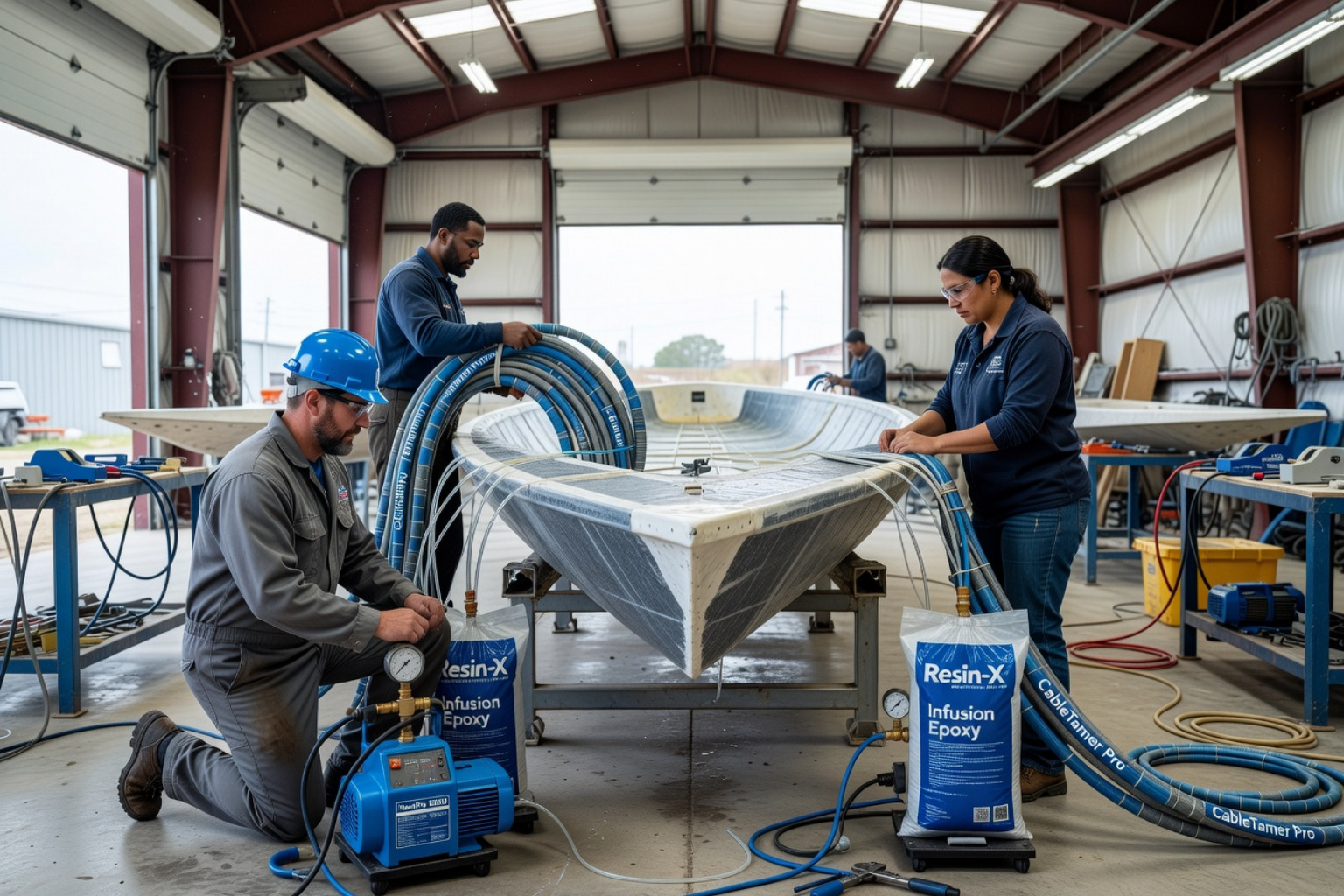
Because Heli-Tube® spiral cable wrap is spirally cut, it allows resin to flow freely from the line into the flow media along its length. That spiral design also permits breakouts for individual wires, cables, hoses, and pneumatic tubes in any orientation in industrial workplaces outside the mold environment, making it valuable across Aerospace, Robotics, Public Utilities, Automated Manufacturing, marine, and boat manufacturing applications.
M.M. Newman Corporation manufactures Heli-Tube® spiral cable wrap in PTFE, Nylon, and Polyethylene, along with a wide variety of sizes suited to temperature, abrasion, and chemical exposure requirements. Color-coded Heli-Tube® spiral cable wrap supports identification for resin feed lines versus vacuum lines in complex setups and also helps label bundled hoses and cables on equipment for faster maintenance, reduced downtime, and improved equipment lifespan. Forward-cut and reverse-cut configurations are available, and certificates of conformance and certifications to applicable military specifications can be provided. Heli-Tube® spiral cable wrap is made in the USA and supported by ISO 9001:2015 certification, with REACH and RoHS compliance. It is also a UL-recognized component listed under category UZKX2.
M.M. Newman Corporation also manufactures a distinct hot knife product for cutting materials such as awnings and sailcloth. This 60 Watt, 900°F hot knife is separate from Heli-Tube® spiral cable wrap and is not part of the infusion manifold function.
Selecting the Right Resin and Reinforcements
Not all resins are suitable for infusion. You need a system with low viscosity—think the consistency of thin vegetable oil rather than honey. Epoxy is the gold standard for high-performance parts due to its mechanical properties, though vinyl ester is often used in marine applications for its water resistance.
When it comes to reinforcements, carbon fiber and fiberglass are the most common. However, the weave matters. Stitched fabrics (such as biaxial or triaxial) are often preferred over traditional woven fabrics because they have fewer “crimps,” allowing the resin to flow more easily through the layers.
Step-by-Step Guide to the Infusion Process
Preparing the Mold and Dry Layup
Success begins with the mold surface. It must be polished and treated with a high-quality release agent to ensure the finished part doesn’t become a permanent fixture of the mold. Once the release agent is cured, the dry reinforcement layers are positioned.
For vertical surfaces or complex geometries, a light mist of specialized spray tack can be used to hold the dry fabric in place. It is vital to ensure the fabric is tucked into all corners to avoid “bridging,” where the fabric spans a gap rather than touching the mold surface.
Achieving and Verifying Vacuum Integrity
Once the peel ply, flow media, and Heli-Tube® spiral cable wrap manifolds are in place, the vacuum bag is applied and sealed with mastic tape. Now comes the most critical step: the leak test.
The vacuum pump is turned on, and the air is evacuated. A professional vacuum gauge should read at least 99.9% vacuum. The pump is then isolated, and the gauge is monitored. If the needle moves, there is a leak. Even a tiny “hiss” can introduce air bubbles that ruin a part. Technicians often use ultrasonic leak detectors or simply move around the seal, pressing the mastic tape until the gauge stabilizes.
Troubleshooting Your Vacuum Bagging Resin Infusion Project
Common issues include:
- Bridging: If the bag is too tight, it will bridge over corners, creating a resin-rich area that is structurally weak.
- Race Tracking: This occurs when resin finds a “path of least resistance,” such as a gap along the edge of the mold, and zips to the vacuum port before the rest of the fabric is wet out. Proper placement of Heli-Tube® spiral cable wrap as a flow-control manifold can help manage this.
- Exotherm: If a large amount of resin collects in the catch pot or a thick section of the part, it can generate intense heat as it cures.
Calculating Resin Requirements and Managing Flow
Calculating the exact amount of resin is both a science and an art. A standard rule of thumb for a 60/40 ratio is that you need approximately 66 grams of resin for every 100 grams of dry fabric. However, you must also account for the resin that will stay in the flow media (roughly 700g per square meter) and the resin that will fill your feed lines and Heli-Tube® spiral cable wrap manifolds.
Factors Influencing Resin Distribution
The “pot life” of the resin—the time it takes to begin gelling—must be longer than the time required to complete the infusion. If the resin begins to thicken mid-infusion, the flow will stall, leaving “dry spots.”
The placement of your feed lines is paramount. In large parts, multiple feed lines using Heli-Tube® spiral cable wrap are used to ensure the resin doesn’t have to travel too far from any single source. By using the spiral wrap to create a manifold, you ensure that the resin front moves linearly and predictably across the part.
Outside composite infusion, the same spirally cut design permits breakouts for individual wires, hoses, and pneumatic tubes while keeping bundles organized on standoffs and robotic components. Available in different diameters, wall thicknesses, colors, and material options such as PTFE, Polyethylene, and Nylon, Heli-Tube® spiral cable wrap can be specified to meet application requirements in industrial workplaces, marine systems, and boat manufacturing.
Post-Infusion and Curing Protocols
Once the resin front reaches the vacuum ports and the fabric is completely saturated, the resin feed lines are clamped off. However, the vacuum pump must remain running. Maintaining vacuum pressure during the initial cure is what keeps the laminate compacted and prevents air from being drawn back into the part.
Cure times vary wildly based on the resin system and ambient temperature. Some epoxies cure in 24 hours at room temperature, while others require an “elevated temperature cure” in an oven or autoclave to reach full strength. After the part is fully cured, the bag, mesh, and peel ply are stripped away, and the part is demolded.
Frequently Asked Questions about Resin Infusion
What is the ideal fiber-to-resin ratio for vacuum infusion?
The industry standard for a high-performance part is a 60/40 ratio (60% fiber, 40% resin). This provides the best balance of weight reduction and structural integrity.
How do I prevent resin from entering the vacuum pump?
You must use a catch pot or resin trap. This is a sealed container placed in the vacuum line between the mold and the pump. The vacuum draws air through the pot, but any liquid resin that enters the line drops into the container rather than continuing to the pump.
Why is spiral wrap used in the infusion process?
Heli-Tube® spiral cable wrap is used because its unique spirally cut design allows it to act as a distribution manifold. It can be placed along the edges or center of a layup to provide a clear path for resin to enter the system. Once the resin enters the Heli-Tube® spiral cable wrap, it can move out through the spiral openings along the full length of the manifold, helping the resin front start uniformly.
M.M. Newman Corporation’s Heli-Tube® is available in materials such as Polyethylene, PTFE, and Nylon, as well as a range of sizes and colors to meet identification requirements in advanced composite manufacturing and broader cable, hose, and tubing management applications. Its spirally cut design also permits wire and hose breakouts in any orientation, which is valuable in Robotics, Public Utilities, marine, and boat manufacturing environments. This contributes to reduced downtime and improved equipment lifespan through faster routing, rerouting, and maintenance.
Conclusion
Mastering vacuum bagging resin infusion is a transformative step for any composite manufacturer. By shifting from manual layups to this controlled, atmospheric-driven process, industries can achieve technical precision that was once only possible with expensive pre-preg materials.
The success of the process relies on the quality of the components in the stack. M.M. Newman Corporation’s commitment to quality—evidenced by its ISO 9001:2015 certification and REACH and RoHS compliance—ensures that critical components like Heli-Tube® spiral cable wrap perform reliably under vacuum. Whether you are in Aerospace, Robotics, or Marine manufacturing, using the right materials and following a disciplined process will lead to reduced downtime, enhanced equipment lifespan, and, most importantly, perfect parts every time.
For more information on high-performance spiral wrap for your next infusion project, visit M.M. Newman Corporation.