

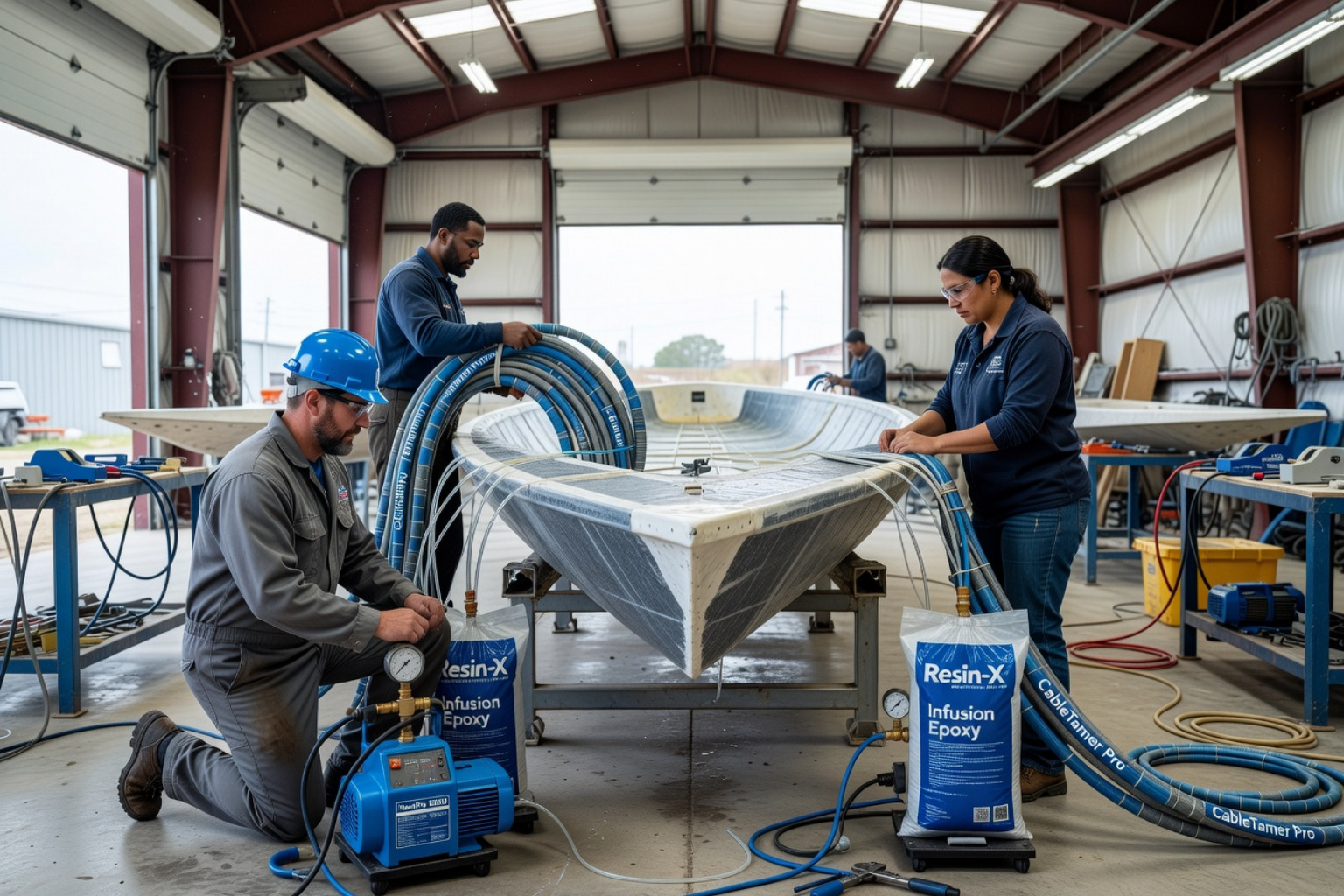
What Is Vacuum Infusion — and Why Does It Matter for Composite Manufacturing?
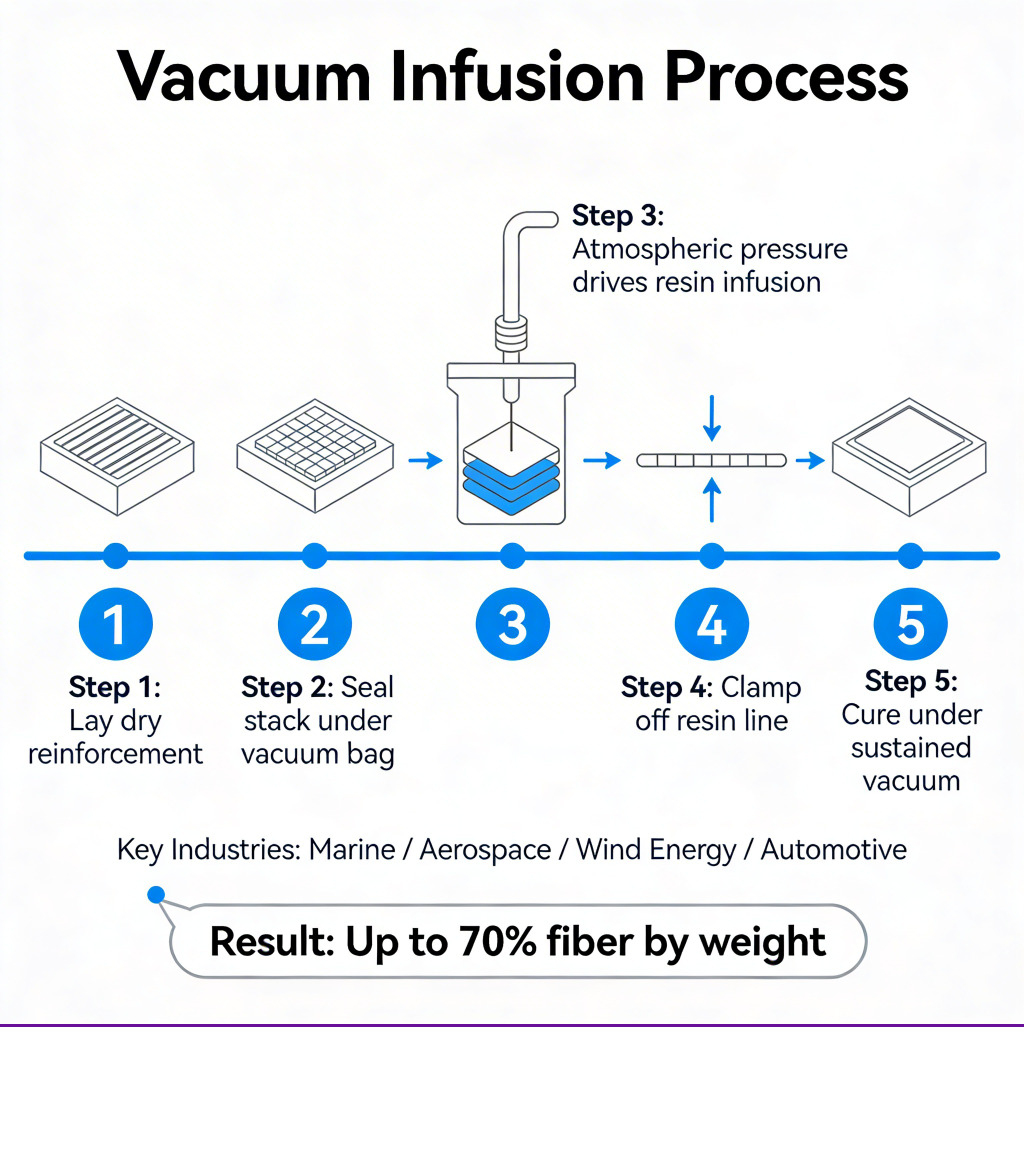
Vacuum Infusion is a closed-mold composite manufacturing process where dry reinforcement materials are laid into a mold, sealed under a vacuum bag, and then resin is drawn through the dry fibers using atmospheric pressure — not a pump actively pushing resin in.
Here’s the core idea in plain terms:
- Lay dry reinforcement (fiberglass, carbon fiber, Kevlar) into the mold
- Seal the stack under a vacuum bag and pull a full vacuum
- Introduce resin — atmospheric pressure (~14 psi) drives it through the dry fibers
- Clamp off the resin line once the laminate is fully saturated
- Allow to cure under sustained vacuum
The result is a laminate with up to 70% fiber by weight — significantly stronger, lighter, and more consistent than anything achievable with hand lay-up.
For engineers and manufacturers, the appeal is straightforward. Traditional hand lay-up typically results in resin exceeding 100% of the fabric weight. That excess resin doesn’t add strength — resin alone is brittle, and too much of it weakens the part. Vacuum infusion solves this by letting physics do the work.
It’s used across marine, aerospace, wind energy, automotive, and automated manufacturing — anywhere structural performance, weight savings, and process consistency are non-negotiable.
But it’s not a beginner-friendly process. Setup is complex, leaks can ruin an entire part, and the learning curve is real. This guide walks through everything — from the physics behind it to step-by-step execution, materials, troubleshooting, and the supporting equipment that keeps your operation running without costly downtime.
Understanding the Mechanics of Resin Infusion
To master Vacuum Infusion, one must first understand the physics governing the flow. The process relies entirely on a pressure gradient. When a vacuum pump evacuates air from the sealed bag, it creates a “void” or an area of near-zero pressure. Outside the bag, the Earth’s atmosphere is pushing down at approximately 14.7 psi (at sea level). When the resin inlet is opened, this atmospheric pressure literally pushes the resin into the laminate to fill the vacuum.
This relationship is mathematically described by Darcy’s Law, which relates the flow rate of a liquid through a porous medium to the pressure gradient and the permeability of the material. In practical terms, this means that the tighter the fiber packing, the harder it is for resin to flow. Conversely, using flow media or high-permeability reinforcements allows for faster, more even distribution. By removing air before the resin enters, the process significantly reduces voids—tiny air bubbles that can compromise structural integrity. This leads to a higher laminate density and superior mechanical properties compared to traditional open-molded parts. For more on the fundamental steps, see this Step-by-Step Guide for Resin Infusion.
The Role of Spiral Tubing in Vacuum Infusion
In a professional Vacuum Infusion setup, getting the resin from the bucket to the furthest corners of the mold requires a reliable delivery system. This is where Heli-Tube® spiral cable wrap becomes a critical component of the infrastructure. While often used for organizing electrical wires, its unique design makes it an industry standard for resin feed lines and vacuum line extenders.
The “spiral” geometry of Heli-Tube® allows resin to flow freely along the length of the tube while simultaneously bleeding out through the gaps between the spirals into the reinforcement stack. This ensures that the resin front moves uniformly across the part rather than just saturating the area immediately around the hose.
M.M. Newman Corporation provides Heli-Tube® in a vast range of sizes, from 1/16″ to 1.5″ O.D., allowing engineers to select the exact diameter needed for the volume of resin required. Furthermore, the availability of color-coded labeling helps technicians distinguish between resin feed lines and vacuum lines in complex, multi-line setups, reducing the risk of catastrophic errors.
- Available Materials: Polyethylene, Nylon (self-extinguishing), and PTFE for extreme chemical resistance.
- Key Benefit: The spiral design allows for individual wire or tube breakouts at any point, providing unmatched versatility in automated manufacturing environments.
- Industrial Standard: Spiral tubing is a resin infusion standard for creating in-bag manifolds that ensure complete wet-out.
Achieving Optimal Fiber-to-Resin Ratios
The primary goal of Vacuum Infusion is to maximize the fiber-to-resin ratio. In a standard hand lay-up, the glass-to-resin ratio is often 40:60. With infusion, that ratio can be flipped to 70:30. Because resin is heavy and brittle, reducing its volume while maintaining fiber saturation creates a part that is both lighter and stronger. For instance, a yacht hull built with infusion can be up to 500 kg lighter than a hand-laminated counterpart, significantly improving the vessel’s performance and safety. Consistency is another hallmark of the process; once a setup is dialed in, every part produced will have nearly identical weight and resin content, ensuring long-term mechanical durability and predictable performance in aerospace and robotics applications.
Essential Materials and Equipment for High-Performance Laminates
Success in Vacuum Infusion is heavily dependent on material compatibility. You cannot simply use any resin or fabric and expect perfect results. The system requires specialized components designed to work under vacuum pressure.

Selecting Flow Media and Core Materials
Because vacuum pressure compresses the dry fiber stack, it can become so tight that resin struggles to move through it. Flow media—such as EnkaFusion nylon matting or Lantor Soric®—is used to create a “path of least resistance.” These materials act like a highway for the resin, allowing it to race across the surface or through the center of the laminate before soaking down into the structural fibers.
Core materials also play a vital role. When building sandwich structures, manufacturers use materials like balsa wood or Divinycell foam. To facilitate infusion, these cores are often “grid-scored” or perforated. These small channels allow resin to pass from one side of the core to the other, ensuring that both the inner and outer skins are fully bonded. Selecting the right weave is equally important; for example, carbon fiber tends to pack more tightly than fiberglass, often requiring more aggressive flow media to prevent dry spots.
Protecting Infrastructure in Vacuum Infusion Environments
Beyond the laminate itself, the surrounding industrial environment requires protection. In automated manufacturing and robotics, pneumatic tubing and hydraulic hoses are constantly exposed to sharp edges and repetitive motions. Protecting these critical lines is essential for reducing downtime and extending the lifespan of industrial equipment.
Heli-Tube® spiral cable wrap provides the necessary abrasion protection and mechanical durability to withstand these harsh conditions. M.M. Newman Corporation manufactures these wraps to meet rigorous standards, including ISO 9001:2015, REACH, and RoHS compliance. For environments involving extreme temperatures or aggressive chemicals, PTFE (Polytetrafluoroethylene) spiral wrap can operate from -320°F to 500°F. In confined spaces where fire safety is a priority, Nylon offers self-extinguishing properties that protect both the equipment and the personnel. Unlike generic plastics, these materials are engineered for the high-stakes world of aerospace and public utilities.
Step-by-Step Execution of the Infusion Process
Executing a Vacuum Infusion project is a test of patience and precision. The “resin clock” doesn’t start until you open the feed line, which gives you unlimited setup time to ensure everything is perfect.
Preparing the Mold and Reinforcements
The process begins with a pristine mold. It must be rigid, airtight, and have a high-gloss finish. A wide flange (typically 6 to 10 inches) is necessary to provide enough room for the sealant tape and the various lines. After applying a high-quality release agent, the dry reinforcement is carefully laid in.
Because the fibers are dry, they can be easily tailored and “kit-cut” beforehand to ensure a perfect fit. In corners, “slip joints” are used—cutting the fabric and overlapping it—to prevent “bridging,” where the fabric pulls away from the mold corner under vacuum. Using non-crimp fabrics (NCFs) like biaxial or triaxial glass is preferred, as they allow for better resin flow than traditional woven roving.
Vacuum Integrity and Leak Detection
Once the bag is sealed, the most critical step begins: the drop test. The vacuum pump is turned on to evacuate the air, and then the system is isolated. If the vacuum level drops more than a few millibars over several minutes, there is a leak. Even a pinhole leak can introduce air bubbles that create structural voids or dry spots.
To find these leaks, professionals use specialized tools:
- Ultrasonic Leak Detectors: These pick up the high-frequency “hiss” of air entering the vacuum.
- Stethoscopes: A budget-friendly way to pinpoint smaller leaks around sealant tape or fittings.
- Digital Vacuum Gauges: Essential for providing an absolute reading of the vacuum level, ensuring the system is truly airtight before the resin is introduced.
Troubleshooting Common Vacuum Infusion Challenges
Even with perfect preparation, challenges can arise during the “shot.” Understanding how to react is the difference between a successful part and a pile of scrap.
- Air Leaks: If a leak develops mid-infusion, it must be found and sealed immediately with extra sealant tape.
- Dry Spots: These occur when resin fails to reach an area before the resin front passes it or the resin gels. This is often caused by poor flow media placement or inadequate feed lines.
- Resin Racing: Also known as “racetracking,” this happens when resin finds a path of low resistance, such as a gap along the edge of the mold, and skips over the reinforcement.
- Bridging: If the vacuum bag or the fabric isn’t pushed firmly into a corner, resin will pool there, creating a heavy, weak, resin-rich area.
Industrial Applications and Environmental Impact
Vacuum Infusion has revolutionized industries that demand high strength-to-weight ratios. In Aerospace, it allows for the creation of large, complex wing structures and fuselage sections with fewer fasteners. In Robotics and Automated Manufacturing, infused composites provide the stiffness required for high-speed arms while keeping the mass low enough for rapid acceleration.
The Marine industry has perhaps seen the biggest shift. High-end boat builders have moved away from open molding to infusion to produce hulls that are lighter, stiffer, and completely free of the osmotic blistering issues often associated with hand-laid polyester resins. As noted in the industry press, Boatbuilding’s resin-infused future is already here, driven by the need for efficiency and performance.
Environmental Benefits of Closed Mold Processes
Beyond performance, Vacuum Infusion is a “greener” way to build. Because the resin cures inside a sealed bag, Volatile Organic Compound (VOC) emissions—specifically styrene—are reduced by up to 95% compared to open molding. This creates a much safer and cleaner work environment for technicians and allows facilities to meet stricter environmental regulations without expensive air-scrubbing equipment. Furthermore, because the resin amount is precisely calculated, there is significantly less waste, as the process avoids the “over-wetting” common in hand lay-ups.
Frequently Asked Questions about Resin Infusion
Why is low resin viscosity critical for successful infusion?
Resin must flow through long distances of tightly packed fibers. If the viscosity is too high (thick), the resin will move too slowly, potentially gelling before it reaches the end of the part. Ideal infusion resins have a viscosity between 100 and 300 centipoise—roughly the consistency of vegetable oil or maple syrup.
How does vacuum infusion differ from traditional vacuum bagging?
In vacuum bagging, you apply resin to the fabric first (wet lay-up) and then use a vacuum bag to squeeze out the excess. In Vacuum Infusion, the fabric is laid in dry, and the vacuum is used to pull the resin into the part. Infusion generally results in a much higher fiber-to-resin ratio and a cleaner process.
What are the primary causes of dry spots in a finished laminate?
Dry spots are usually caused by vacuum leaks, inadequate flow media, or resin that is too viscous. They can also occur if the resin feed lines are spaced too far apart (generally, they should be no more than 30-36 inches apart for large projects).
Conclusion
Vacuum Infusion is a sophisticated manufacturing technique that rewards precision and high-quality materials. By leveraging the power of atmospheric pressure, manufacturers can create composite parts that push the boundaries of what is possible in aerospace, marine, and industrial robotics.
Supporting a reliable vacuum infusion setup takes more than resin, fabric, and a strong vacuum. It also depends on well-managed resin feed lines, vacuum line extenders, and protected tubing to ensure resin travels where it should. M.M. Newman Corporation’s Heli-Tube® spiral cable wrap plays an important role here by organizing and protecting lines and serving as a practical solution for resin infusion layouts. Used on feed lines and vacuum extensions, spiral cable wrap helps maintain open flow paths, allowing the resin front to advance more evenly across the part, improving consistency and reducing the risk of uneven wet-out. At the same time, its abrasion resistance and mechanical durability help protect wires, hoses, and pneumatic tubing from wear in demanding production environments. For more information on the tools that support industrial excellence, explore our spiral cable wrap solutions.