

Last updated on January 28th, 2026 at 12:47 pm
Selecting the correct flexible tubing material is essential for protecting cabling, wiring, and components in demanding environments. Industrial applications often expose cables and hoses to extreme temperatures, chemicals, abrasion, moisture, and mechanical stress. Choosing the wrong material can result in premature failure, costly downtime, and safety risks.
Materials such as PTFE, FEP, and Nylon tubing are widely used because of their ability to withstand harsh conditions while maintaining flexibility and durability. Although each material has distinct properties, they share common advantages such as chemical resistance and adaptability to custom configurations, including convoluted or corrugated designs. These tubing materials are used across industries, including aerospace, automotive, electrical and electronics, medical devices, robotics, automation, and scientific instrumentation.
Below is a closer look at how PTFE, FEP, and Nylon tubing compare—and which material may be best suited for your application.
Key Considerations When Choosing Flexible Tubing
Before selecting a tubing material, it’s important to evaluate the operating environment and performance requirements. Key considerations include:
- Temperature range and heat exposure
- Chemical and solvent resistance
- Flexibility and bend radius
- Abrasion and wear resistance
- Exposure to UV radiation or outdoor elements
- Regulatory or industry-specific requirements
Understanding these factors helps ensure long-term performance and protection.
PTFE Tubing
PTFE (polytetrafluoroethylene) is a synthetic fluoropolymer widely known by its trademarked name, Teflon®. Derived from tetrafluoroethylene (TFE), PTFE is valued for its exceptional thermal stability and chemical resistance.
The strong carbon–fluorine bonds in PTFE give it outstanding nonreactivity and mechanical resilience. With a high melting point of approximately 327°C, PTFE tubing performs exceptionally well in high-temperature environments. It is hydrophobic, chemically inert to most industrial chemicals and solvents, and maintains flexibility across both high and low temperature ranges.
One of PTFE’s most notable characteristics is its extremely low coefficient of friction—the lowest of any solid material—making it ideal for applications requiring smooth movement and non-stick performance.
Common PTFE tubing applications include:
- High-temperature cable and wire protection
- Chemical processing environments
- Aerospace and electronics applications
- Protection against corrosive solvents and acids
FEP Tubing
Fluorinated ethylene propylene (FEP) shares many of PTFE’s benefits while offering additional advantages in durability and transparency. Developed as a melt-processable fluoropolymer, FEP is a copolymer of tetrafluoroethylene and hexafluoropropylene.
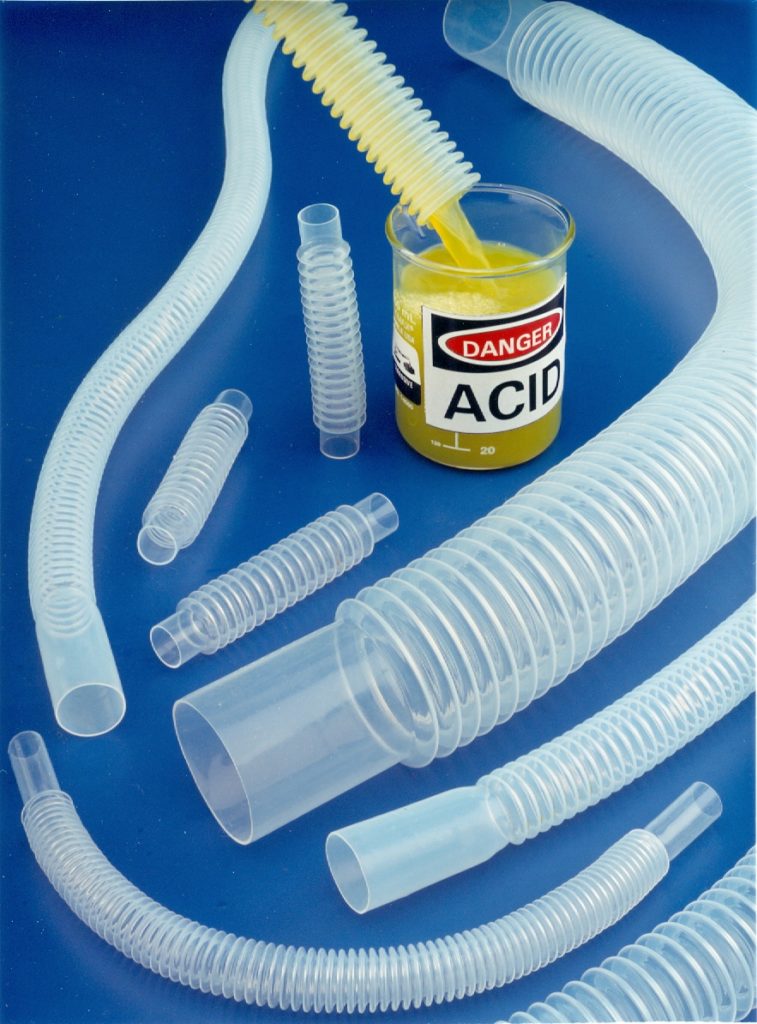
FEP tubing features a melting point of approximately 260°C and can safely operate across a wide temperature range—from cryogenic conditions up to 204°C. It is softer and more flexible than PTFE, while still providing excellent chemical resistance, low friction, and moisture non-reactivity.
Highly transparent and UV-resistant, FEP is also impermeable and resists oxidation, acids, bases, vapors, and gases. Its superior abrasion resistance makes it well-suited for dynamic or outdoor applications.
Common FEP tubing applications include:
- Abrasion-resistant cable protection
- Outdoor and UV-exposed environments
- Medical and laboratory tubing
- Applications requiring visibility of contents
Nylon Tubing
Nylon is a thermoplastic polymer derived from petrochemicals and classified as a linear polyamide. While often associated with textiles, nylon’s mechanical strength and resilience make it an excellent material for tubing and protective applications.

Nylon tubing offers exceptional abrasion resistance, durability, elasticity, and chemical resistance. It is lightweight, flexible, and performs reliably under mechanical stress. Notably, nylon is self-extinguishing and does not emit toxic or irritating fumes when exposed to flame or elevated temperatures.
These characteristics make nylon tubing especially suitable for enclosed or high-risk environments where fire resistance and safety are critical.
Common nylon tubing applications include:
- Protective cable and wire wraps
- Automotive and robotics systems
- High-wear industrial environments
- Applications requiring lightweight flexibility
Why Choose M.M. Newman Corporation?
When selecting flexible tubing solutions, quality, reliability, and expertise matter. M.M. Newman Corporation delivers dependable tubing products designed to perform in demanding industrial environments.
- Proven Material Expertise: We understand the unique performance characteristics of PTFE, FEP, and Nylon and help customers choose the right material for their application.
- Custom Manufacturing Capabilities: Our tubing solutions can be fabricated to meet specific dimensional, performance, and environmental requirements.
- Consistent Quality and Compliance: We maintain strict quality standards to ensure reliable performance across industries and applications.
- Customer-Focused Solutions: Our team works closely with customers to provide application-specific recommendations and long-term value.
Frequently Asked Questions
Which tubing material is best for high-temperature applications?
PTFE is typically the best choice for high-temperature environments due to its high melting point and thermal stability.
What tubing material offers the best abrasion resistance?
FEP and Nylon both offer excellent abrasion resistance, with FEP performing well in harsh outdoor or UV-exposed environments.
Is nylon tubing safe for enclosed environments?
Yes. Nylon is self-extinguishing and does not release toxic fumes, making it suitable for enclosed or heat-sensitive applications.
Can tubing be customized for specific applications?
Yes. Flexible tubing can be fabricated in various configurations, sizes, and forms—including corrugated or convoluted designs—to meet application-specific needs.
Find the Right Flexible Tubing for Your Application
Selecting the right flexible tubing material is critical to protecting cables, wires, and components in challenging environments. PTFE, FEP, and Nylon each offer distinct advantages depending on temperature requirements, chemical exposure, abrasion resistance, and safety considerations.
Need help choosing the right flexible tubing solution? Contact M.M. Newman Corporation today to speak with our knowledgeable team and discover tubing solutions engineered for performance, durability, and reliability across demanding applications.